
AUTHORIZATION
Blog

IT subscription or internal administrator?
If one IT administrator goes on vacation, gets sick, or handles several incidents at the same time, the company quickly realizes how much operational risk is concentrated in one person. That is why the question IT subscription or internal administrator is not just about monthly costs. It is a decision about availability, responsibility, cybersecurity, and the company’s ability to keep working in situations where technology must not stop.
In a small or medium-sized company, the internal administrator is often a trusted person who knows the colleagues, systems, and day-to-day nuances. An IT subscription, on the other hand, provides team expertise, structured processes, and a predictable service model. Neither solution is automatically right for everyone. What matters most are the company’s risks, growth plans, and requirements for IT management.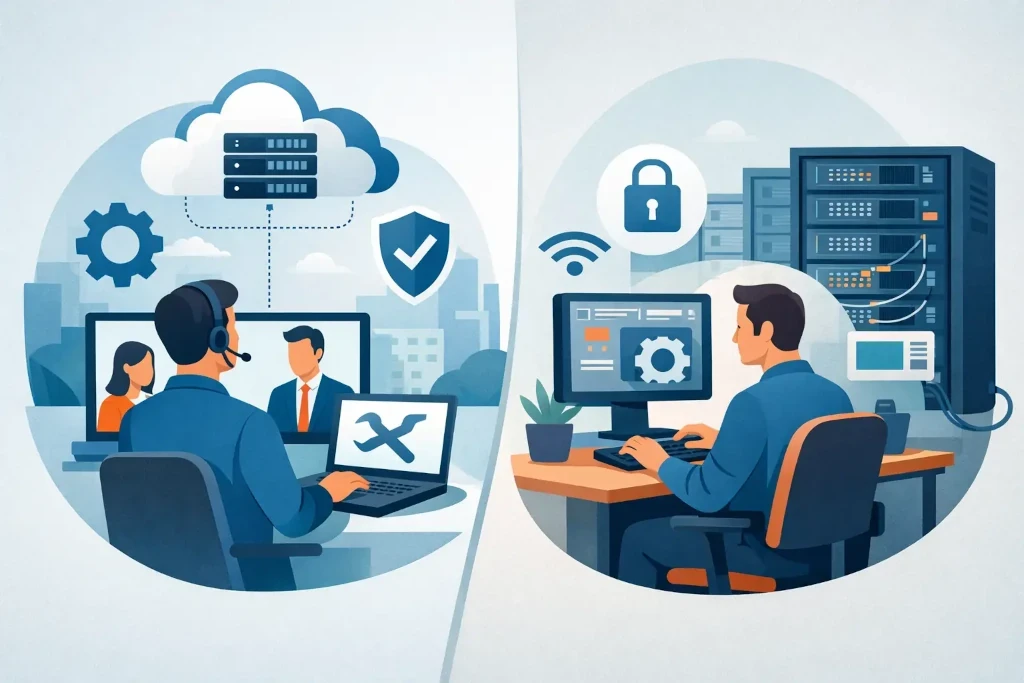
What is the company actually buying?
When comparing the two approaches, the mistake is to look only at salary versus subscription fee. An internal administrator is an employee with a fixed working time, limits of competence, and availability. An IT subscription is a managed service in which the company usually receives support processes, incident monitoring, documentation, access to various specialists, and regular infrastructure reviews.
The strength of an internal specialist is context. They know how a particular warehouse operates on the morning shift, which financial system reports are critical at the end of the month, and which employees use specialized software. This knowledge is valuable, especially in companies with complex internal processes or a non-standard production environment.
However, one person is rarely at the same time a security expert, cloud infrastructure architect, network administrator, backup specialist, and strategic IT manager. If a company needs expertise in several areas, the subscription model often reduces dependence on a single resource.
IT subscription or internal administrator: cost comparison
The costs of a full-time IT administrator are not made up only of gross salary. Taxes, training, certification, workplace, software, vacations, replacement, and the risk that essential knowledge remains only in their notes or memory must be taken into account. If the specialist leaves, the company may have to search for a new employee and update documentation in parallel while incidents continue.
An IT subscription usually has a clearer monthly price and a defined scope of service. This helps with financial planning, because support, prevention, and regular checks are not purchased only when the system has already failed. But discipline is also required here: the contract must clearly state what is included, what the response times are, how unplanned projects are handled, and which services are subject to additional fees.
The cheapest model does not always create the lowest total cost. One day of downtime in sales, logistics, or customer service systems can cost more than the difference saved on IT services over a year. Therefore, costs should be assessed together with the price of downtime, the risk of data loss, and the management time spent coordinating problems.
Availability and continuity are different concepts
An internal administrator can be very responsive, but they cannot be available around the clock, 365 days a year. If the company works in multiple shifts, serves customers abroad, or relies on remote access, it must be planned what happens outside working hours. A promise that someone will answer the phone if needed is not enough.
The advantage of a managed IT service is the team model. An incident can be taken over by another specialist, documentation does not belong to one employee, and support procedures are created to be repeatable. This is especially important after a cybersecurity incident, internet connection problems, or a server failure, when fast and coordinated action determines how long the company cannot work.
However, the subscription must not become a formal ticket system without business understanding. The service provider needs to know which systems are critical, what downtime is acceptable, and who in the company has the authority to make decisions during an incident. Without this information, even a technically competent team may act too slowly or with the wrong priority.
Security requires process, not just experience
In cybersecurity, the most dangerous situation is often not a complete lack of competence, but irregular management. Uninstalled updates, unchecked backups, shared passwords, and uncontrolled administrator rights do not cause visible problems at first. They become visible after ransomware, data leakage, or a failed system recovery.
An internal administrator can provide a high level of security if the company gives them time for preventive work, a budget for necessary solutions, and clear management support. In practice, such a specialist is often involved in daily user questions and urgent tasks, so audits, access reviews, and disaster recovery tests are postponed.
In an IT subscription model, security activities can be included in a regular management rhythm: vulnerability remediation, backup control, access rights review, equipment monitoring, and maintenance of incident procedures. But management must make sure that these activities are real and measurable, not just a general promise of “secure IT.” Demand reports, a list of risks, priorities, and clearly defined responsibility.
When is an internal administrator the right choice?
A full-time specialist is a logical solution if the IT environment is large, technically specific, and requires presence every day. For example, in a manufacturing company with industrial systems, many workstations, and locally managed infrastructure, an internal administrator may be operationally necessary.
It is also justified when the company regularly runs digital projects, has extensive software development, or when the IT function itself creates a competitive advantage. In such a case, the question is not about replacing outsourcing with one employee. Rather, an internal team should be built with sufficient capacity, process documentation, and replacement coverage.
Even in such companies, an external partner can add value in specific areas: independent IT audits, backup and disaster recovery assessments, infrastructure projects, or an external IT director-level perspective. The internal team and the external partner are not opposites if responsibilities are defined precisely.
When does a subscription deliver greater business value?
An IT subscription is often more suitable for companies with 20 to 250 employees that need stable support but cannot economically maintain several narrowly specialized experts. In this model, management gets not only a help desk, but also regular reporting on risks, development priorities, and the state of the infrastructure.
It is especially useful during growth and change phases: opening a new office, moving systems to the cloud, acquiring another company, introducing hybrid work, or organizing the IT environment before an audit. In such moments, everyday user support alone is not enough. The ability to make architecture, security, and budget decisions at the same time is needed.
In KSK IT practice, the most effective model is often a clearly managed external team that provides day-to-day support and brings in strategic IT leadership when decisions must be made about investments, risks, or infrastructure direction. The company does not maintain an expensive reserve of competencies, but retains access to it when it is truly needed.
How to make the decision without assumptions?
Start not with the question of which option is cheaper, but with three practical questions. How long can the company operate without email, accounting, ERP, or file access? Are critical knowledge and accesses documented so that another person can take them over? And does management regularly receive a clear picture of IT risks and priorities?
If there are no convincing answers to these questions, the first step is to establish a management foundation: an infrastructure inventory, access procedures, backup verification, incident responsibilities, and a development plan. Only then can personnel costs be objectively compared with a subscription service.
A good decision does more than reduce the number of tickets in the IT support system. It gives management confidence that the company’s technologies are managed even when something unplanned happens - and that IT can support the next business step rather than delay it.
