
AUTHORIZATION
Blog
When does a company need an external CIO?
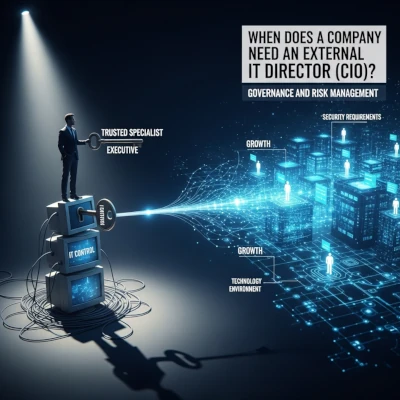
There are companies where IT relies for a long time on the decisions of a single trusted specialist, an external support partner, or the decisions of the manager themselves. This works until the moment growth begins, security requirements increase, or the technological environment becomes too complicated for daily management. It is precisely then that the question of when a company needs an external CIO is no longer theoretical - it becomes a matter of management and risk management.
An external CIO is not simply an experienced IT person brought in for a few consulting hours. It is a management-level role with responsibility for IT direction, priorities, budget justification, security, vendor control, and technology alignment with business goals. For a small or medium-sized company, it is often a way to obtain strategic IT leadership without the costs of a full-time director.
When a company most often needs an external CIO
In practice, the need does not usually arise because a company suddenly decides to become technologically mature. It appears at the moment when the existing model can no longer keep up. IT is operational, but it is unclear whether it is being managed in the right direction, whether the risks are understood, and whether the investments truly benefit the business.
A typical signal is rapid growth. New departments open, the number of employees increases, the number of systems expands, and previous decisions that were acceptable in a small team begin to create friction. Without clear IT management, fragmentation arises - different vendors, incomplete documentation, inconsistent access control, and unpredictable costs.
The second common scenario is a period of change. The company is migrating to cloud services, planning a merger, implementing a new ERP, or reviewing cybersecurity requirements. At such moments, a mere technical execution is not enough. It requires a person who sees the big picture, understands the sequence, evaluates the impact on operations, and makes decisions from a management perspective.
The third signal is a situation where IT support exists, but there is no owner driving the strategy. There are administrators, external maintainers, project executors, but there is no one who determines priorities for the next 12 to 36 months. The result is usually a series of technical initiatives without clear business logic.
What an external CIO does in practice
To understand whether such a model is needed, one must understand what exactly an external CIO provides to the company. Firstly, they bring governance. This means not only technology selection but also clear accountability, decision-making processes, risk assessment, and a transparent development plan.
Secondly, the external CIO connects management goals with IT reality. The company owner or manager usually does not think in terms of servers, licenses, or network segmentation. They think about growth, cost control, customer service, operational continuity, and compliance. The CIO's task is to translate these goals into technological decisions.
Thirdly, they help avoid costly mistakes. Not every IT project fails because it was technically unsuccessful. Many do not justify themselves because they were started in the wrong order, with improperly defined scope, or without adequate risk control. The external CIO serves here as a management filter, rather than just a technical voice.
Signs that internal capacity is no longer sufficient
If a company does not have a full-time IT director, the management function often gets dispersed among several roles. Some decisions are made by the financial manager, some by the operations manager, some by an external service provider, while others simply remain unresolved. This may seem economical in the short term, but it creates a management vacuum in the long term.
Usually, it manifests quite clearly. The IT budget increases, but there is no confidence about where it goes. There are several different providers, but no one takes full responsibility. Security issues are addressed after incidents rather than before them. Backups exist, but it is unclear if restoration will actually work. There is a sense that the company is dependent on a few specific individuals and their memory.
Another sign is management fatigue from IT decisions. If board-level discussions regularly revolve around access, vendor coordination, system problems, or urgent infrastructure investments, it means management time is being spent in the wrong places. The external CIO takes on such a burden in a structured way.
When an external CIO is better than a full-time director
Not every company needs a permanent CIO. In small and medium-sized businesses, there is often not enough IT decision-making volume to justify the costs of such a position full-time. At the same time, strategic IT leadership may be needed very specifically and regularly.
Here the external model provides a pragmatic solution. The company receives experience, methodology, and management-level engagement to the extent that is genuinely needed at that particular stage. It can be a few days a month, defined involvement in projects, or regular technology management with a clear agenda.
An advantage is also a broader perspective. An external CIO often sees different company scenarios, typical risks, and practical solutions. This helps make more mature decisions than in a situation where everything is built solely from internal experience. However, there is also a trade-off - the external partner must be adequately involved in business processes, otherwise, they remain too theoretical.
Situations where an external CIO provides the greatest value
The greatest benefit usually comes at moments when a company needs not only to maintain the existing environment but also to make sequential, financially justified decisions. For instance, opening a new office, integrating an acquired company, implementing cloud solutions, or preparing for an audit. In these cases, a single technical choice is not what matters, but the entire chain of decisions.
This role becomes especially important when a company has heightened requirements for continuity. If downtime directly affects revenues, customer service, or reputation, a simple principle of “we’ll fix it when there’s a problem” is no longer sufficient. A person is needed who pre-defines critical systems, prioritizes restorations, establishes contingency scenarios, and clarifies vendor responsibilities.
The same applies to security. An external CIO is not a SOC team and does not replace antivirus. However, they ensure that security is not an isolated technical topic but a manageable risk with a budget, policy, priorities, and metrics.
How to understand whether a company is ready for such a model
An important question is not just about need but also about readiness. If management expects that an external CIO will “just organize IT,” but is not prepared to accept priorities, define business goals, and disciplinedly follow a plan, the result will be weak. This role works best when the company wants clarity and is ready to subordinate decisions to it.
It also needs to be assessed whether the problem is indeed a lack of strategy. Sometimes a company needs not an external CIO but a better helpdesk, infrastructure organization, or a specific project team. If the basic IT environment is chaotic, a strategy alone will not solve the situation. First, operational stability must be ensured, then management can be built.
This is why a good external CIO does not start with grand slogans but with an assessment of the existing situation. What systems are critical, where are dependencies on specific individuals, how organized is the documentation, what is the real state of backups and restorations, how access is managed, and which projects really support business goals.
What to expect from an external CIO partner
It is easy to go wrong here. The market is full of consultants who can talk about transformation but are less convincing when it comes to day-to-day responsibilities. A company needs a partner who understands both management-level decisions and operational reality - from infrastructure stability to audit requirements and vendor coordination.
It is important to see whether the partner can not only advise but also implement order. Do they have experience with risk assessment, IT audits, continuity planning, budget discipline, and service management? Can they work with the existing internal team rather than just criticize it? Are their recommendations understandable for the board while also specific enough for the technical side?
For companies that do not want to maintain a large internal IT management structure, this model often provides a practical balance. For example, KSK IT's approach to external IT director or CIO services is based precisely on this principle - strategic control, operational clarity, and execution tied to business needs rather than an abstract technological agenda.
If the company's management regularly feels that IT is critical but not adequately managed, waiting for the ideal moment is usually unproductive. An external CIO is most often needed not when everything has already collapsed, but when the company realizes that for further growth, security, and control, improvisation is no longer sufficient.
