
AUTHORIZATION
Blog
External IT director for the company - when does it pay off
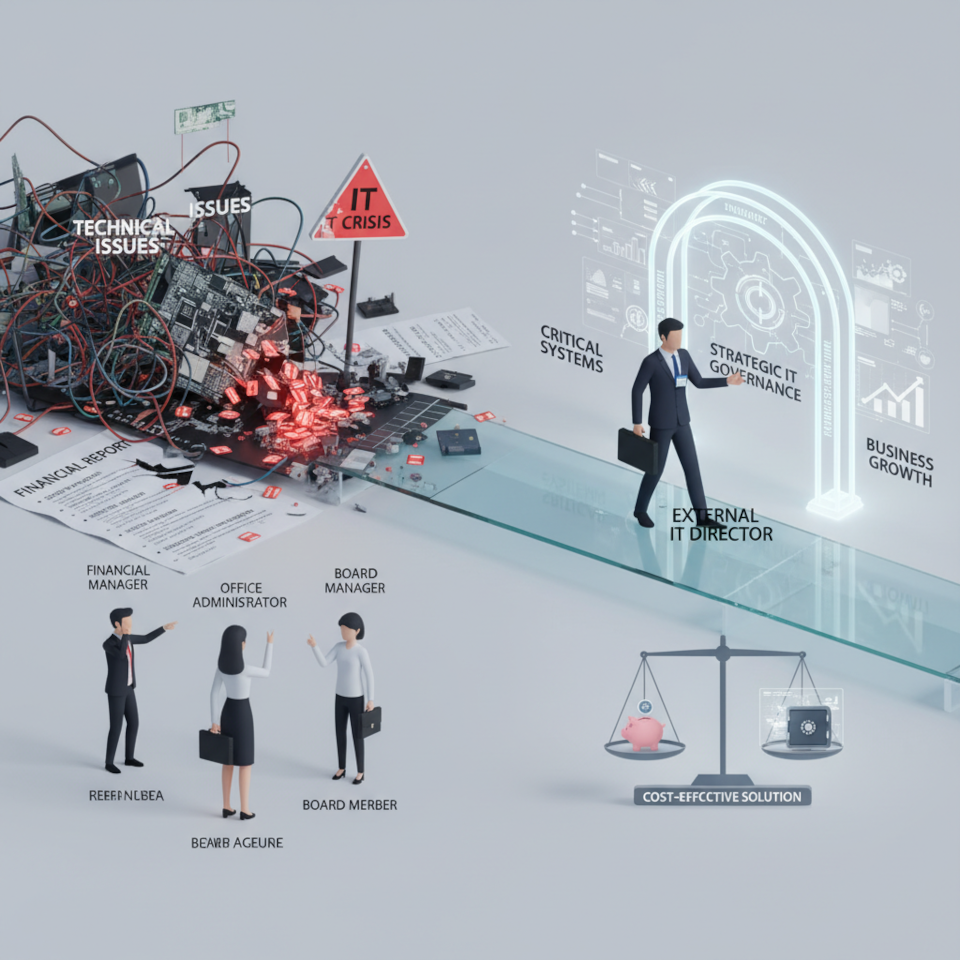
If IT issues regularly reach the board, the finance manager, or the office administrator in a company, the problem is usually not just technical. It is a management problem. An external IT director becomes relevant to a company when the systems are already critical to the business, but maintaining a full-time CIO or IT director is not yet economically justified.
In small and medium-sized enterprises, this is a common stage. There are servers or cloud services, employees need stable access to data, there are cybersecurity risks, backups, suppliers, licenses, and various individual IT partners. However, there is no one person who sees the big picture and makes decisions with business logic, rather than just reacting to incidents.

What an external IT director practically does for a company
The role of an external IT director is not just that of a “senior system administrator”. It is a management-level service. Such a partner helps the company determine what the IT environment should look like in 12, 24, or 36 months, which risks should be mitigated first, and in which technology areas money provides a real return.
On a daily basis, this means several very specific responsibilities. The existing infrastructure is assessed, access control is reviewed, the backup procedure is evaluated, responsibilities between internal staff and external suppliers are defined, and incident management is organized. If the company is growing, scaling is planned. If the company is preparing for an audit, changes, or attracting investments, the documentation and management are organized.
The most important thing is that the external IT director does not work only with technology. He works with priorities. Where is the greatest operational interruption risk? What will happen if access to files or email is lost? Are the company's data recoverable not just in theory, but in practice? Are suppliers managed, or just paid?
When an external IT director is a logical step for a company
Not every company needs this service right away. If the team is very small, processes are simple, and the IT environment relies on a few standardized cloud tools, a support-level service and good internal discipline are sufficient. However, there are clear signals that this is no longer enough.
The first signal is growth. The company opens a new office, hires more people, implements new business systems, or starts operating in multiple countries. This increases not only technical complexity but also reliance on IT. The second signal is fragmentation - one supplier maintains the network, another implements business software, a third is responsible for cloud services, but no one takes overall responsibility.
The third signal is risk awareness. Management realizes that cybersecurity, data recovery, and continuity plans are no longer “to be solved later” issues. The more expensive downtime becomes, the more valuable organized IT management becomes. The fourth situation is a change period - a company acquisition, due diligence process, ERP or CRM implementation, migration to the cloud, office relocation, or operational centralization.
At such times, what is needed is not just a technician, but a person who can lead the technology direction in the interest of the business.
Full-time IT director or outsourcing
This is not just a cost comparison, although costs are significant. A full-time IT director is usually justified in larger organizations where there are several internal IT specialists, a large number of users, a complex environment, and a continuous transformation process. In this model, the leader has a full workload and daily team.
In smaller companies, the picture is often different. High-level competence is needed, but not 40 hours a week. A strategic view, supplier management, risk control, and periodic decisions on architecture, security, and investments are required. Here, the external model is more rational.
However, compromises must also be considered. An external IT director is not physically in the office every day. Therefore, cooperation needs to be structured - with clear responsibilities, regular reports, access to key metrics, and management involvement. If the company expects that a strategic partner will simultaneously address every minor user incident, the model will not work. Here, the boundary between the management function and operational support is important.
What value is created for the business
The biggest gain is not “more technology.” The greatest gain is control. The management of the company becomes clear about what is happening in the IT environment, what is critical, where the weak points are, and what the action plan is.
This generally improves four areas. The first is continuity. When backups, access, equipment lifecycle, and incident response are organized, unplanned interruptions become rarer and their consequences - smaller. The second is security. Not at a theoretical level, but practically - fewer unnecessary permissions, clearer responsibilities, more organized processes, and verifiable recovery.
The third area is budget. Without IT management, companies often purchase technology in a fragmented manner and react to urgency. With an external IT director, investments become more planned. Sometimes this means additional spending where the risk is too high. Other times it means foregoing unnecessary solutions, licenses, or parallel service providers.
The fourth area is the quality of decisions. Management receives a clear, business-understandable evaluation rather than just a technical flow of information. This helps make informed decisions on modernization, migration, compliance, or new projects faster.
How to assess whether the service will be effective
An external IT director is valuable to a company only if the role is clearly defined. If the company is looking for “someone to organize IT”, but cannot specify whether the priority is security, cost control, growth support, or process standardization, the collaboration will be murky from day one.
A good starting point is to understand three things. First, what are the biggest business risks associated with IT. Second, what decisions will have to be made in the next year. Third, where is responsibility currently lacking. In some companies, there is no strategy. In others, there is no transparency. In yet others, there is no one to professionally manage external suppliers.
An effective model usually involves a regular management rhythm. This means periodic meetings, reviews of risks and priorities, assessments of infrastructure and security status, and maintenance of an investment plan. If the service is limited to irregular consultations without a management mechanism, it resembles an expert on call rather than IT management.
Common mistakes when searching for external IT management
The most common mistake is to focus only on the price. If the goal is to find the cheapest available option, the result is usually insufficient commitment and formal management. The company needs not just a symbolic “IT manager”, but a person or team that understands infrastructure, security, the supplier ecosystem, and management needs.
The second mistake is expecting immediate results without internal discipline. Even a strong external partner cannot instill order if management does not make decisions, responsible employees do not follow procedures, or the organization does not participate in prioritization.
The third mistake is to confuse the strategic role with the helpdesk function. The company often needs both, but they are not the same. If operational maintenance is not separated from management responsibility, the service quickly gets bogged down in daily minutiae.
This is why the external IT director model works best in conjunction with an organized support structure. In this approach, the company gains both everyday technical execution and management-level control. This principle is also used in KSK IT, combining infrastructure maintenance with strategic IT oversight.
What to ask in the first conversation
Managers should not start with a technical specification. It is more valuable to ask some direct business questions. How will our current risk be assessed? How will cooperation with existing suppliers take place? What will the reporting format for management be? How will priorities and budget sequences be defined? What will happen in the event of an incident or interruption?
A good partner answers these questions clearly and without ambiguity. He does not talk only about technology but about responsibility, processes, control, and results. And he does not promise that everything will always be perfect. The right approach is different - to understand the real environment, identify critical points, and gradually reduce risk.
For companies that can no longer afford to manage IT intuitively, an external IT director is often not an additional cost item, but a management tool. The earlier this role is implemented before a serious incident, rapid growth, or complex change project, the more decisions can be made according to plan rather than under pressure.
