
AUTHORIZATION
Blog

Hybrid infrastructure for businesses in practice
If a company's data lives in three different locations, employees work both in the office and remotely, but system availability must not stop even for an hour, hybrid infrastructure for companies is no longer a technological experiment. It is becoming a practical management model. It is here that many leaders understand that the question is not whether to use the cloud or local resources, but rather how to combine them without excessive risk and chaos in everyday maintenance.
What is hybrid infrastructure for companies
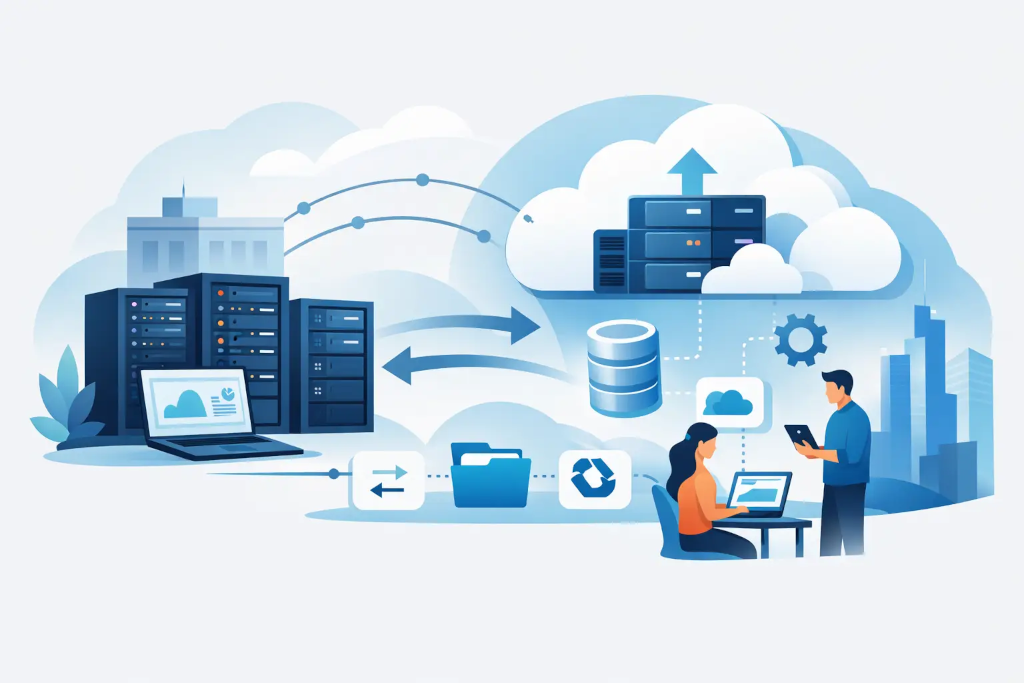
In simplified terms, it is an environment where part of the IT resources is maintained in the company's local infrastructure, while part exists in the public or private cloud. This can mean a file server in the office and backups in the cloud. It can also mean a business system database locally, while applications front-end or collaboration tools operate in cloud services.
This approach is appealing to companies not because of theory, but because reality is rarely black and white. Not all systems are ready for full migration. Not all data can be moved outside of a certain jurisdiction. Not all costs decrease by moving everything to the cloud. A hybrid approach allows control to be maintained where it is needed, and flexibility where it provides real benefits.
Why companies choose the hybrid model
For small and medium-sized enterprises, decisions about infrastructure are usually not ideological. They are related to availability, cost predictability, security, and team capacity. That is why hybrid infrastructure is often the most rational option.
Firstly, it helps avoid sudden and costly leaps. If the company has invested in local servers, networks, and specific business systems, a complete shift to the cloud may not be economically justified. The hybrid model allows utilizing existing investments and gradually modernizing the environment.
Secondly, it improves operational continuity. If one environment encounters an incident, the other can serve as a backup layer. This is especially important for companies where even a short downtime affects revenues, customer service, or contractual obligations.
Thirdly, it allows for compliance requirements to be adapted. In some industries, certain data or systems are not recommended or even permitted to be fully migrated to the public cloud. The hybrid approach allows separating critical resources while still leveraging the cloud's advantages for other needs.
Where the hybrid approach provides the most benefits
Not every company gains the same benefit from the same model. Hybrid infrastructure works best where there are clear business priorities and different requirements for various systems.
For example, a manufacturing company may have local systems related to equipment, access control, or warehouse processes. At the same time, email, collaboration platforms, backups, and document management live successfully in the cloud. The result is lower risk for operational processes and more convenient work for teams.
Professional services companies that work with sensitive client information often prioritize data location control. However, they also need staff to securely access systems from various locations. The hybrid environment here allows connecting security requirements with flexible access.
For rapidly growing companies, the hybrid model is useful during the transition phase. A new office, a branch in another country, an acquisition, or a systems consolidation after a reorganization rarely happens in a single day. Hybrid infrastructure helps navigate these phases without excessive haste and without business interruptions.
Hybrid infrastructure for companies is not just about technology
A common mistake is to think that a hybrid model simply means several platforms running simultaneously. In reality, the most important issue is management. If the local environment, cloud services, backups, access rights, and monitoring are maintained separately, the company gains not flexibility but complexity.
This is why it is crucial to consider a common architecture and responsibilities. Where does authentication take place? How are user rights managed? Where are backups stored and how quickly can data be restored? How is operational continuity ensured in the event of an incident? If there are no clear answers to these questions, the infrastructure becomes fragile even if each individual component is good.
At the management level, this means a very specific need – the IT environment must be understandable, auditable, and controllable in costs. A company owner or operations manager does not need to know all the technical nuances, but they must see how the infrastructure supports business continuity and where the main risks lie.
Main risks that should not be ignored
The hybrid model provides flexibility but also introduces new obligations. The first risk is accountability dilution. If some systems are with one provider, some with another, but the local environment is maintained by a third team, when an incident occurs, the response begins not with resolution but with shifting blame. This costs time and money.
The second risk is security inconsistency. Often companies adequately protect the local environment, but leave overly broad access rights, weak multi-factor authentication, or insufficient log file monitoring in cloud services. On paper, everything looks modern, but in practice, the attack surface has become larger.
The third risk is an incorrect cost model. Cloud services often seem financially attractive initially, but without management, they can turn out to be more expensive than expected. Maintaining local infrastructure is not free either. Without a common view of licenses, capacities, backup resources, and support levels, the budget begins to fracture where it is least expected.
Fourthly, many underestimate recovery scenarios. A backup by itself does not imply readiness for a crisis. It must be clear what is restored first, how long it will take, who makes the decisions, and how systems interdepend. This is often where theory clashes with unpleasant practice.
How to make the right decision about hybrid architecture
A good decision starts not with questions about platforms but with business requirements. Which systems are critical? How long of a downtime can the company tolerate? What data are particularly sensitive? Where is flexible scaling needed? These questions determine the architecture far more than vendor marketing promises.
Next, the existing environment must be assessed. Sometimes, the company already has a sufficiently good local foundation that makes it unreasonable to hastily replace it. Other times, it is the local infrastructure that has become a risk because it lacks backup capacity, support, or a recovery plan. An objective audit at this point is more valuable than assumptions.
The next step is to define the management model. Who owns monitoring, updates, access control, backups, incident response, and documentation? If these responsibilities are not shared, the hybrid environment becomes costly and inefficient in the long term.
In practice, companies often work safest with a gradual approach. First, organize identity and access management, then backups and recovery scenarios, then migrate those systems where the cloud benefit is clear. This sequence reduces risk and allows management to see results not just in technical promises but in daily operations.
When an external IT partner is needed
The more mixed the company's environment becomes, the more important unified accountability becomes. This is especially relevant for organizations that do not have a full internal IT department or where the internal team focuses on user support rather than infrastructure architecture and risk management.
In such situations, an external IT partner provides not only technical resources but also management discipline. This means a documented environment, clear response times, regular monitoring, change control, and recovery readiness. This combination usually distinguishes an organized hybrid infrastructure from an improvised solution.
For companies that are growing or going through changes, a strategic outside perspective is also useful. For example, the role of a KSK IT-type partner is not just to maintain servers or licenses. More importantly, it is to help management make informed decisions about what to keep locally, what to migrate, where to invest, and where to reduce risk before it becomes an incident.
What to expect from a well-structured hybrid environment
If the architecture is well thought out, the company gains not just a more modern IT environment but a more predictable business operation. For users, this means stable access to systems. For management, it means better cost control and a clearer risk picture. For owners, it means less dependency on one person or one platform.
However, there is no universal formula here. For some companies, the hybrid model will be a long-term strategy. For others, it will be a transitional stage on the way to a broader cloud environment or, conversely, towards stricter local control over certain systems. The most important thing is that the infrastructure model is subordinate to the business, not the other way around.
If it currently seems that your IT environment has been assembled from separate decisions made at different times and for different needs, this is a good time to review the overall picture. Hybrid infrastructure for companies works best when it is purposefully created rather than accidentally formed.
