AUTHORIZATION
Blog
IT infrastructure maintenance for the company
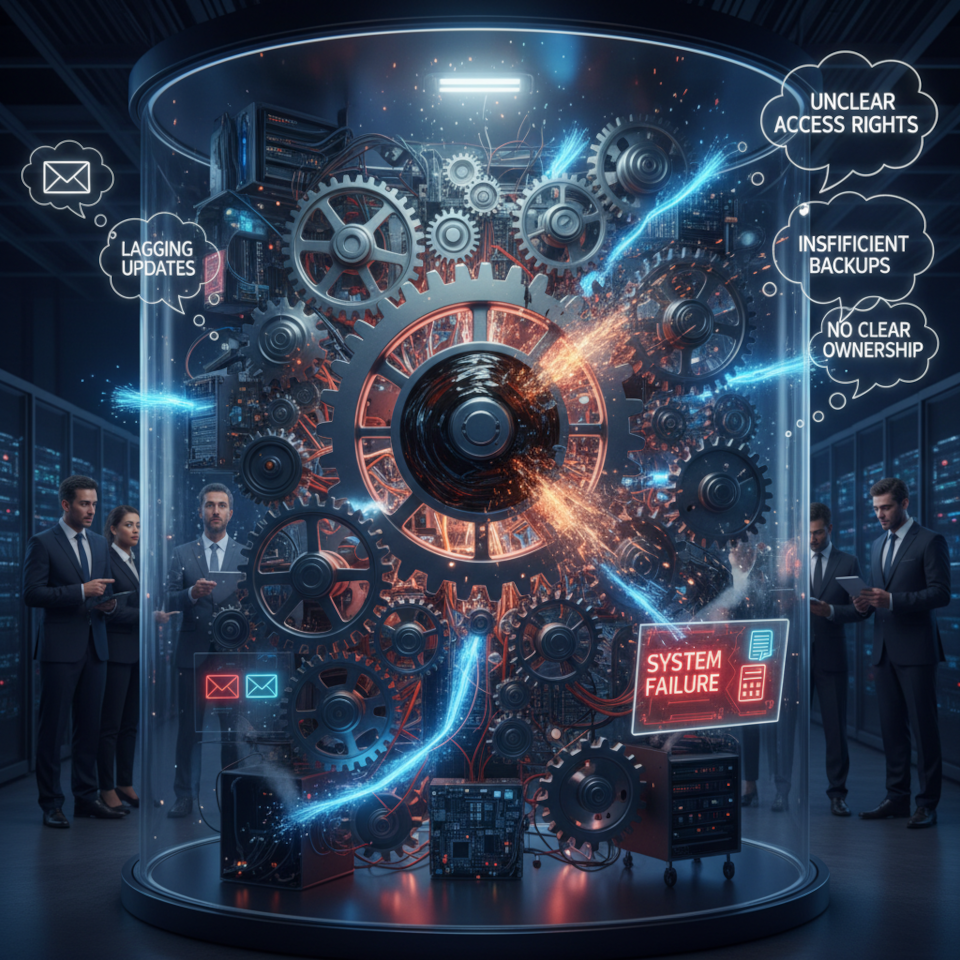
If a company's operations stop because an email, file server, or accounting system is unavailable, the problem is usually not a single broken device. Most often, it is a signal that the maintenance of IT infrastructure has been fragmented—lagging updates, unclear access rights, insufficient backups, or no clear responsibility for the environment as a whole. At the management level, this means not just a technical inconvenience but a risk to operations.
This situation is particularly common in small and medium-sized enterprises. The IT environment usually develops gradually—one internet connection, a few computers, later the cloud, warehouse systems, remote work, a new office, and outsourced solutions. Systems become interdependent, but management often remains reactive. As long as everything works, it seems acceptable. At the moment an incident occurs, it becomes clear how costly unmanaged infrastructure is.
What IT infrastructure maintenance actually means for a company
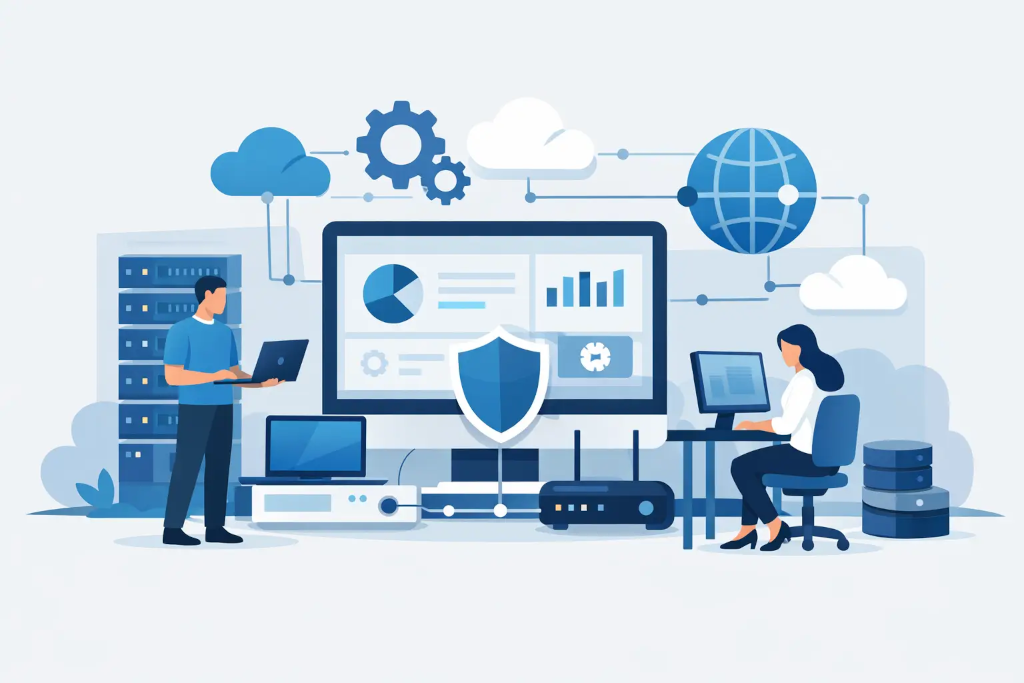
IT infrastructure maintenance for a company is not just computer repairs or user support. It encompasses the entire technological foundation upon which daily operations rely—workstations, servers, networks, access control, cloud services, backups, security solutions, license management, and incident resolution. Monitoring, documentation, and planning are equally important.
From a business perspective, the goal is simple: to keep systems available, secure, and predictable. This means less downtime, fewer unexpected costs, and greater control over what is happening in the infrastructure. A good maintenance model does not wait until something breaks. It identifies risks earlier and mitigates them before they impact business operations.
Here, a nuanced view is important. Not every company needs the same IT model. For a manufacturing company, where uninterrupted access to equipment management systems is critical, priorities will differ from those of a professional services office, where the greater value is on data security, access to documents, and employee mobility. Maintenance is not a one-size-fits-all service. It is a management approach that must be tailored to the logic of the company's operations.
Why a reactive approach costs more
The most common scenario is as follows: a company addresses IT issues as they arise. When the printer doesn’t work, a specialist is called. When space runs out on the server, an additional disk is purchased. When an employee leaves, the account is sometimes closed immediately; sometimes later. This approach seems economical as there are no ongoing cost lines. In practice, it leads to incomparably larger losses.
A reactive model usually means there is no complete overview of assets, no centralized monitoring, backup restores are untested, and updates are done irregularly. Each of these points may seem acceptable on its own. Together, they create an environment where a simple incident turns into a problem for a day or even a week.
That’s why maintenance should be viewed not as an IT expense, but as a business continuity tool. If management understands the cost of one hour without access to customer data, the ERP system, or email, the maintenance budget takes on a whole new significance.
What is included in a professional maintenance model
Well-organized IT maintenance starts with a clear environment. It should be known what devices and systems are in use in the company, where critical data is stored, who has administrative rights, and where there are dependencies on specific suppliers or employees. Without this foundation, managing risks is impossible.
Next comes daily management. This includes system monitoring, security updates, performance control, user support, access rights administration, and license reviews. If a company operates a hybrid environment, coordination between local infrastructure and cloud services becomes essential. This is critical because problems often arise precisely at the junctions between different platforms, rather than within a single system.
No less important is backup and recovery readiness. Just having backups isn’t enough. The question is—how quickly can data be restored, what is the acceptable amount of data loss, and has the recovery process been tested in practice? These are management issues, not just technical parameters.
IT infrastructure maintenance for companies and security requirements
Security is not a separate project implemented once every few years. It is a component of maintenance. On a practical level, this means multi-factor authentication, endpoint protection, log monitoring, vulnerability management, access control, and a clear process for adding and removing employees from systems.
Smaller companies often have the false conception that they are not an interesting target for attackers. In reality, attacks are often automated and aimed directly at environments with weaker management. Moreover, risk is not just about malicious attacks. Data leaks, misconfigured rights, or accidentally deleted files can have equally serious consequences as external incidents.
The level of security is determined not by a single technology, but by discipline. If updates are delayed, access rights are not regularly reviewed, and there is no accountability for incident escalation, technical tools alone won’t save the situation. Therefore, companies need a managed approach where security is integrated into daily maintenance.
Internal IT team or outsourcing
This question is rarely black and white. For a company with 20 or 50 employees, a full internal IT team is often not economically justified. One specialist, on the other hand, struggles to cover everything—user support, infrastructure, cybersecurity, backups, strategy, and supplier management. As a result, there is a dependency on one person's knowledge and availability.
The outsourcing model here provides broader expertise and continuity of processes. This is especially valuable for companies in a phase of growth, restructuring, or modernization, where the technological environment is changing faster than internal capacity can be built. At the same time, outsourcing works best when collaboration is not limited to a help desk. Strategic oversight is also needed—clear levels of responsibility, development plans, and regular environment assessments.
In some cases, the best solution is a combined model. Process owners or one IT coordinator remain inside the company, while an external partner provides infrastructure monitoring, security, backups, and specialized projects. This approach is often more practical than trying to maintain everything in-house.
How to understand that the maintenance model no longer fits the company
The signals are usually very practical. Incidents repeat, but the cause is not addressed. System documentation is incomplete or outdated. Training a new employee takes too long. Management is unclear about what the critical IT risks are and the state of the backups. There are many suppliers, but no one has overall responsibility.
Another common indicator is the slowdown of change. The company wants to open a new branch, migrate to cloud services, implement a new business system, or organize compliance requirements, but the existing environment is too unclear and fragile. This means that maintenance is no longer just an operational issue. It begins to restrict business development.
At this point, an external audit or independent infrastructure assessment can be helpful. It helps to understand not only what is not functioning well today, but also what could become a problem in the next 12 to 24 months. This time perspective is usually the most valuable to management.
What to expect from an IT maintenance partner
A company does not need a supplier that simply reacts to tickets. It needs a partner that can provide daily support while managing infrastructure as a business-critical environment. This means clear service levels, monitoring, incident escalation, distribution of responsibilities, and transparent communication with management.
It is also important whether the partner can look beyond a single technical task. For example, if the company plans to migrate part of its systems to the cloud, the question is not just about migration. Costs, security, recovery scenarios, user work habits, and dependencies on existing systems must also be assessed. A good partner raises these questions in a timely manner, not after problems arise.
It is here that companies appreciate an approach where operational maintenance is connected with strategic oversight. KSK IT applies such a model in practice, as many companies need not only technical support but also clear direction, priorities, and control over the IT environment without extensive internal team building.
IT infrastructure within a company rarely demands attention when everything is working. Therefore, decisions about maintenance are often postponed. However, it is precisely during stable periods that it is the right time to organize the environment, reduce risks, and implement management that can withstand even more pressing situations. If technology is the foundation of the company's operations, its maintenance should be managed with the same discipline as financial, personnel, or supply processes.
