
AUTHORIZATION
Blog

How to implement subscribed IT management in a company
A company rarely decides to change its IT support model without reason. Usually, this is preceded by repeated system failures, unclear invoices for outsourced services, insufficient data backups, or a situation in which management does not know who is actually responsible for IT risk. The question of how to implement managed IT services is therefore not just about buying technical support. It is a decision about clear responsibility, predictable costs, and business continuity.
Managed IT services mean that a company receives a defined scope of IT services and a management model for a regular monthly fee. Depending on the needs, this can include user support, infrastructure monitoring, security management, backups, cloud services, incident resolution, and management-level IT consulting. However, the result is not determined by signing the contract alone. It is determined by the correct implementation sequence.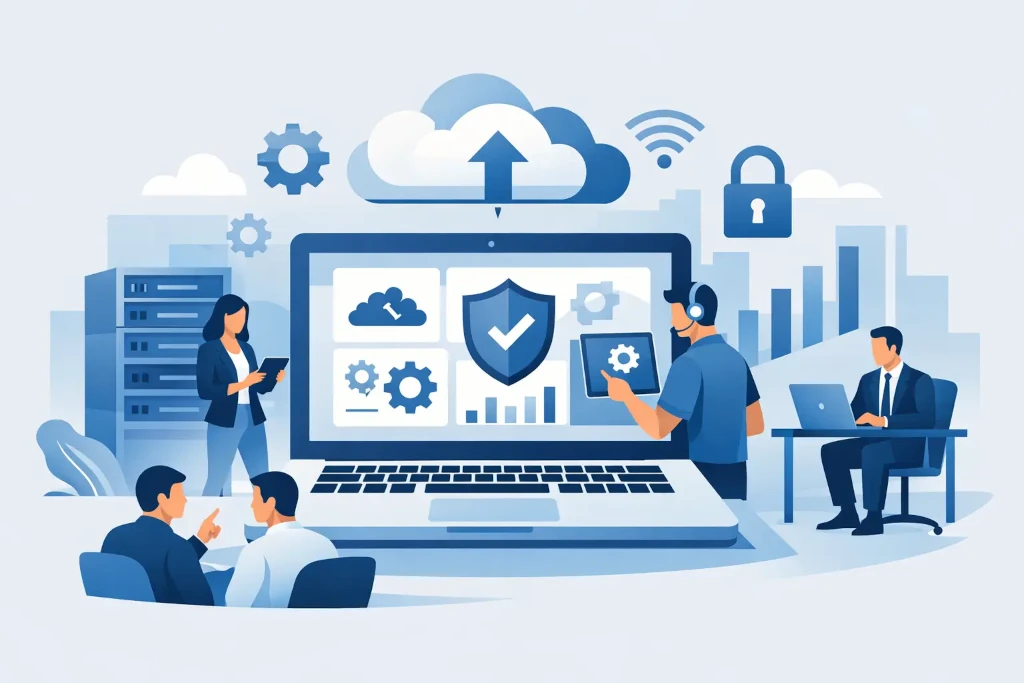
Start with business risk, not with a list of technologies
The first step is to understand what the IT environment means for the company’s daily operations. For a manufacturing company, loss of access to the warehouse or accounting system may be critical. For a professional services company, the biggest risk is often a leak of client data, email downtime, or insecure access for remote employees. Meanwhile, for a growing company, the key need may be the ability to quickly open a new office or provide technology for new teams.
Before defining the service scope, management should be able to answer three questions: which systems must not stop, how much downtime the company can afford, and what data must be restored after an incident. These answers make it possible to distinguish what is truly necessary from the desire to buy everything possible.
An IT audit or an initial environment assessment is a practical investment at this stage. It shows what devices, licenses, access rights, servers, cloud solutions, and integrations already exist in the company. At the same time, risks are revealed, such as outdated operating systems, shared administrative accounts, untested backups, or a lack of documentation.
Define the boundaries of managed IT services
The managed model works best when both parties clearly understand what is included in regular management and what is a separate project. For example, daily user support, workstation monitoring, software updates, and backup checks are usually predictable, repeatable tasks. In contrast, server migration, office network deployment, technical assessment of a company merger, or implementation of a new ERP system usually require separate planning and budget.
An unclear boundary creates frustration on both sides. The client may assume that any technical work is included in the monthly fee, while the service provider may not have planned resources for a large infrastructure project. Therefore, the service description should specify the managed systems, number of users, support channels, working hours, response principles, and change request procedure.
It is also important to agree on service levels, or SLAs. The response time for a critical incident cannot be the same as for a request to install a new program. SLA should reflect business impact, not just the technical category of an incident. If a business system available to everyone is down, the priority must be high. If one user wants consultation about organizing files, the solution can be planned for another time.
Organize access, ownership, and documentation
One of the most common transition risks is a situation in which a company does not have full control over its digital assets. The domain may be registered in the name of a former employee, the cloud platform administrator may be an external consultant, and passwords may be stored in an informal document or a personal password manager. Such an environment makes not only daily support more difficult, but also the sale of the company, audits, and incident response.
During implementation, a structured asset and access register should be created. It should contain information about hardware, licenses, warranties, critical systems, data storage locations, administrator accounts, and responsible persons. Ownership of accounts and services must remain with the company, even if day-to-day management is carried out by an external partner.
Documentation is not a bureaucratic appendix. It reduces dependence on one person and speeds up incident resolution. A well-documented environment also makes it easier to evaluate the service provider’s work objectively, because it is clear what is being managed and what changes have been made.
Implement management gradually
A complete transition in one day is possible only in very simple environments. In most companies, a phased implementation is safer. First, monitoring, inventory, and documentation are taken over, then user support, security improvements, backup testing, and the infrastructure modernization plan.
This sequence helps reduce disruption. The IT partner first gains visibility into the environment, while company employees understand where to turn for help and how incident reporting will work. If the changes affect access policies or multi-factor authentication, employees must be given a clear explanation. Otherwise, even a justified security solution will be perceived as an unnecessary obstacle to work.
The transition plan should also include an escalation procedure. While the new model is stabilizing, the company must know who makes decisions about critical changes, how management is informed, and what to do outside normal support hours. This is especially important for companies with international teams or customer service outside standard working hours.
Do not leave security and backups as an add-on
The value of managed IT services increases significantly if they include not only incident response but also preventive control. Update management, antivirus protection, access rights reviews, and monitoring help reduce the likelihood of incidents. However, this alone is not enough if the company cannot restore critical data or systems after a failure, cyberattack, or human error.
Backups must not only be created, but also regularly tested. Management needs to know how quickly it is possible to restore files, virtual servers, or essential business systems. Here, two indicators must be separated: the acceptable data loss period and the acceptable system recovery time. A company that can afford to lose one working day of data will choose a different solution than a company for which every hour of transactions is critical.
A disaster recovery plan does not need to be overly complex, but it must be usable. It should specify responsible persons, communication procedures, recovery priorities, and the main vendor contacts. Periodic tests show whether the plan will also work under real pressure.
Measure results in management terms
After implementation, managed IT services must not turn into an invisible monthly expense. Management should regularly receive clear information about incidents, recurring problems, security status, backup results, license situation, and planned risks. Such reporting helps make decisions rather than merely recording technical facts.
A good IT partner does not stop at announcing that the server has been updated. They explain what this work reduces in the context of business risk, what investments will be needed in the near future, and where continuity problems may arise. Here, the managed model can also include the function of an external IT director - regular strategic insight without the cost of a full-time manager.
In KSK IT’s approach, management is based on this principle: daily support, infrastructure control, and management-level review must work as a single system. This reduces situations in which technical issues are handled separately from business goals.
When the managed model is not enough on its own
Managed services are not a replacement for every IT investment. If the infrastructure is significantly outdated, an office relocation, cloud migration, or company acquisition is expected, a separate project with specific scope, deadlines, and responsibilities will be necessary. It is precisely in such moments that the management partner’s knowledge of the existing environment becomes especially valuable, because planning starts from facts rather than assumptions.
The company must also take its share of responsibility. Management must set priorities, make decisions about risks, and support security requirements among employees. An external partner can manage the environment, but cannot decide on behalf of the company how much downtime or data loss risk is acceptable.
Properly implemented managed IT services give management more than a help line. They create discipline in IT decisions, visibility over risks, and a clear path for further changes. Start with an honest assessment of the existing environment and define which business operations IT must protect first - this decision shapes both service quality and the company’s resilience.
