
AUTHORIZATION
Blog
Cloud solutions or local infrastructure?
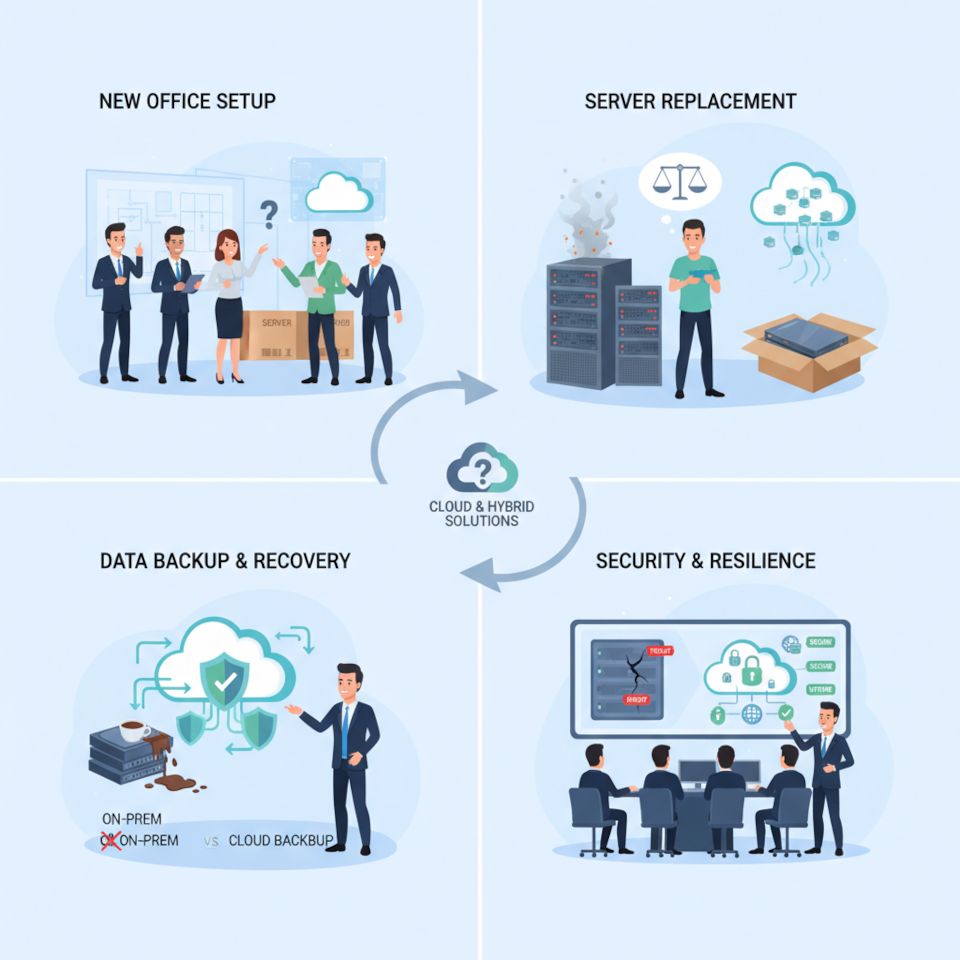
The decision on whether cloud solutions or local infrastructure are more suitable for a company usually does not arise from a theoretical discussion. It typically appears when a new office needs to be opened, an outdated server needs to be replaced, backups need to be organized, or management finally needs a clear answer to the question - how secure and resilient is our IT environment, really.
This is not just a question of technology choice. It is a decision regarding cost structure, operational continuity, security control, and how quickly a company can adapt to changes. For small and medium-sized enterprises, a mistake here often costs not only money but also time, reputation, and management's attention.
Cloud Solutions or Local Infrastructure - What the Choice Depends On
There are no universally correct answers. Companies with a similar number of employees can make different decisions because their requirements regarding data availability, system performance, regulation, and internal control vary significantly.
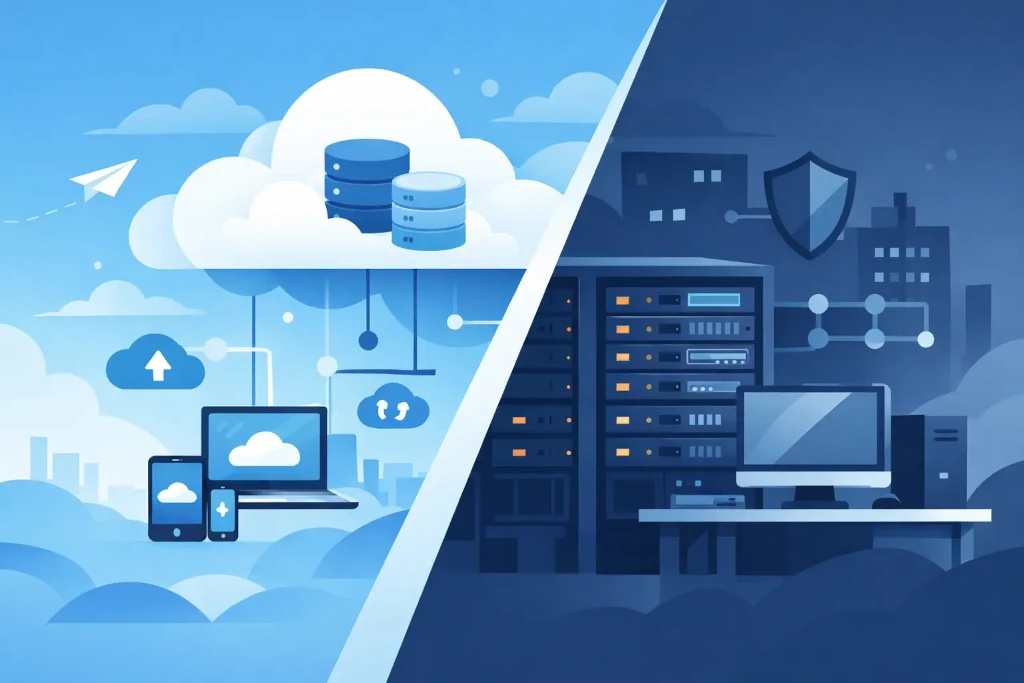
If a company works with standard office applications, document circulation, email, collaboration tools, and remote access, the cloud often provides quicker results and simpler management. If a company's operations are based on specific manufacturing systems, local databases, equipment integrations, or specific security requirements, local infrastructure or a hybrid model may be more reasonable.
The most important factor is not where the data is currently stored but how well the IT environment supports the company's operations. A well-organized local environment is more valuable than a chaotic migration to the cloud. Similarly, a qualitatively managed cloud is safer than an office server that nobody systematically monitors.
When Cloud Solutions Give a Company Advantages
The greatest advantage of cloud solutions is flexibility. If a company is growing, hiring new employees, implementing new services, or operating from multiple locations, the cloud environment allows for faster resource expansion without large initial investments in hardware.
From a management perspective, this often means more predictable costs. Instead of capital expenditures, a service model with monthly costs is formed, which includes infrastructure, availability, and part of maintenance. This is especially useful for companies that do not want to plan for server replacements, storage expansions, or data center upgrades every few years.
A significant advantage is also access. Remote work, outsourcing teams, branches in other countries, and mobile management teams require secure and predictable access to systems from various locations. The cloud is often more practical here than a local environment tied to a single office or network configuration.
However, the cloud is not automatically cheaper. If the environment is built without management principles, costs gradually rise - extra licenses, unused resources, overlapping services, uncontrolled data storage. Therefore, a cloud environment requires the same discipline as local infrastructure, only in a different form.
When Local Infrastructure is Still a Justifiable Decision
There are situations where local infrastructure is not an outdated model, but a deliberate and business-justified choice. This applies to companies that use specialized systems with low latency, maintain large volumes of data for local processing, or whose operations are closely tied to manufacturing, warehousing, or industrial equipment.
Sometimes, the decisive factor is control. For companies in regulated industries or environments with strict security requirements, it is essential to know precisely where the data is, who has access to the infrastructure, and how backups, network segmentation, and physical security are managed.
A local environment can also be justified if a company has already made significant investments in servers, virtualization, power backup, and backups. In this case, moving to the cloud should not be done just because it sounds more modern in the market. If the existing environment is secure, documented, and aligns with development plans, keeping some systems on-premises can be financially rational.
However, local infrastructure has its demands. To work reliably, it is not enough to have a server in a cabinet. Monitoring, update management, physical protection, backup testing, a clear disaster recovery plan, and responsibility for daily oversight are needed. Without this, a local environment becomes a risk rather than an advantage.
Costs - Where Companies Often Go Wrong
When comparing cloud solutions or local infrastructure, companies often only evaluate visible costs. The cloud is looked at through the lens of the monthly fee. Local environments are viewed in terms of the server price. The real picture is broader.
The total costs of local infrastructure include hardware, licenses, warranties, power supply, cooling, networking equipment, backups, recovery solutions, and specialist time. Conversely, the cloud environment must consider not only the subscription but also data transfer, administration, security configuration, backups, user access control, and potential costs for misselected resources.
The most useful question for management is not "which is cheaper," but "which model poses less risk and better supports planned development over a three to five year period." Sometimes, a lower initial price later translates into higher maintenance costs. At other times, a larger initial investment results in a more stable and cheaper environment over a longer period.
Security is Not an Argument for One Side Only
There is a common assumption that data is safer on-premises because it is under the company's control. Equally often, there is the opposing claim that the cloud is always safer because it is maintained by large service providers. Both assertions are incomplete without context.
Security is determined not only by location but by the quality of management. If the local environment is regularly audited, updated, segmented, and backed up, it can be very secure. If the cloud environment is properly configured, with strict access control and continuous monitoring, it can provide high resilience and availability.
The greatest risk usually lies between the solution and daily discipline. Incorrect access levels, untested backups, outdated accounts, unmanaged endpoints, and unclear responsibilities lead to incidents much more often than whether a server is located in an office or a data center.
A Hybrid Approach is Often the Most Pragmatic Option
For many companies, the right answer is not a choice between two poles. Hybrid infrastructure allows for keeping critical or specific systems locally while utilizing cloud services for email, collaboration, backups, remote access, or part of business applications.
This approach is especially useful for companies in a transition phase. For example, if part of the systems cannot be quickly migrated, but management wants to improve availability, security, and flexibility, a hybrid model reduces risk and allows for gradual modernization.
However, a hybrid environment is not a compromise without complications. It requires a clear architecture, unified security principles, transparent identity management, and centralized monitoring. If this is not organized, a company may find itself in a situation where it is paying for two environments at once but does not have full control over either.
How to Make a Decision Without Guessing
A practically good decision starts with an assessment of the existing environment. It is essential to understand which systems are critical for the business, how long the company can afford downtime, what the data protection requirements are, and what changes are expected in the coming years.
Then, not only the technology but also the management model must be evaluated. Who will be responsible for monitoring? How will recovery be tested? How will access rights control happen? How will capacity be planned? If there are no clear answers to these questions, the issue lies not in the chosen platform but in management.
Right here, it is often worthwhile for companies to engage an external perspective. Not to purchase a specific solution but to understand what model fits business processes, risk profiles, and budgets. In such cases, KSK IT usually evaluates infrastructure not only from the technical side but also from the perspectives of continuity, security, and long-term maintenance.
If the choice has to be summed up in one sentence, it would sound like this: the cloud is a good tool, local infrastructure is a good tool, but a company needs the right combination, not the most popular word in the market. The smartest decision is usually not the loudest - it’s the one that allows the business to operate seamlessly on Monday morning.
