AUTHORIZATION
Blog
Veeam Backup overview for enterprise data protection
A server can stop within a few minutes, but inconsistent data recovery can halt accounting, customer service, or production for several days. That is why the Veeam Backup review is not just a comparison of software features. For management, it is a question of how quickly work can resume after an incident, how much data may be lost, and whether the recovery process has been tested before a crisis.
Veeam is a widely used data protection platform for virtual, physical, and cloud workloads. It is especially well suited for organizations that need centralized backup management, clear recovery objectives, and the ability to build protection for both local infrastructure and Microsoft 365, public cloud, or hybrid environment resources. However, the product itself does not guarantee business continuity. The result depends on architecture, storage policy, access control, and regular recovery testing.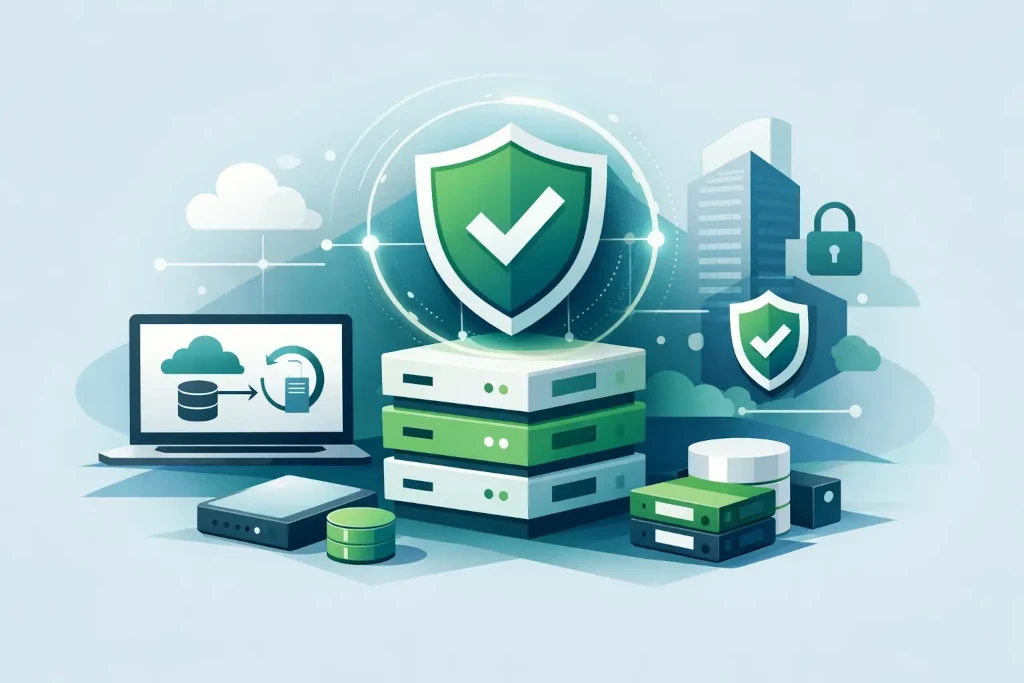
What business problem does Veeam Backup solve
A backup is often seen as a technical file created at night. In practice, it is the company’s insurance against errors, malware, hardware failures, failed updates, and human mistakes. If an employee deletes an important document, restoring a single file may be enough. If ransomware affects several servers, a secure and clean system rollback to a specific point in time is required.
Veeam’s approach is to create backups at the application and workload level rather than simply copying files to another disk. This means you can restore an entire virtual machine, individual files, database objects, or specific application components. For a company, this reduces downtime risk and allows priorities to be defined more precisely: for example, an ERP system may require fast restoration, while archive data may allow a longer recovery time.
A key benefit is centralized visibility. An IT manager or external IT partner can see whether backups have been created, whether jobs have ended with errors, how long the data is retained, and whether the versions needed for recovery are available. This is also valuable in audits, in assessing insurance requirements, and in the process of selling or acquiring a company, where data protection practices must be justified.
Veeam Backup review: features that matter
Veeam’s strength is not one individual feature, but an interconnected protection model. It enables a backup strategy tailored to the company’s infrastructure and risk profile.
Virtual server and application recovery
In organizations with VMware or Hyper-V environments, Veeam enables image-level backups of virtual machines and their restoration at different levels. If an entire server is damaged, you can restore the full virtual machine. If only one document or email is needed, there is no need to move the entire system back into the production environment.
Particularly important is the ability to perform rapid recovery from the backup repository. In a properly designed environment, a critical virtual server can be started from backup while a full system recovery is performed. This capability can be decisive for customer service, warehouse, finance, or production systems, where several hours without access cause direct losses.
However, fast recovery is not automatically fast in every environment. The result depends on repository performance, network throughput, virtual infrastructure capacity, and data volume. Therefore, any promise of restoration within a few minutes must be based on tests, not just on the license description.
Protection against ransomware
In modern attacks, criminals often try to delete or encrypt backups as well. Therefore, a copy stored on the same server, under the same administrator account, or on the same network is not sufficient protection.
Veeam supports immutable backup storage, where data cannot be modified or deleted for a specified period, even by an administrator. This principle helps implement the 3-2-1-1-0 approach: at least three copies of data, two different types of media, one copy in another location, one immutable or isolated copy, and zero undetected errors after verification.
It is important to understand that immutability is not a complete cybersecurity solution. It does not stop the initial attack, fix weak passwords, or replace access segmentation. But it gives the company an independent recovery point at the moment when the primary environment is no longer trustworthy.
Verification, not just a successful job status
A green message in the backup console does not mean the company will be able to restore operations. A backup may have been created technically, but it may not contain the required application consistency, available credentials, or sufficiently fast storage.
Veeam offers automated verification options, including starting recovered virtual machines in an isolated environment. This makes it possible to confirm whether the operating system boots and whether critical services are available without affecting the production environment. For organizations with regulated requirements or high downtime costs, this kind of verification is more valuable than a monthly report that only shows the copy job was completed.
Where Veeam is suitable, and where alternatives should be considered
Veeam is a logical choice for companies with multiple servers, a virtualized environment, a hybrid cloud, or a need for detailed recovery. It fits well in organizations where data protection must be tied to disaster recovery planning, auditable processes, and responsible governance.
In a small business with one file server and a minimal IT environment, the platform’s broad capabilities may be more than are needed day to day. In such a situation, the priority is not to choose the most complex solution, but to ensure that backups are encrypted, stored outside the primary location, and regularly tested. Costs must also be assessed in full: a license is only one part. Storage, possible cloud resources, monitoring, incident procedures, and specialist time are also required.
The type of workload must also be taken into account. Microsoft 365 data is not automatically fully protected just because it resides in Microsoft’s cloud. Service availability and the company’s own data recovery needs are separate issues. For specific SaaS systems, Veeam may not have direct integration, and then the vendor’s export options or a specialized backup tool should be considered.
Costs and licensing: what management should ask before deciding
The licensing model should generally be chosen according to the workloads to be protected and the planned growth. The cheapest initial option is not always the most economical after two years if the company adds new servers, branches, or cloud services.
Decision-makers should ask not only the license price, but also answers to specific operational questions. What is the acceptable system recovery time? How much data may be lost, for example, the last four hours of changes? Where will the copies be physically stored? Who is allowed to delete them? Who will prove, and how often, that recovery actually works?
These questions turn a technical procurement into a managed risk decision. If management defines recovery targets, the IT team or external partner can design an appropriate solution rather than applying a standard policy to all systems by default.
Implementation starts with priorities, not installation
Successful implementation first requires a map of the critical systems. You need to know where customer data, financial information, contracts, emails, and application databases are stored. Then each system should be assigned a recovery priority, retention period, and a responsible person on the business side.
The next step is the backup infrastructure. Local storage can provide fast recovery, while an offsite or cloud copy protects against fire, theft, and local infrastructure damage. A removable or immutable copy helps reduce ransomware risk. The safest model is often a combination rather than a single location.
Finally, operational discipline is needed. Error notifications must reach a specific responsible person, recovery tests must be included in a regular schedule, and access rights must be separated from day-to-day administration. In KSK IT practice, it is often these governance elements that determine whether backups become a real business continuity instrument or merely a formal IT task.
The most valuable next step is not to ask whether Veeam is a good platform in general. It is to determine which company service cannot be afforded to lose, how quickly it must be restored, and whether that promise can already be proven with a test now.
