
AUTHORIZATION
Blog
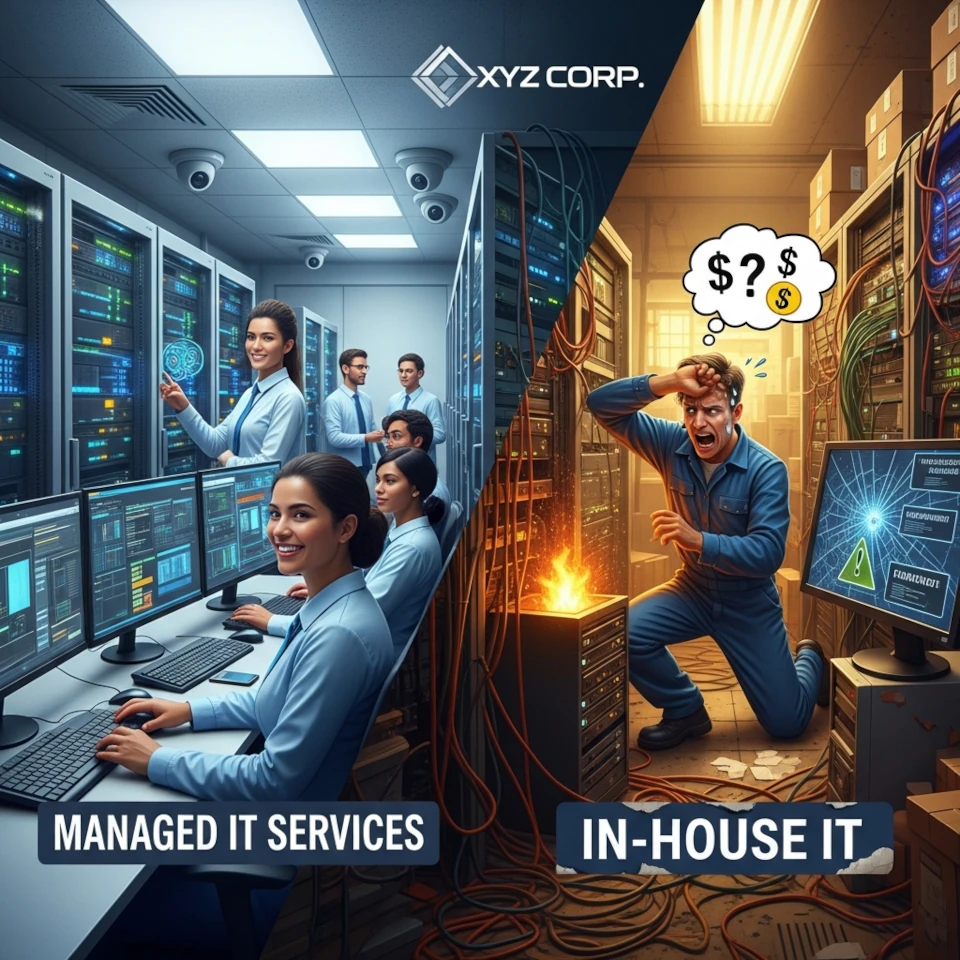
Managed IT services vs internal IT
When work in a company first seriously stops because of IT, the question stops being theoretical. That is exactly when the topic "managed IT services vs. internal IT department" becomes a management-level decision — with an impact on costs, security, availability, and the company's ability to grow without unnecessary friction.
For small and medium-sized companies, this choice rarely comes down only to who will "fix the computers." In reality, it is about how the infrastructure will be managed, how quickly incidents will be resolved, who will take responsibility for backup and recovery, and whether the company will have access to a sufficiently high level of expertise when it is truly needed.
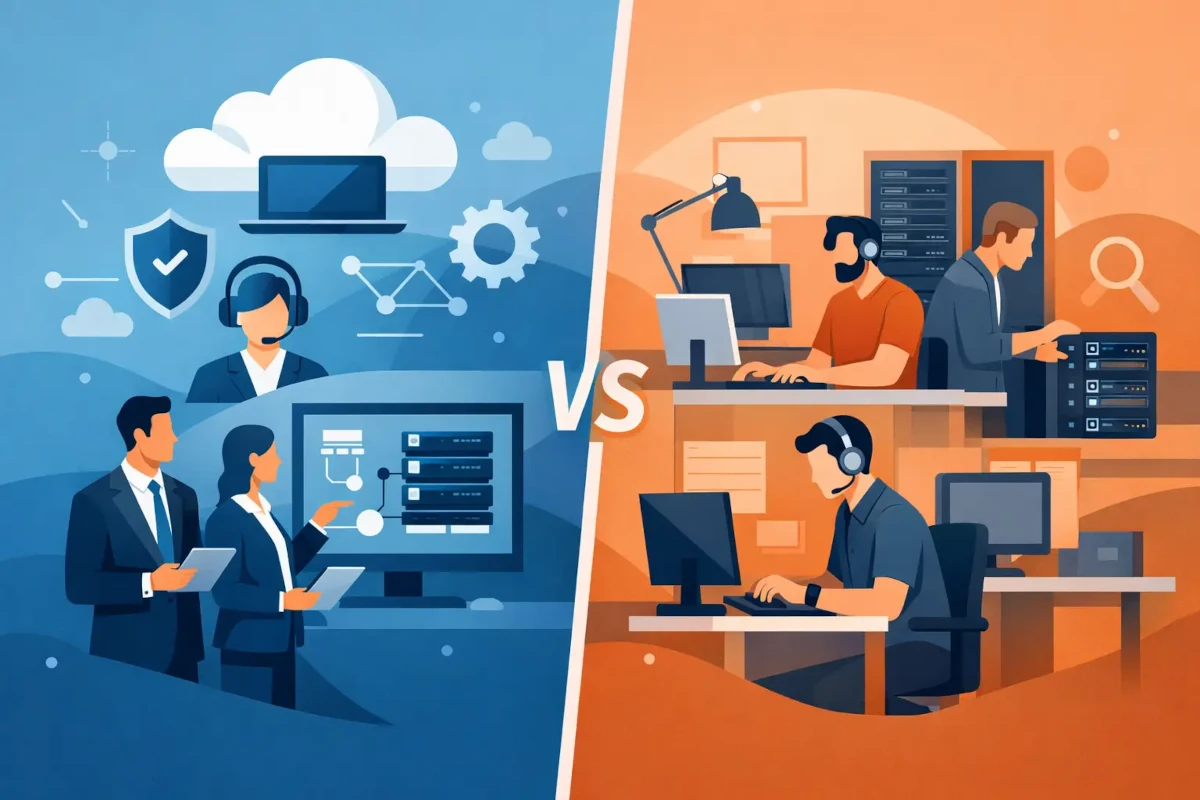
Managed IT services vs. internal IT department — what are you actually comparing
At first glance, the comparison seems simple. On one side is your own employee or internal IT team. On the other is an external partner that provides IT support and management. But in practice, these models differ not only in cost structure, but also in the distribution of responsibility, coverage of expertise, and managerial control.
An internal IT department usually means direct presence in the company, deeper knowledge of everyday processes, and a fast response to local needs. This is valuable if the environment is complex, there are many employees, or processes are strongly tied to a specific location, production, or particular internal systems.
In turn, managed IT services mean a service model defined in a contract — with monitoring, support, security practices, documentation, and often access to a broader range of specialists. Here, the company is not buying one person. It is buying a function, a process, and a system of accountability.
Costs — not just salary versus subscription fee
Managers usually start with the budget, and that is logical. In the case of an internal IT department, costs are not only the gross salary. They also include taxes, training, coverage during vacations, compensation for a lack of specialized knowledge, software tools, and the time management spends controlling and organizing this function.
One IT administrator can handle everyday support, workstations, and basic infrastructure well. But as soon as cloud services, cybersecurity setup, backup strategy, Microsoft 365 management, network segmentation, or incident analysis are needed, one person is often not enough. Then the company starts buying external specialists separately, and the overall cost picture becomes less predictable.
In the managed IT services model, costs are usually easier to forecast. A monthly fee makes it clear what is included in the basic service and which tasks are separate projects. This is especially useful for companies that value budget discipline and do not want to build a full internal IT structure for every next step of growth.
However, there are nuances here too. If the scope of the service is not defined precisely, a gap may arise between expectations and what is actually delivered. Therefore, more important than the lowest price is the clarity of the service boundaries, response time, and whether the partner also takes on strategic responsibility, not just user support.
Competence and availability — one person versus a team
Internal IT often wins because of familiarity. Your own specialist knows the employees, the internal culture, the company history, and why the infrastructure has developed the way it has. That knowledge is difficult to replace.
But that is exactly where the risk lies as well. If critical information is in one person's head, the company becomes dependent on a specific employee. Illness, resignation, or simply overload can create an unpleasant situation in which nobody else really knows how the environment is set up or how to support it safely.
The advantage of managed IT services is the team model. The company gains access to different areas of expertise — infrastructure, cloud, security, backup, audits, migrations, and sometimes even a virtual layer of IT management. This means not only more hands, but also a broader view of risks and opportunities.
Of course, an external partner cannot know the company as intuitively as a long-term internal employee, unless good documentation, regular communication, and clear management are maintained. That is why a quality service is not just technical execution. It is also a process in which the partner gets to know the environment, records knowledge, and ensures continuity.
Security and business continuity
If a company's IT is evaluated only by how quickly a new computer is connected, the choice is too narrow. At management level, much more important are questions of data protection, access control, backups, recovery procedures, and the ability to continue operations after an incident.
The internal IT model can be very effective if the company already has mature processes, a documented environment, and people with experience in security and continuity management. But in smaller companies the reality is often different — everyday support consumes time, and preventive tasks are pushed to the background.
Managed IT services in this area often provide a more structured approach. Monitoring, update policies, backup control, disaster recovery planning, and audit capability are usually built into the logic of the service. This does not mean the risk disappears. It means the risk is managed more systematically.
This is precisely the aspect that often determines a company's choice during periods of growth, restructuring, or compliance requirements. If management needs to be able to demonstrate that the IT environment is controlled and risks are under management, the external management model is often more practical than trying to build everything internally from scratch.
Scalability and pace of change
A company with 15 employees and one office has one set of needs. A company with 60 employees, hybrid work, multiple locations, and customer data on several platforms has very different ones. The IT model must keep up with the business.
Internal IT can become a bottleneck when the number of projects grows. If one or two people have to support daily operations, implement a new system, migrate data to the cloud, and handle security incidents at the same time, priorities inevitably collide. Then the company starts living from one urgent issue to the next.
The managed IT services model is usually more flexible. It is easier to scale by adding users, locations, security levels, or separate projects. This is especially important for companies that open a new office, acquire another company, or hire new people quickly.
Here, however, we need to be honest — not every external service provider can be a strategic partner. Part of the market works as a support service, not as a management team. If a company needs not only support but also a clear direction of development, it should choose a partner who can speak about architecture, risks, budgets, and priorities in management language.
When internal IT is the right choice
The internal model is justified if the company has a large and constantly loaded IT environment, complex specialized systems, or a high need for on-site presence every day. This is especially relevant in manufacturing, logistics, or organizations where IT is closely tied to operational processes and equipment.
It also fits when the company deliberately builds internal technological competence as part of its core capability. In that case, IT is not just a support function. It becomes an element of competitiveness.
Even then, however, it is often useful to keep an external partner for specific areas — audits, cybersecurity assessments, disaster recovery planning, or higher-level consulting. A fully internal model does not always mean that everything has to be done alone.
When managed IT services add more value
For small and medium-sized companies, an external management model is often more sensible from the standpoint of both economics and operations. It makes it possible to obtain stable support, access specialized knowledge, and achieve clearer IT governance without bearing the full costs of an internal team.
This is especially useful if the company is in a period of change — growing, implementing new platforms, revising security requirements, opening new locations, or simply wanting to organize an environment that has been built fragmentarily for years. In such moments, what is needed is not only a response to problems, but structured management.
This is where the strategic value of managed services also becomes visible. A good partner helps not only keep systems running, but also make better decisions about infrastructure, risks, reserves, and investment priorities. An approach like KSK IT is important for companies that need not only technical support, but also an external view of IT management without the costs of a full-time CIO.
In practice, the best model is often hybrid
The choice between managed IT services and internal IT does not have to be black and white. In many companies, a hybrid model works best — one internal specialist or a small team handles everyday, business-close needs, while an external partner provides monitoring, security, documentation, projects, and higher-level expertise.
Such a model reduces dependence on one person while maintaining operational proximity to the business. This is often also the safest path for companies that are not ready to give up their internal IT function completely, but clearly see the limits of its capabilities.
If you are currently evaluating which option is better, start not with technology, but with business reality. How costly is downtime for you, how critical are the data, how quickly is the environment changing, and can your current model withstand the next stage of growth, not just today.
