
AUTHORIZATION
Blog

How to move to a hybrid infrastructure
The transition to a hybrid environment usually does not begin with choosing technology. It begins at the moment when one model no longer works for a company - everything on site or everything in the cloud. If you are evaluating how to move to hybrid infrastructure, the main question is not about trends or market fashion. The main question is how to ensure continuous operation, data control, reasonable costs, and the ability to grow without unnecessary risk.
Hybrid infrastructure is not a compromise in the weak sense. When well planned, it allows you to keep critical systems where they need to be, while using the flexibility of cloud services where it truly brings business value. For small and medium-sized businesses, this is often the most practical path, because it does not require choosing extremes.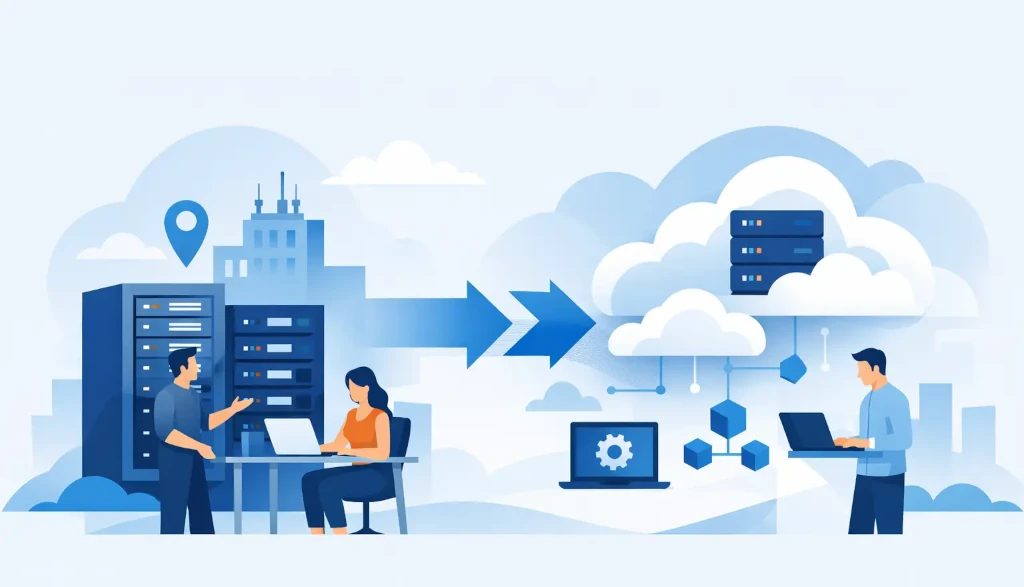
What hybrid infrastructure actually means for a company
Simply put, hybrid infrastructure combines local IT resources with public or private cloud services. But at the business level, it means something else - you distribute workloads according to requirements instead of forcing all systems to live in one environment.
For example, an accounting or production system with strict integrations can remain on premises or in a private environment. Meanwhile, email, file sharing, backups, remote access, or a testing environment can move to the cloud. This approach often provides better control over costs and security than a full migration in one direction.
That is precisely why the question is not only how to move to hybrid infrastructure, but also what exactly to move, what to keep, and in what order to do it.
When the transition to a hybrid model is justified
Many companies start thinking about this model after a specific pressure point. It may be an outdated server nearing replacement. It may also be rapid growth in employee numbers, the opening of new branches, tighter cybersecurity requirements, or the need to improve backup and recovery after an incident.
A hybrid approach is especially justified when a company has critical systems that require a low-latency environment or specific integrations, while also having standard services for which it makes no sense to maintain expensive local infrastructure. It is also justified when management wants to reduce dependence on a single scenario. Not everything local, and not everything in one cloud.
However, there is also the other side. A hybrid environment is not automatically simpler. It requires clear governance, security policies, monitoring, and a division of responsibilities. If implemented without architectural discipline, the company does not gain flexibility, but rather a chaotic environment with hard-to-predict costs.
How to move to hybrid infrastructure without unnecessary risks
A successful transition rarely happens in one project. It is more often a sequential modernization with clear decision points. The first step is to understand the current environment. Without an accurate picture of servers, applications, data flows, licenses, backups, and dependencies, any migration becomes a guessing game.
Start with an infrastructure and risk assessment
Before moving any system, you need to understand what is critical for the company. Not all systems are equally important. Not all have the same recovery requirements. Some services can tolerate short downtime, others cannot.
At this stage, several business questions need to be answered. How much does one hour of downtime cost? Which data is sensitive? What are the regulatory or contractual requirements? What happens if the internet connection is disrupted? Are the existing backups truly recoverable, rather than only formally created?
A good assessment usually reveals not only technical shortcomings, but also governance problems - incomplete documentation, unclear access rights, outdated integrations, and untested recovery scenarios.
Divide systems according to business logic, not convenience
A common mistake is to move what is easiest to move, rather than what brings the greatest benefit. A more practical approach is to divide systems into four groups: critical on-premises systems, candidates for cloud migration, backup or archiving workloads, and systems that first need modernization.
If an application is tightly tied to a specific device, production process, or local database, moving it may not be the first step. By contrast, collaboration tools, document storage, identity management, or remote access often deliver quick results with relatively low risk.
Organize identity, access, and security
A hybrid environment without unified identity management creates problems very quickly. Users have multiple passwords, access becomes unclear, and incident investigations take too much time. That is why one of the early tasks is to centralize identity, define roles, and implement multi-factor authentication.
It is also important to understand that security in a hybrid model is not just a firewall or antivirus. The whole picture must be visible - endpoints, user access, data encryption, backups, log files, and incident response. If any of these parts remain outside governance, the risk does not disappear, it simply moves.
Costs - where companies make the most mistakes
One of the most popular assumptions is that the cloud is always cheaper. Sometimes that is true. Sometimes not. If a workload is stable, predictable, and already amortized in the local environment, a full migration may even increase costs. On the other hand, if the company regularly needs to scale resources flexibly or quickly open new workplaces, the cloud is often financially more justified.
In a hybrid model, cost control depends on discipline. You need to understand not only subscription fees, but also data transfer, backups, licensing, monitoring, security tools, and outsourced support. Otherwise, double costs arise - the company continues to maintain the local environment while simultaneously paying for cloud resources that are not optimized.
Therefore, the right goal is not simply to reduce the bill. The right goal is to obtain predictable costs against a clear service level, risk profile, and availability.
Business continuity is one of the main benefits
If the transition is planned professionally, hybrid infrastructure significantly improves operational resilience. This applies not only to backups, but also to the ability to continue working during an incident. The company can separate critical services, implement recovery scenarios, and reduce the impact of a single point of failure.
Important nuance here - a backup alone does not yet guarantee continuity. There must be a clear plan for how quickly the system can be restored, who is responsible for it, and whether the process has been tested. A hybrid environment provides more options, but only if the recovery logic is defined, not merely the technical possibility.
For companies where customer service, logistics, financial accounting, or remote work are important, this is one of the strongest arguments in favor of the hybrid model.
Governance determines whether the model will work long-term
Buying technology is not the same as managing infrastructure. After migration comes the more complex part - monitoring, updates, capacity planning, access reviews, incident reviews, and change control. Without this, the hybrid environment begins to live its own life.
This is exactly where smaller and medium-sized businesses often lack internal capacity. Not because the team lacks competence, but because day-to-day support and strategic management require a different focus. For this reason, many companies choose a model where operational maintenance and higher-level IT oversight are handled by an external partner. KSK IT in such situations is usually involved not only in implementation, but also as a governance and continuity partner.
How to understand where to start in your company
If the company is currently running on aging on-premises infrastructure, the right starting point is often an audit. If the biggest problem is remote work and access control, the starting point will be identity and the collaboration environment. If management is more concerned about downtime and data recovery, the priority will be backup and disaster recovery architecture.
There is no single universal scenario. A company with one office and standard business applications will have a completely different transition than a manufacturing company with local equipment, specialized software, and multiple sites. A good plan takes this into account from the beginning, rather than trying to adapt reality to a chosen product.
The most practical step is to accept that the transition is not a one-time technical project. It is a transformation of business infrastructure, where the most important thing is not the cloud or the server itself, but the company’s ability to work stably, securely, and predictably even after the next growth phase, incident, or reorganization.
If you want to move to hybrid infrastructure with minimal interruptions, start not with platform comparisons, but with a clear answer to one question - which systems in your company really need to work all the time.
