
AUTHORIZATION
Blog

How to create a company's IT infrastructure
If a company grows faster than its technological environment, problems usually arise not in the server cabinet, but in daily operations - slow access to systems, unregulated licenses, weak security, and costly interruptions. Therefore, the question of how to build a company's IT infrastructure is not a technical detail. It is a management decision about how stable, secure, and scalable the company's operations will be in the coming years.
What does a company's IT infrastructure really mean
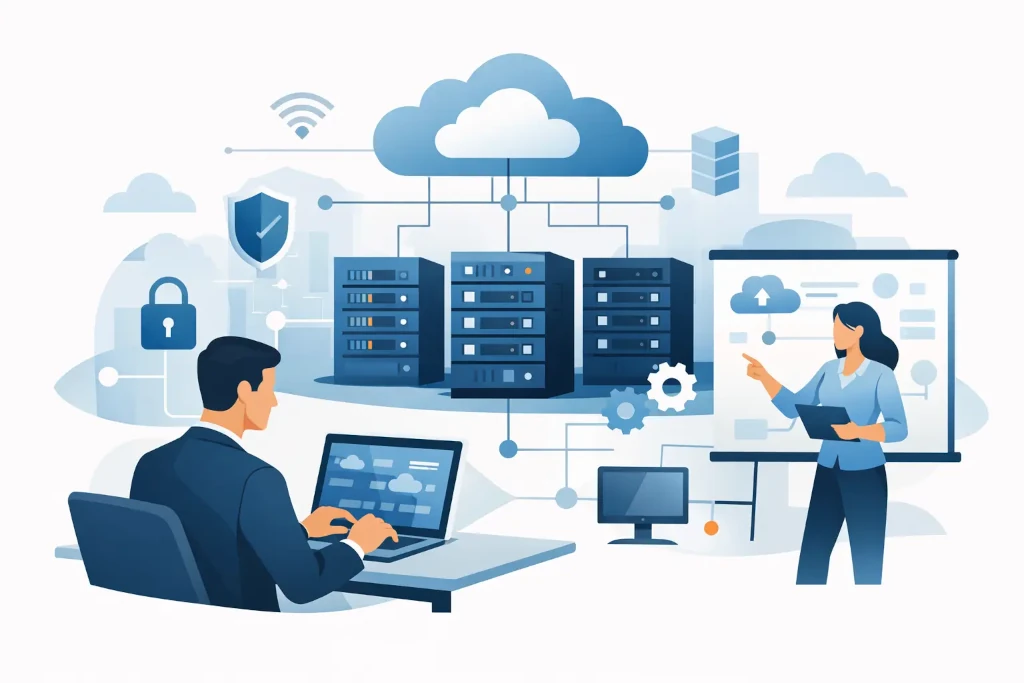
For many executives, IT infrastructure still associates with computers, the internet, and file servers. In reality, it is a much broader environment that enables business operations: user devices, networks, identity and access management, cloud services, business systems, data backups, cybersecurity layers, monitoring, and support processes.
The most important thing is to understand that good infrastructure is not just a set of technologies. It is a manageable system with clear rules, responsibilities, and recovery scenarios. If these parts are not planned, even expensive equipment does not guarantee stability.
How to create a company's IT infrastructure from business needs
The correct sequence starts not with equipment procurement, but with the company's operating model. It is necessary to answer several very practical questions: how many people will work in the systems, where will they connect from, where will the data be stored, what are the availability requirements, and how costly is one hour of downtime for the company.
A smaller company with one office and standardized work may suffice with a well-thought-out cloud-centric environment. In contrast, a manufacturing company, logistics operator, or organization with multiple branches often needs a hybrid approach, where some systems operate locally while others are in the cloud. There is no universal formula here. Infrastructure must be built according to risk, process, and growth plans, not fashions.
A good starting point is to define critical systems. These are usually email and collaboration environments, document storage, accounting or ERP, CRM, access management, backups, and security solutions. If it is not clear which of these systems are critical and how long the company can do without each of them, the infrastructure is already being built on assumptions from the start.
Essential components that must not be ignored
User environment and device management
Employee computers, laptops, and mobile devices are the front line of infrastructure. They must be standardized, with centralized configuration, update control, and security policies. If each device is managed differently, support costs increase, while security decreases.
Standardization does not mean that everyone must use identical computers. It means a unified approach - approved models, defined life cycles, centralized software deployment, and clear maintenance responsibilities.
Network and connectivity
A stable internet connection alone does not constitute infrastructure. Consideration must be given to network segmentation, secure remote access, wireless coverage, firewalls, and backup connections. In companies where everything is based on a single internet line and the router's default configuration, operational continuity is not actually ensured.
If office work stops due to a single network failure, the question is not whether an investment in the network is needed. The question is, why wasn't this investment made earlier.
Identity and access control
The center of modern infrastructure is often not a server, but identity. User accounts, multi-factor authentication, role-based access, and centralized account management are the foundation of a secure environment. This is especially crucial for companies with remote work, outsourcing partners, and multiple systems.
If access is granted manually and not revoked in a timely manner, the risk is not theoretical. It directly affects data security, compliance, and incident costs.
Data storage, backups, and recovery
Backups are one of those areas where companies often think everything is fine until an incident occurs. The question is not just whether copies are made. The question is, are they restorable, how quickly does it happen, and does the company know the recovery priorities.
It is essential to distinguish backup from disaster recovery. Backup helps restore data. Disaster recovery helps restore business operations. If recovery times and responsible parties are not defined, backups alone will not save business processes.
Cloud, local environment, or hybrid model
The choice between cloud services, local infrastructure, and a hybrid model is one of the most important decisions. However, it should not be reduced to a simple question of costs. The cloud offers flexibility, faster implementation, and less dependence on local hardware. However, in the long run, costs can increase if the environment is not managed disciplinarily.
A local environment may still be justified in some cases - for example, for specific industry systems, integrations of manufacturing equipment, or data sovereignty requirements. However, it means a greater responsibility for backups, hardware cycles, and physical availability.
The hybrid model is often the most pragmatic solution for medium-sized companies. It allows critical or specific systems to be kept in a controlled local environment while leveraging the advantages of the cloud for collaboration, identity, backups, and remote work.
How to create a company's IT infrastructure with security as a foundation
Security cannot be added later as an afterthought. If the infrastructure is built and security is only considered afterward, the access, network, and user policies usually have to be rebuilt. This is more expensive and complicated.
Practically, this means several fundamental principles. First, access must be built on the principle of least privilege. Second, all critical systems must be auditable. Third, there should be monitoring so that problems are identified before they lead to downtime or incidents.
Again, compromises must be considered here. Not every company needs a complex security operation model at the outset. However, every company needs a clear minimum: multi-factor authentication, endpoint protection, backups, access management, and incident response procedures.
Management is as important as technology
One of the most common mistakes is to believe that the infrastructure project ends with implementation. In fact, this is when the most important part begins - management. Who keeps track of licenses, updates, capacity, security events, and supplier contracts? Who makes decisions about modernization, budgets, and risks?
For small and medium-sized enterprises, a vacuum often forms here. There is no full internal IT manager, but the business already needs operational level control. In such situations, an external IT partner or CIO-as-a-Service model can be more effective than trying to coordinate various suppliers in a fragmented manner.
A good management model provides not only technical order. It gives management transparency - what belongs to the company, where the risks are, what needs to be done in the next quarter, and how IT supports business goals.
Typical mistakes that increase infrastructure costs
The most expensive infrastructure is not always the one in which the most has been invested. Often, the most costs stem from a fragmented environment without architectural principles. This happens when systems are added one by one, responding to current needs rather than according to a common plan.
The second common risk is insufficient documentation. If no one knows exactly how systems are connected, what access exists, and where critical data is located, any failure or personnel change becomes an operational problem.
The third mistake is focusing only on initial costs. The cheapest solution at the time of procurement can become the most expensive solution in terms of maintenance, support, and incident response.
A practical approach to implementation
If a company is starting from scratch or transforming an existing environment, it is wiser to work in phases. First, an assessment of the current situation or requirements definition must be carried out, then the target architecture, implementation sequence, and management model should be developed. Only then does it make sense to make final decisions about suppliers and technology stacks.
At this stage, an audit is very valuable, as it reveals not only technical deficiencies but also processes that create risks. For example, a company may have purchased good security software, but it lacks centralized monitoring. Or backups are being made, but there are no regular recovery tests.
KSK IT's typical approach in such projects is based on the principles of business continuity, security, and scalability, rather than just a simple list of equipment. This helps avoid a situation where the infrastructure appears organized on paper but fails to support daily operations.
IT infrastructure must be built in such a way that management receives not only technology but also control. If you make the right architectural and management decisions today, the next growth phase will not be a struggle with system limitations but a foreseeable step in the company's development.
