
AUTHORIZATION
Blog
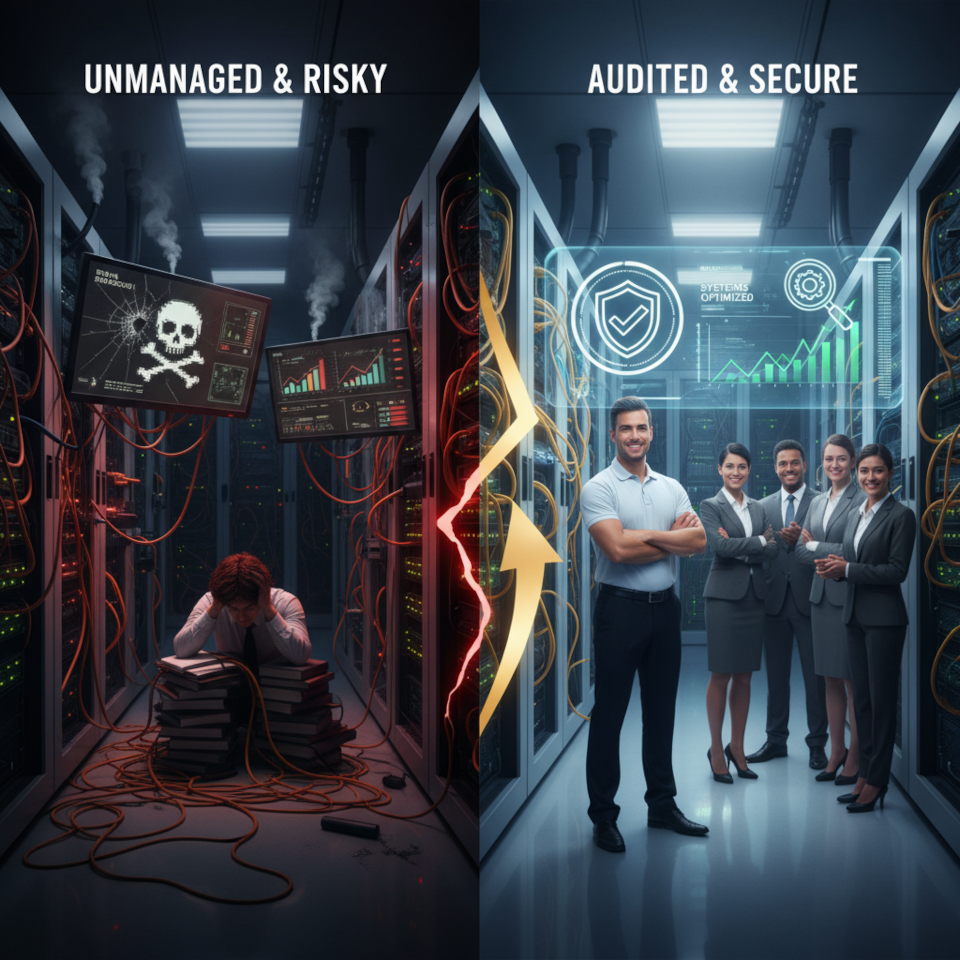
IT audits for the company - what does it really reveal
When everything seems to be working in a company, the IT environment often remains outside the management's attention until downtime, a data incident, or unexpectedly high costs occur. Therefore, an IT audit for a company is not a formal check in a document folder. It is a management tool that helps understand whether the technology environment truly supports business continuity, security, and growth.
In smaller and medium-sized companies, this issue becomes particularly relevant. Often, the infrastructure has developed gradually - one supplier implemented a server, another configured Microsoft 365, and yet another set up backups. As a result, technology seems to work, but the overall picture is unclear. Management does not have full confidence in the risks, responsibilities, and actual readiness for incident situations.

What is an IT audit for a company
Practically speaking, an IT audit for a company is a systematic evaluation of the existing IT environment. It encompasses infrastructure, user access, data protection, backups, recovery capabilities, licensing, documentation, use of cloud services, and often compliance issues.
It is important to understand that an audit is not the same as everyday IT support. Support addresses problems when they arise. An audit looks for the reasons why problems may arise, where systemic weaknesses lie, and where the company takes risks without fully realizing it.
A good audit does not start with technical terms. It starts with business questions. Which systems are critical? How much downtime can the company afford? What happens if access to files, email, or accounting systems is lost? Who in the company makes decisions at the time of an incident? It is from these answers that it becomes clear what to evaluate in the audit first.
Why do companies order an IT audit
The most common reason is not just security. The most common reason is management's need to gain clarity. If the company is growing, opening a new office, migrating to the cloud, changing IT suppliers, or preparing for investments, an unclear IT situation becomes a business obstacle.
For some companies, an audit is a preventive step. They want to ensure that the infrastructure is not based on one person's knowledge and verbal orders. For others, an audit becomes relevant after an incident - lost data, a ransomware attack, prolonged downtime, or unsuccessful system implementation.
There is also a third scenario - the company does not seem to be doing poorly, but feels that it is paying too much for unclear results. Then the audit helps understand whether the costs correspond to the real level of service, whether the license is being used effectively, and whether infrastructure choices are outdated.
What the audit typically checks
The scope of the audit may vary, but in most cases, it covers several layers simultaneously. The first is the technical environment - servers, workstations, network, firewalls, Wi-Fi, cloud platforms, and key business systems. The second is security management - password policy, multi-factor authentication, access rights, logs, vulnerabilities, and device protection.
The third layer is resilience. Here it is evaluated whether backups are not only enabled but also verifiable and recoverable. This is a crucial point, as many companies believe that backups exist until recovery fails. The fourth part is management - documentation, distribution of responsibilities, supplier access, change control, and logic of technology decisions.
Here the audit often does not reveal one big problem but several medium-sized risks that together create a significant vulnerability. For example, access is too broad, backups are not tested, there is no up-to-date documentation for critical systems, and former employees' accounts have not been fully deactivated. Each of these shortcomings may seem tolerable individually. Together they create an unacceptably high business risk.
What management gains after an audit
If the audit has been conducted correctly, the result is not just a technical report. Management should receive a clear understanding of what works well in the company, where the critical risks lie, how urgently they need to be addressed, and in what order to act.
This translates into priorities, not just findings. A company manager does not need a 40-page list of configuration details without a clear business impact. A clear explanation is needed of what threatens business continuity, what may lead to data leakage, what increases costs, and what hinders further development.
A good audit result also aids in budget planning. Not all shortcomings need to be addressed immediately. Sometimes it is sufficient to organize access management and test backups. Other times, the problem is deeper - an outdated local server, insufficient network segmentation, or complete dependence on one outsourcing partner. Management can only make informed decisions if risks are prioritized rather than simply listed.
When an IT audit is particularly needed for a company
There are situations when an audit should not be postponed. One of them is rapid growth. The faster a company grows, the more often the IT environment expands in a fragmented manner. This is understandable, but it is precisely at such stages that the most invisible weaknesses arise.
The second moment is a change in ownership or management. If a company is being bought, sold, or merged, the state of IT becomes a crucial element of due diligence. It is not just a matter of listing servers. The question is whether the acquired company carries hidden technological risks, inadequate licensing, or weak security discipline.
The third case is changing suppliers. If the existing IT partner provides insufficient transparency, an audit helps understand the real situation before the transition. It reduces the risk of taking over an environment without documentation, with unclear ownership of systems, or dependence on non-standard solutions.
The fourth moment is after an incident. Here, it must be admitted that an audit after a problem is less beneficial than an audit before it. However, it helps understand whether the incident was an isolated case or a symptom of broader management deficiencies.
Common misconceptions
One of the most common assumptions is the idea that an IT audit is only needed for large organizations. In reality, for smaller companies, it is often even more important as they do not have an internal team continuously monitoring architecture, security, and change discipline.
The second assumption is that if an IT service is provided by an outsourcing partner, an audit is not needed. On the contrary. Outsourcing does not absolve management of responsibility. In this case, the audit has double value: it assesses both the technical environment and the quality of service management.
The third mistake is to believe that an audit means a complete overhaul of the infrastructure. Sometimes yes, but often no. Many problems can be resolved with clearer access policies, organizing documentation, verifying backups, or formalizing responsibilities. An audit is not intended to artificially create projects. Its goal is to reduce risk and increase control.
How to assess whether the audit has been quality
A quality audit does not only speak about technologies. It connects technical findings with business implications. If the report does not clearly indicate how a specific deficiency may affect downtime, data availability, cybersecurity, or costs, management will find it difficult to make decisions.
It is also important whether the auditor can distinguish critical problems from improvements that can wait. An overly dramatic assessment of everything at once is not useful. Likewise, an overly superficial audit, limited to general conclusions without demonstrable analysis, is not helpful.
In practice, a valuable audit provides three things: a clear picture of the existing environment, a prioritized action plan, and a rationale for investment that is understandable to management. This approach makes the audit a management tool rather than just an IT check. This approach is also implemented in KSK IT's work, focusing on continuity, transparency, and practically implementable improvements.
An IT audit for a company as a basis for management decisions
In companies where IT is perceived only as a support function, audits are often postponed. However, at the moment when technology affects sales, customer service, cash flow, and internal efficiency, it becomes a management issue.
This is the main reason why the audit has strategic significance. It helps not only to find deficiencies but also to determine how organized and scalable the company's digital base is. If growth is planned, new processes are to be introduced, work is to be automated, or operations are to be conducted in multiple locations, a disorganized IT environment will become a brake.
A smart audit does not seek to create fear. It creates clarity. And it is precisely clarity that allows management to make calm, economically sound decisions before technical issues turn into business problems.
