AUTHORIZATION
Blog
What is strategic planning consulting?
Simply put, these are external expert consultations that help a company identify priorities, make informed decisions, and create a feasible action plan. Not a theoretical document for presentation, but a practical guide for growth, risk mitigation, and the sensible use of resources. This is especially important in the IT environment, as technology choices affect not just costs but also operational continuity, security, and the company’s ability to grow.

What strategic planning consultations are in practice
Strategic planning consultations are not just a single workshop with the management team or a document with several objectives for the next three years. In practice, it is a structured process where the company’s current situation is analyzed, business goals are defined, constraints are evaluated, and actions necessary to achieve the desired outcomes with manageable risks are outlined.
When it comes to technology, the consultant looks at the bigger picture, not just servers, licenses, or help desks. They assess whether the IT environment supports the company's business model, whether the infrastructure can withstand growth, whether data protection meets requirements, whether there is a clear division of responsibilities in case of incidents, and whether investments in technology genuinely yield business results.
It’s important to understand that strategic planning is not reserved only for large companies. For small or medium enterprises, its impact is often even greater, as erroneous decisions have less error tolerance. If the organization does not have its own internal IT director or strategic development function, external consultations help to gain this perspective without the costs of a full-time manager.
When strategic planning consultations become necessary
Typically, companies seek such support not because they want a "strategy" but because there is a specific business situation. For example, rapid growth is occurring, a new branch is opened, the company is moving to cloud services, preparing for an audit, a purchase, or internal reorganization. Sometimes management simply sees that IT costs are rising but is not sure why.
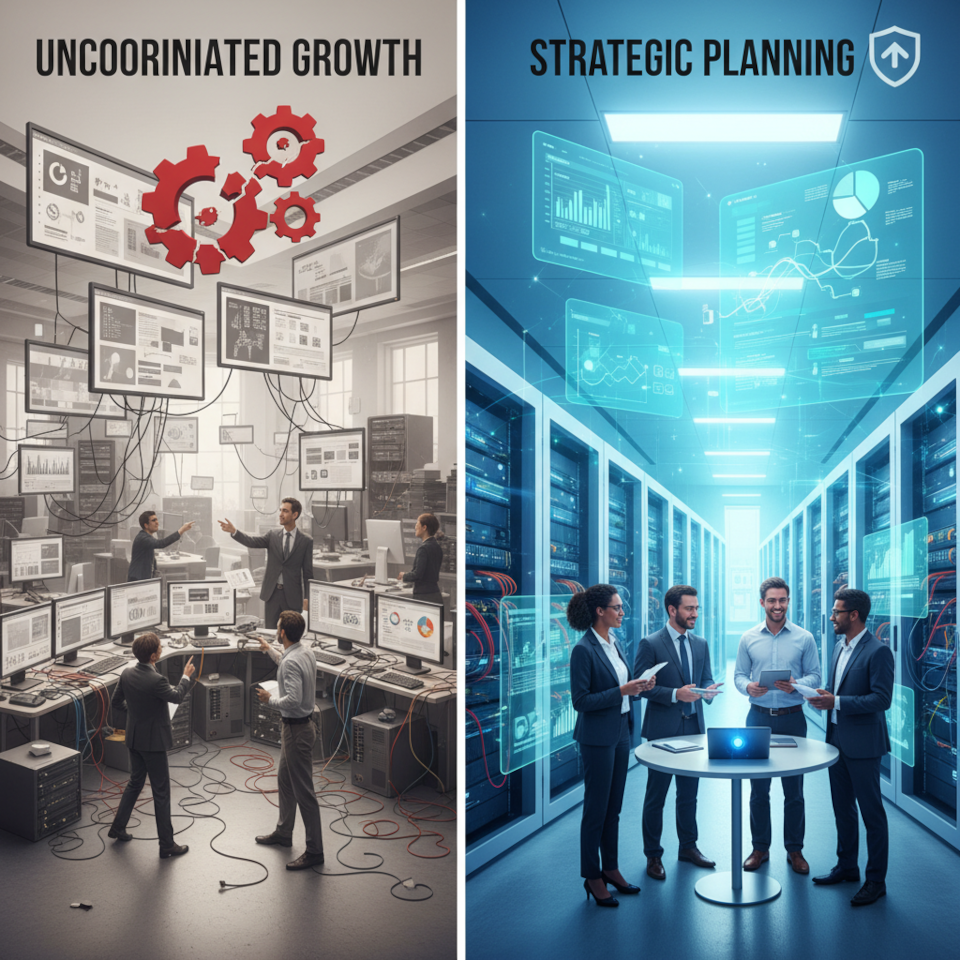
In such circumstances, operational IT maintenance is no longer sufficient. Systems may work today, but the question is different—will they be suitable after a year or two? Strategic consultations help shift from reactive responses to manageable planning.
They are particularly critical when a company relies on digital processes, and decisions about technology have previously been made by various suppliers without unified accountability. In such models, fragmentation often arises: one platform does not align with another, backup procedures are untested, access rights have accumulated chaotically, and no one sees the full picture.
What a company gains from such a service
A good consultation process does not start with ready answers. It begins with questions about the business model, critical operational processes, risks, growth plans, and levels of responsibility. Only then does it make sense to talk about the choice of technology or the sequence of investments.
Typically, the result is clarity at four levels. The first is an assessment of the current situation—what works, what poses risks, where there are dependencies on a single person or supplier. The second is prioritization—what needs to be addressed immediately, what can be planned gradually, and what can be deferred altogether. The third is a roadmap with timelines, responsibilities, and estimated investments. The fourth is a governance model—how management will subsequently monitor execution and make decisions.
This last point is often undervalued. Companies do not just need a plan. They also need the discipline to keep it current, align it with the budget, and integrate it with daily operations. Otherwise, the strategy remains in a folder.
In the IT context, strategic planning consultations mean more than just choosing technology
Many leaders initially assume that consultations will be a discussion about software, servers, or cloud solutions. That is just one layer. In fact, it concerns the company’s ability to operate seamlessly, recover from incidents, and make decisions that do not create additional risks in the future.
For example, if a company plans to move part of its systems to the cloud, the question of “which service is better” is not enough. Data classification, access policy, integration with existing systems, backup logic, cost model, and what happens in the event of a failure must all be evaluated. Without a strategic perspective, a cloud project can become more expensive and complex than initially planned.
The same applies to cybersecurity. Individual tools do not create a security strategy. If priorities, responsibilities, and recovery order are not defined, even a good technical solution may not provide sufficient protection. That is why strategic consultations often cover backup solutions, disaster recovery plans, audits, supplier management, and compliance requirements.
How to distinguish valuable consultations from formal strategy
Not all strategic planning consultations are equally useful. Sometimes the company receives a quality presentation but does not gain practical direction. The main difference is in feasibility.
Valuable consultations are based on data, real situational analysis, and business priorities. They not only name objectives but also compromises. For example, greater resilience usually means higher costs. Faster implementation can increase the risk involved in deployment. Full standardization improves governance but can sometimes reduce flexibility for specific teams. A good consultant does not hide these compromises.
It is also important that recommendations are not detached from the company's capacity. If the organization does not have internal resources for managing complex projects, then the strategy must anticipate external support or gradual implementation. Otherwise, the plan may be theoretically correct but unfeasible in practice.
Who benefits the most from such a service
The greatest value from strategic planning consultations is usually provided to companies that have already outgrown improvised IT management but are not yet ready to establish a full-fledged internal technology management team. This is typical for companies in manufacturing, logistics, professional services, wholesale, and other sectors where technology is critical but not the core business.
This service is also particularly useful during times of change. If a company is changing its ERP system, merging several divisions, implementing a hybrid work model, or preparing for an investment, it needs not just technicians but also someone who sees the big picture. This is where an external IT partner with strategic competence can fill the gap between daily support and management-level decisions.
KSK IT operates in such a model as a partner that combines practical infrastructure management with management-level insights into continuity, risk, and development priorities.
How cooperation usually works
Although the approach depends on the size and industry of the company, the process usually begins with assessing the current environment and business goals. This may include interviews with management, IT environment audits, risk assessments, contract and supplier reviews, and identifying critical processes.
Subsequently, conclusions and recommendations are formulated. Prioritization is important here since it rarely makes sense for the company to tackle everything at once. In some cases, the first step will be organizing backup solutions and access control. In others, it may be standardizing infrastructure or clarifying cloud service management. In a good consultation process, recommendations are linked to budgets, timelines, and business impact.
This may be followed by implementation oversight or external IT management functionality. This is crucial because a strategy without execution control quickly loses its value. It is advantageous for the company if one partner can not only define the direction but also ensure that it is implemented in a disciplined manner.
How much strategy does a company really need
There is no single formula. Some companies may suffice with a concentrated assessment and a 12-month action plan. Others require a long-term technology roadmap, regular reviews, and involvement at the external CIO level. This depends on the pace of growth, regulatory environment, supplier complexity, and how critical IT access is for daily operations.
The most important thing is not to create the possibly most comprehensive strategy. The most important thing is to obtain a decision framework that helps the company not to get stuck on each subsequent choice. If there is a clear direction, priorities, and accountability, then technology starts to serve the business, not the other way around.
A good moment to start is not when everything is already burning. A good moment is when management realizes that future decisions will be too costly to make without a clear plan.
