
AUTHORIZATION
Blog

7 critical IT risks in companies and how to manage them
The server can run flawlessly until the moment it no longer works. That is exactly when it becomes clear whether the company has managed IT or merely responded to day-to-day requests. These 7 critical IT risks in companies rarely start with one big mistake. More often, they arise from delayed updates, untested backups, unclear responsibilities, and decisions made without a full picture of the infrastructure.
For small and medium-sized businesses, the risk is not only a technical incident. It means halted sales, unavailable accounting, delayed production, loss of customer trust, and unplanned costs. Below are seven areas where management should ask not “is everything working?” but “what will happen if it stops working?”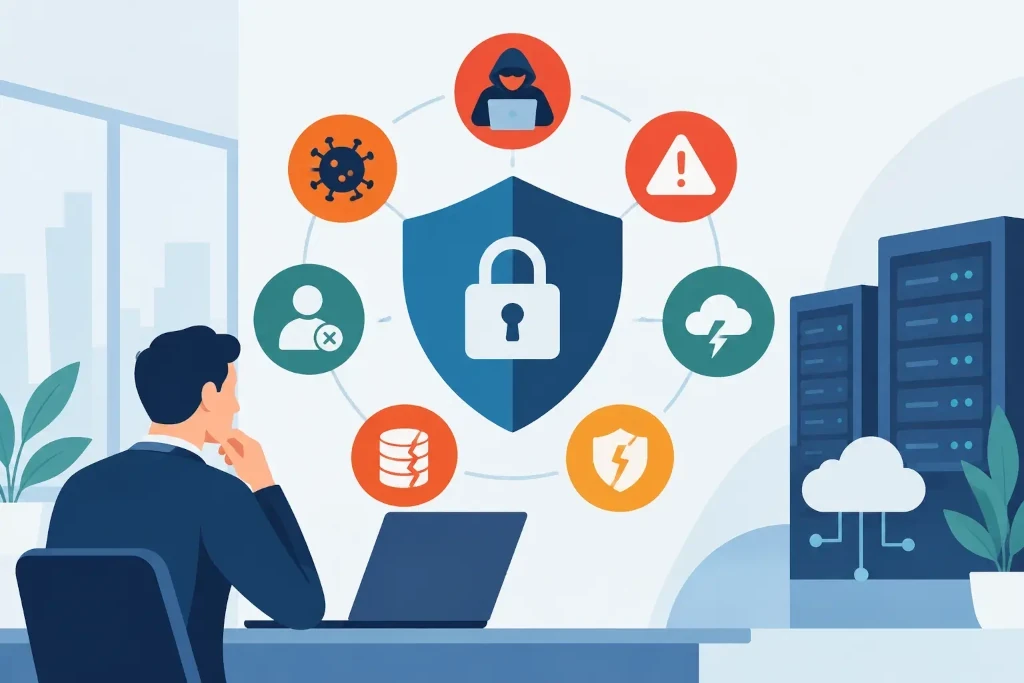
7 critical IT risks in companies
1. Cybersecurity incidents and ransomware
Ransomware, account takeovers, and fraudulent emails are not a risk only for large corporations. Attackers often target companies with smaller internal IT teams because they are more likely to have outdated systems, weak password policies, or insufficient access control.
The most dangerous scenario is not just encrypted files. An attacker can obtain customer data, financial information, or access to email and use it for fraud against the company’s partners. Even after systems are restored, contract, reputation, and data protection issues may follow.
Risk reduction starts with multi-factor authentication, regular vulnerability patching, and clearly separated user permissions. Employee training is also essential, but one seminar a year is not enough. Human error cannot be fully eliminated, so the technical environment must be able to limit the consequences of mistakes.
2. Backups that cannot be restored
Many companies create backups, but not all check whether the most important systems can actually be restored from them. This difference is crucial. A backup that is on the same network and accessible to an attacker can be encrypted together with production data. Meanwhile, an incomplete backup may not restore the accounting system, file structure, or a specific database.
An effective approach should define which data is critical, how often it must be backed up, and how quickly it must be restored. For one company, restoration by the next business day is enough; for another, even two hours of downtime causes significant losses. These indicators are determined by business priorities, not just by the IT budget.
Proper backup management includes a separate copy outside the primary environment, access protection, and regular restore tests. The test result should be documented: how long the process took, what failed, and what needs improvement.
3. A single critical person or supplier
If only one employee knows the administrator passwords, network architecture, or business system configuration, the company has a business continuity risk. The same applies to an external supplier who has all the information, but the company lacks clear documentation, access management, and a handover process.
The problem usually becomes apparent during an employee’s absence, dismissal, a supplier change, or an urgent incident. Then the responsible people have to try to recover accounts, licenses, and configurations while the company’s operations are already disrupted.
Management must ensure that important access is under the company’s control, not in a personal email account or an individual password vault. Infrastructure documentation, license tracking, administrator access, and contact lists are basic control elements. An outsourcing model can be an advantage here if the service provider ensures transparent documentation and a defined division of responsibilities.
4. Outdated infrastructure and unupdated software
An outdated server or firewall does not always create an immediate problem. But it may not receive security updates, be difficult to replace, or be unable to support newer business systems. As a result, the company pays for maintenance while at the same time accumulating technical debt and security risk.
Software updates also require balance. Uncontrolled automatic updating can affect the operation of specialized applications, while prolonged failure to update leaves known vulnerabilities in place. The right approach is a managed update process with testing, priorities, and a clear change plan.
Regular infrastructure audits help distinguish equipment that is still economically justified to maintain from solutions that should be planned for replacement. This allows investments to be made predictably, rather than after a breakdown and at a higher cost.
5. Uncontrolled use of cloud services
The cloud can reduce initial costs and make work from different locations easier, but that does not mean security is fully transferred to the service provider. The company remains responsible for user access, data classification, settings, and compliance with its obligations.
A common risk is the so-called shadow IT environment: employees store files in personal accounts, use unapproved file-sharing platforms, or connect business data to external tools without assessment. This behavior usually starts with a desire to work faster, but later makes data control and incident investigation more difficult.
Cloud environment management requires a clear policy on approved tools, access levels, and data storage location. A hybrid infrastructure may be suitable for companies with specific performance, regulatory, or integration requirements, but it needs centralized oversight. Otherwise, the risk is simply moved from the server room to the administration panel.
6. An untested business continuity plan
A business continuity plan is not a document that should be created only because of a client audit or insurer requirements. Its purpose is to help make decisions when time is short: who notifies employees, how priority systems are restored, how the company continues serving customers, and who approves emergency expenses.
Each company’s plan looks different. For a trading company, the availability of payment and warehouse systems may be critical. For a professional services company, customer files, email, and remote access matter most. In manufacturing, the control systems for equipment and the supply chain must also be considered.
The plan must be based on real scenarios: a cybersecurity incident, loss of internet connection, power outage, server failure, or office inaccessibility. More importantly, it must be tested. A tabletop exercise with management and IT responsible parties often reveals ambiguities that are not visible in the document.
7. Lack of IT governance at management level
The final risk is often the cause of all the others. If IT is viewed only as a cost item or help desk, timely decisions are not made about security, infrastructure development, suppliers, and budget. As a result, the company reacts after an incident rather than managing the risk before it occurs.
IT governance does not mean the board must delve into firewall configuration. It means regularly receiving clear information about the most significant risks, investment priorities, restoration readiness, and responsible persons. Management needs to understand which systems generate revenue, which contracts create dependence on a single supplier, and what the acceptable downtime limits are.
For companies without a full internal IT management level, this function can be provided by an external IT director or a strategic partner. The KSK IT approach in such a situation combines operational support with transparent management-level control, so that technical decisions are linked to the company’s business goals.
Where to start with risk control
There is no need to rebuild the entire infrastructure at once. First, a clear picture of the current situation should be created: which systems are critical, where data is stored, who has administrator access, whether backups have been tested, and what happens in the first 24 hours after an incident. Such an audit usually reveals quickly fixable shortcomings and helps justify larger investments.
A good next step is a risk priority list with responsible parties, deadlines, and business impact. If management regularly reviews this list, IT becomes a controllable business function rather than an unpredictable source of emergency costs.
