AUTHORIZATION
Blog

Zero Trust trends in companies in 2026
An employee connects to the financial system from a home computer, a supplier gets access to a shared document environment, and a manager approves a payment on a phone. These everyday scenarios show why Zero Trust trends in companies are no longer just a security topic for large corporations. Access to company resources no longer happens within a single protected office network, so the traditional approach - trusting everything inside the internal network - is not enough.
Zero Trust is not a single product or firewall. It is a governance approach in which every access request is checked, the user is given only the rights needed for the job, and security decisions are made based on context. For a small or medium-sized company, this means not an endless introduction of new tools, but clear control over identities, devices, data and critical business processes.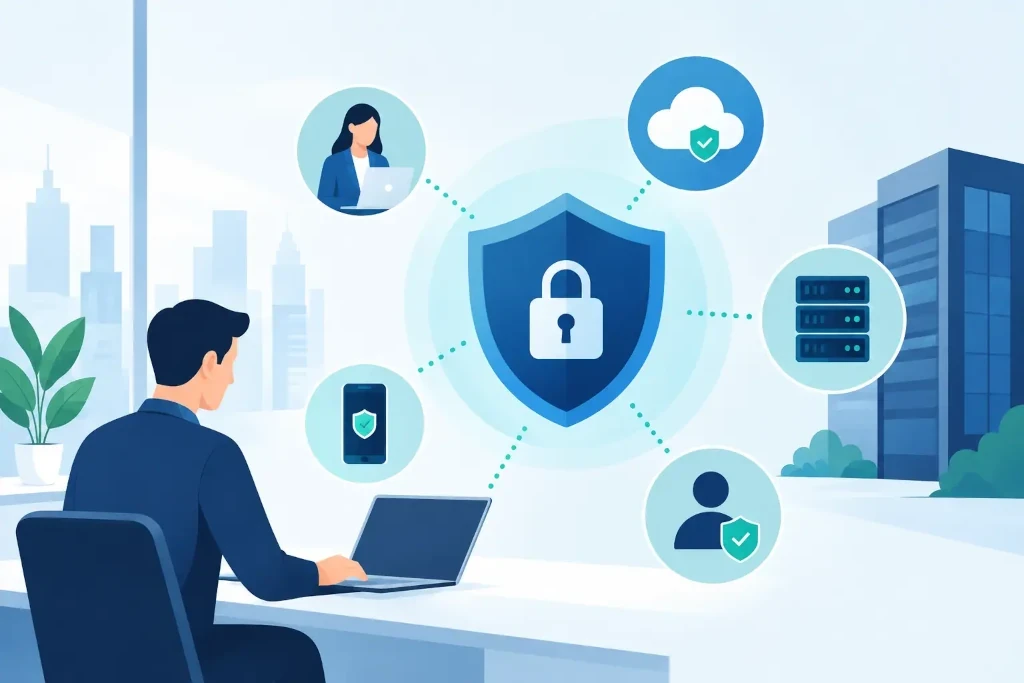
Why Zero Trust trends are accelerating in companies
In recent years, the attack surface has expanded significantly. Cloud services, remote work, outsourcing providers and mobile devices have given business flexibility, but at the same time created more entry points. An attacker no longer necessarily has to break into the company server room. Often a stolen password, a fraudulent email or an insufficiently protected supplier account is enough.
Traditional network protection was usually based on the perimeter: if the user was connected to the company network, they were considered relatively trustworthy. Zero Trust takes the opposite stance - no connection is automatically trusted just because of where it is located. The system evaluates who is requesting access, from which device, to which resource, at what time, and whether the specific action matches the normal usage pattern.
These changes also affect company management. A security incident is no longer just an IT department issue. It can stop invoice processing, prevent access to customer data, delay production, or create an obligation to explain what happened to partners and regulators. Zero Trust helps reduce the impact of such incidents by limiting the attacker’s ability to move through the environment after initial access has been gained.
Identity becomes the main security boundary
One of the most visible trends is the shift from the password as the main protection measure to multi-factor authentication, conditional access and centralized identity management. A password on its own is a weak control, especially when it is reused across multiple systems or obtained in a phishing attack.
Multi-factor authentication significantly reduces risk, but there are nuances to its implementation as well. A simple approval notification on a phone may be insufficient if the user is prompted to approve it repeatedly. Higher-risk accounts, such as financial, administrative and management users, increasingly require more phishing-resistant methods, such as security keys or device-based authentication.
An important principle is granting the minimum necessary rights. An accountant does not need full access to the HR system, and an external consultant does not need a permanent administrator account. Rights should be specific, transparent, and, if possible, granted for a limited period. This reduces both error and the possibility of abuse.
Device status determines what may be accessed
In a Zero Trust approach, it is not enough to know which user is connecting. It is also necessary to know whether the device is managed, encrypted, updated and protected against malware. An employee’s identity may be valid, but access from an outdated or compromised computer still creates unacceptable risk.
In practice, this means device management policies: mandatory security updates, disk encryption, screen locking, centrally managed anti-threat protection and the ability to remotely remove company data from a lost device. Use of personal devices may be allowed, but it requires different access rights than a fully managed company computer.
Proportionality must be considered here. In a small office, there is no need to copy the control model of an international bank if it paralyzes work. However, for critical systems - financial platforms, customer data environments, administration tools and backup management - the requirements should be stricter than for access to general information.
From network access to access to specific applications
Many companies still use VPN as the main remote access solution. A VPN is not automatically insecure, but it often gives the user broad access to the internal network. If an account or device is compromised, the attacker can try to reach other systems as well.
A more modern model grants access to a specific application or resource rather than to the entire network. For example, a warehouse manager can safely use the warehouse system without gaining access to server administration. Such segmentation reduces possible losses and at the same time makes access review easier.
Network segmentation is especially relevant in companies with production equipment, warehouse terminals, guest Wi-Fi and legacy systems. These environments cannot always be modernized quickly, so they must be separated from office workstations and critical data. Zero Trust here is not a requirement to replace everything at once. It is the discipline of clearly defining which systems may communicate with each other and under what conditions.
Data protection and backups become interconnected
Access control alone does not protect a company if sensitive data is downloaded, transferred or stored in the wrong place without control. That is why data classification is becoming increasingly important: you need to know which files contain customer information, financial data, contracts, trade secrets or personal data.
Once the value of the data is understood, appropriate controls can be defined. These may include sharing restrictions, encryption, access logs and alerts about unusual file movement. However, overly aggressive restrictions create the risk that employees will start using unapproved tools. Therefore, security policy should be developed together with process owners, not separately from real work.
Backup protection is closely linked to Zero Trust. In ransomware attacks, backups are often targeted as well, so that recovery becomes impossible. Administrative access to backups should be separated from everyday user accounts, separate authentication mechanisms should be used, and the recovery process should be tested regularly. A backup that cannot be restored within a specified time is not a guarantee of business continuity.
How to start without an excessive project scope
Successful implementation usually starts with risk priorities rather than with buying technology. First, critical systems, administrative accounts, sensitive data and suppliers with remote access should be identified. Then an implementation roadmap can be created that reduces the biggest risks without disrupting core operations.
A practical starting sequence often includes four steps:
- centralize user accounts and implement multi-factor authentication for everyone, especially administrators;
- review access rights, remove inactive accounts and limit shared administrator accounts;
- implement device management and define the minimum security state for access;
- separate critical systems, protect backups and regularly test restoration.
After this foundation is in place, the company can expand conditional access, data protection controls and security monitoring. It is important to define responsibilities: who approves access, who reviews exceptions, who responds to alerts, and how quickly accounts are disabled when an employee or supplier ends cooperation.
In KSK IT practice, it is useful to tie such an approach to the IT audit, continuity requirements and the company’s growth plans. If a new branch is opened, a cloud system is introduced or an acquisition is being prepared, access management should be assessed already at the start of the project. Cleanup performed after an incident usually costs more and creates a greater risk of operational disruption.
Security that supports work
The maturity of Zero Trust is not measured by the number of tools implemented. It is shown by the ability to grant access securely, quickly notice deviations and restore work without hesitation if an incident occurs. A company does not need to implement everything in one day, but it must know where its most valuable data currently is, who has access to it, and what would happen if one user account were compromised.
A good next step is to turn this question into a management decision: assess critical access, define acceptable risk and create an actionable plan for the next 90 days. In this way, security becomes a controlled element of company operations rather than an urgent reaction after an unpleasant surprise.
