
AUTHORIZATION
Blog
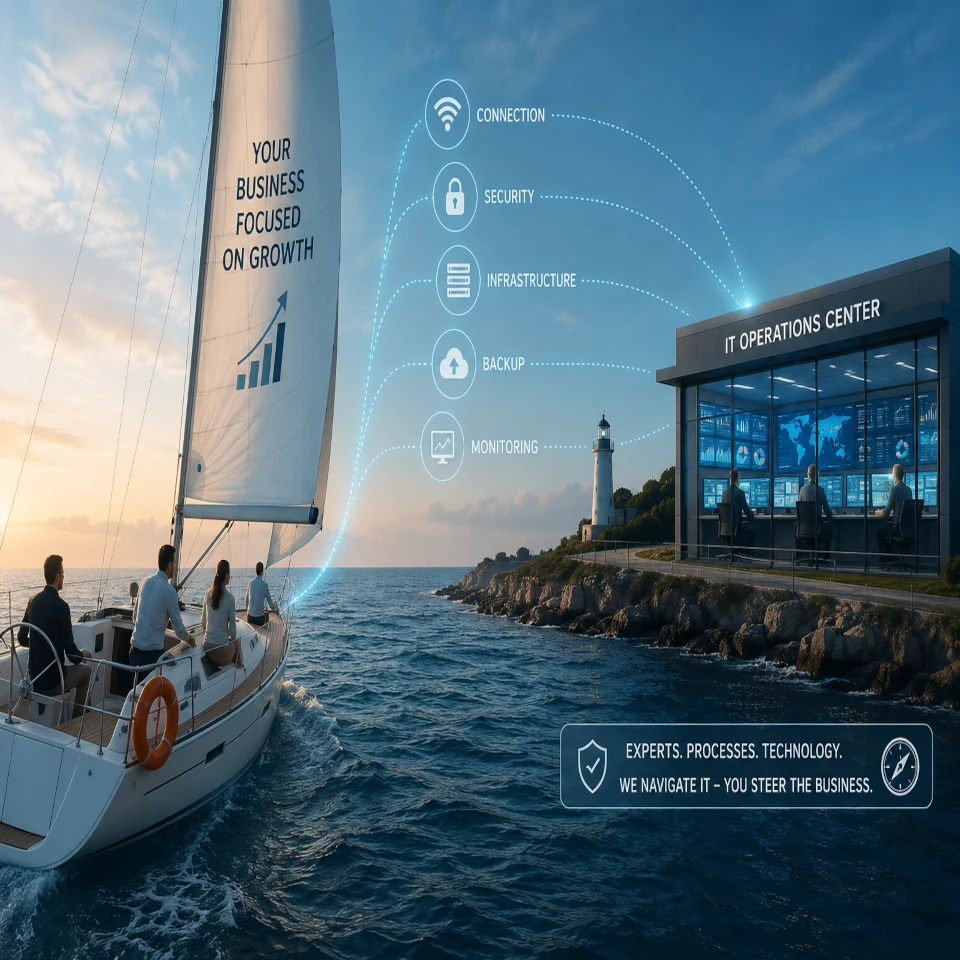
IT outsourcing without an internal IT team
When email is not working, access to customer data is blocked, or an employee cannot log into the system, the company does not have time to look for a separate specialist. The problem must be resolved quickly, with clear accountability and without risk to business continuity. IT outsourcing without an internal IT team makes it possible to receive day-to-day technical support, security oversight, and strategic management without maintaining a full-time IT department.
In a small or medium-sized business, IT often starts with a few computers, cloud service subscriptions, and an external accounting system. As the number of employees, customers, and data grows, this model becomes vulnerable. One person rarely has time to simultaneously handle user requests, manage access rights, check backups, monitor security updates, and plan infrastructure development.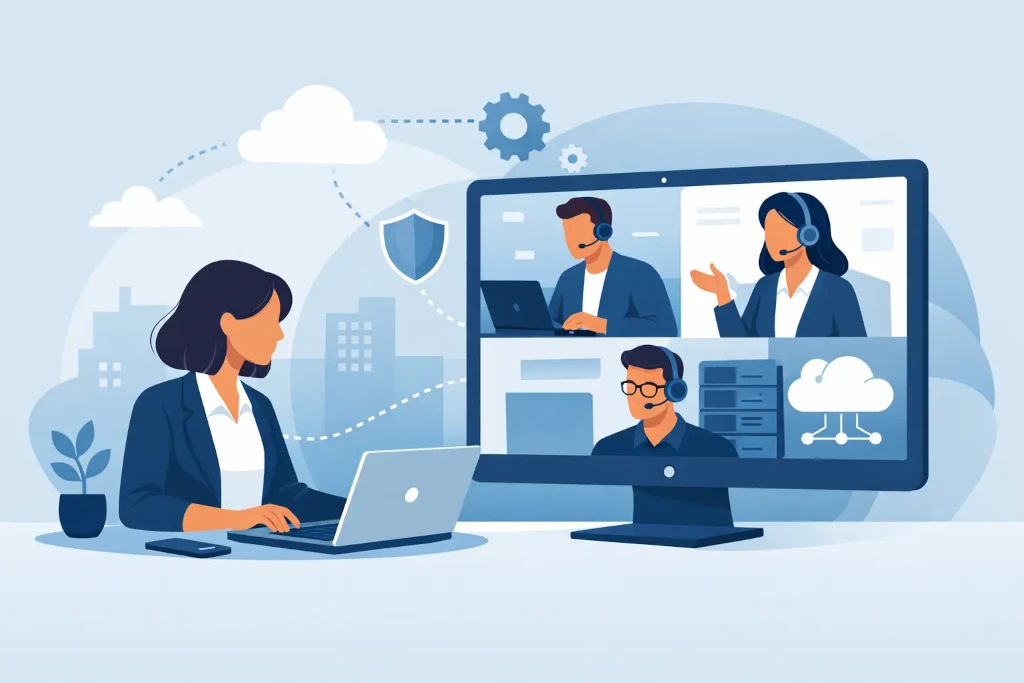
When outsourcing is a sound business decision
Outsourcing is not just a way to reduce costs. It is an opportunity to define responsibility for the IT environment and obtain expertise in exactly the amount the company needs. A full-time IT specialist can be the right solution in a company with a complex, large infrastructure and a continuous internal flow of technical work. However, in many companies, the competence of one specialist would still not be sufficient - they cannot know networks, cloud environments, cybersecurity, backups, user support, and IT governance equally deeply.
In a managed IT services team, these competencies are available as needed. The company gets one partner and a defined service model, rather than separate performers for each problem. This is especially important for managers who need predictable IT governance rather than constant reaction to urgent incidents.
In comparing costs, salary is not the only factor to consider. An internal IT function also has recruitment, replacement, training, licensing, workspace, and competency-maintenance costs. A service subscription usually makes it possible to plan the budget while avoiding a situation where a critical company system depends on the availability of one employee.
IT outsourcing without an internal IT team in everyday operations
A good outsourcing model starts not with a list of technologies but with the company’s way of working. How many employees work in the office, how many remotely? Which systems are critical for customer service, production, or financial processes? What data is processed, and how long can the company operate without it? The answers determine the scope of support, response priorities, and security requirements.
On a day-to-day basis, the service usually covers user support, computer and server management, network monitoring, software updates, access rights, and incident resolution. Employees need to know where to report a problem. Management, in turn, needs to know who is responsible for fixing it, what the response time is, and how recurrence is prevented.
An important distinction is between simple technical help and a managed environment. If the service provider only reacts to requests, the company is still living in incident mode. In a managed approach, risks are monitored, along with update status, device health, access rights, and backup results, so that some problems can be prevented before they affect work.
Clear boundaries prevent unexpected expenses
Before cooperation begins, it should be agreed what is included in monthly support and what is a separate project. Day-to-day user support, monitoring, and regular maintenance are usually subscription services. Opening a new branch, migrating servers, redesigning a network, or evaluating the IT aspects of an acquisition requires a separate plan, deadlines, and budget.
This division is not bureaucracy. It protects both parties from wrong expectations and allows management to approve in time the changes that affect costs or operational risk.
Security and backups are not optional add-ons
Companies often assume that a cloud service automatically solves all security and data recovery issues. In practice, service availability is not the same as recoverability of company data. Accidentally deleted files, compromised user accounts, incorrectly assigned permissions, and ransomware can cause damage even if the core platform works flawlessly.
A managed IT partner should be able to establish a clear security foundation: multi-factor authentication, controlled administrator rights, regular updates, secure device configuration, and an incident escalation procedure. The choice of solutions depends on the risk level, regulations, and the company’s operational specifics. But the principle is the same - security cannot rely on the assumption that employees will always notice a phishing email or never use one password across multiple systems.
Backups must not only be created but also tested. Management should get answers to three practical questions: which data is backed up, how often it is backed up, and how quickly it can be restored. If there are no concrete answers to these questions, the company’s business continuity is not sufficiently controlled.
Strategic IT management without a full-time CIO
Technical support ensures that work continues today. Strategic IT management helps prevent expensive decisions that create problems tomorrow. A company without an internal IT team often lacks someone who can assess technology risks, vendor offers, infrastructure investments, and development priorities at management level.
An external IT director or CIO service can provide this role flexibly. That does not mean regularly creating complex presentations. It means turning business plans into concrete IT decisions: how to open a new office securely, how to integrate an acquired company, how to move to a hybrid infrastructure, how to reduce the risk of legacy systems, and which investments are truly priorities.
Balance is crucial here. Not every company needs a broad digitalization program or an expensive infrastructure overhaul. Sometimes the greatest benefit is well-managed access rights, reliable backups, and a documented network environment. A competent partner does not sell technology for its own sake, but justifies decisions with operational risk, costs, and expected results.
How to choose an external IT partner
In the first conversation, it is not enough to ask how quickly the partner fixes computers. You need to assess whether they can take responsibility for the entire IT environment and communicate clearly with management. The partner should understand the company’s critical processes, be able to perform an initial audit, and identify risks before they become incidents.
Pay special attention to documentation and access management. The company must have controlled access to its domains, cloud accounts, licenses, backups, and configuration information. The relationship with the service provider may be long-term, but the company’s digital assets must not be ambiguously tied to a single vendor or an individual person’s account.
It is also worth clarifying the escalation process. What happens if there is a serious security incident? Who coordinates vendors, insurers, or legal requirements? How is management informed? These questions may seem theoretical until the company’s operations are disrupted. Then the pre-agreed procedure becomes a real advantage.
Transitioning to outsourcing without disrupting work
The transition does not have to happen in one day. The safest path is a structured initial assessment: identifying infrastructure, users, licenses, access rights, backups, and critical systems. Then priorities are set - for example, fixing dangerous access gaps, organizing backups, or replacing an outdated firewall.
The next step is a single support channel and clear communication with employees. Change succeeds when users understand whom to contact and what to expect. Management, in turn, should receive a regular, concise report on incidents, risks, completed work, and next priorities.
KSK IT’s approach is to combine operational support with management-level transparency so that a company does not have to choose between fast technical help and long-term IT control. In practice, this means that IT becomes a managed business function rather than a matter dealt with only when something stops working.
A company does not need a large internal IT department to make mature technology decisions. It needs a clear responsible partner, verifiable processes, and a plan that allows employees to continue working even when technology creates unexpected challenges.
