
AUTHORIZATION
Blog

7 signs that you need an IT audit
If IT issues in a company are only addressed when something has already stopped working, the costs usually become visible too late. That is exactly why the 7 signs that you need an IT audit are not a theoretical list - they are very practical situations in which a company begins to lose control over risk, costs, or continuity.
An IT audit is not intended only for large organizations or companies after an incident. For small and medium-sized businesses, it is often a way to understand in time where vulnerabilities arise, why the infrastructure is slowing growth, and where responsibility is unclear. A good audit is not limited to a technical inventory. It shows whether your IT environment supports business goals or quietly works against them.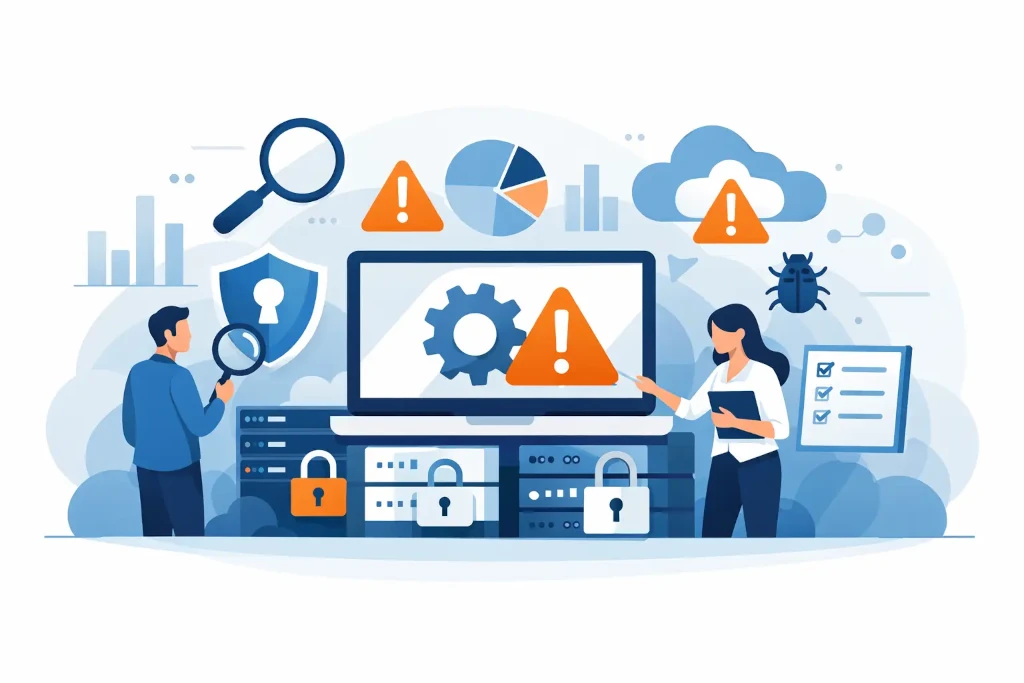
When the 7 signs that you need an IT audit become obvious
Signals do not look the same in every company. For one, it will be frequent system outages; for another - insecure access to data or unclear IT expenses. But one thing is common: it becomes difficult for management to make decisions because there is a lack of a clear picture of the current situation.
1. Downtime and technical disruptions start recurring
If employees regularly face slow servers, unavailable systems, unstable networks, or problems accessing files, this is not just an inconvenience. It is a direct impact on productivity, customer service, and revenue.
A single incident does not yet mean an audit is needed. However, if problems recur and solutions are only temporary, the root cause must be assessed. Often it lies in outdated infrastructure, misconfigured systems, insufficient monitoring, or unplanned growth. An audit helps determine whether the problem is in the technology, the processes, or the distribution of responsibilities.
2. There is no confidence in the level of cybersecurity
Many companies assume security is sufficient as long as no incident has occurred. That is a risky assumption. If it is not clearly known how access rights are managed, how secure endpoint devices are, whether backups actually work, and how critical events are monitored, the company is relying on luck.
An IT audit in this situation makes it possible to assess not only technical settings, but also management controls. Have former employees' access rights been closed? Is sensitive data being stored in an uncontrolled way? Have cloud services been implemented with governance principles rather than piecemeal? The more complex the environment, the greater the risk that problems are hidden in day-to-day operations.
3. IT costs are rising, but there is no clarity
Management does not need to know every technical detail, but it should be able to understand what the company is paying for and what it is getting in return. If the IT budget keeps growing but the result is not measurable, that is a signal to review the environment more broadly.
A common situation is fragmented services - one provider maintains the network, another the backups, a third the cloud solutions, while internally no one sees the full picture. As a result, duplication, unused licenses, inadequate service levels, and decisions made without a long-term plan emerge. An audit helps distinguish necessary investments from chaotic spending.
4. The company is growing, but the IT environment is not keeping up
If a new branch is opened, the number of employees grows, new systems are introduced, or the work model changes, the IT environment must become more structured. Solutions that worked for a team of 10 or 20 people are often no longer suitable for a company with several departments, remote access, and higher security requirements.
Here an audit is especially valuable because it helps assess scalability. Can the existing infrastructure support the next two or three years? Have critical dependency points formed around one person, one server, or one location? During a growth phase, technical compromises become expensive if they are not identified in time.
7 signs that you need an IT audit before changes
Sometimes an audit is needed not because everything is bad, but because decisions with major impact are approaching. In such moments, an independent assessment reduces the cost of mistakes.
5. There is no clear backup and recovery plan
Many companies believe that because backups exist, everything is fine. But the main question is not only whether backups are being made. The question is whether the data can be restored quickly enough and in full when it is truly needed.
If there is no documented recovery process, no tests have been performed, or no priority systems have been defined, then backups are more of an assumption than a safety mechanism. An audit helps assess recovery readiness in a real business context - how much downtime the company can afford and which systems are critical in the first hours after an incident.
6. Responsibility for IT is blurred
This is a common problem in companies that have grown rapidly. Some IT issues are with an external service provider, some with an internal administrator, some with the finance manager or operations manager. As long as everything works, such a model may seem acceptable. The moment an incident occurs, it becomes clear that there is no single person responsible for overall governance.
An IT audit here is not just a technical check. It helps understand where roles are, where processes are missing, and where decisions are being delayed because there is no clear governance structure. For companies that do not have a full internal IT department, this is especially important. Without clear responsibility, it is impossible to ensure either consistent security or predictable development.
7. Changes are planned - an investment, merger, migration, or new office
Before major changes, an audit is one of the most sensible preparation steps. If the company plans a move to the cloud, a new ERP implementation, the acquisition of another company, or an expansion of operations, it is necessary to understand the current state of the environment.
Otherwise, the new project starts on unstable foundations. For example, migrating to the cloud does not solve poor access management. Opening a new office does not remove the need for network segmentation and backup connections. And in a merger transaction, technical debt may turn out to be much more expensive than it initially seems. An audit helps make decisions based on data rather than assumptions.
What an IT audit gives management in practice
Managers do not need an audit in order to receive a long technical document. The value is in clarity. Where are the critical risks that must be addressed immediately? Which improvements can be planned in the next budget cycle? What is already working well and does not need to be changed just for the sake of change?
A good audit also helps set priorities. Not everything has to be solved at once, and this is exactly where a professional assessment is important. In some companies, the biggest risk will be insufficient security. In others - dependence on outdated infrastructure or a single external provider. Elsewhere, the problem will be lack of documentation and a weak disaster recovery plan. Without an audit, these issues are often mixed together, and as a result expensive but not always correct decisions are made.
In practical terms, an audit provides three things: visibility, priorities, and an action plan. This combination is essential for a company that wants not only to keep the IT environment running, but also to use it as a stable foundation for growth.
When not to wait for another incident
Some companies only reach the decision to conduct an IT audit after data loss, a cyber incident, or prolonged downtime. That is understandable, but expensive. It is much more beneficial to assess the signals earlier, while it is still possible to plan corrections in a controlled way and without haste.
If several of these signs appear in the company at the same time, an audit becomes a management tool rather than a technical formality. In such a situation, what matters is not only technical depth, but also the ability to translate conclusions into business language. That is exactly why many companies choose a partner who can combine infrastructure expertise with an operational and strategic perspective, as KSK IT does.
The strongest IT environment is not one in which there are never any problems. It is one in which risks are understood, responsibilities are clear, and the next step is not a guess, but a well-considered decision.
