
AUTHORIZATION
Blog
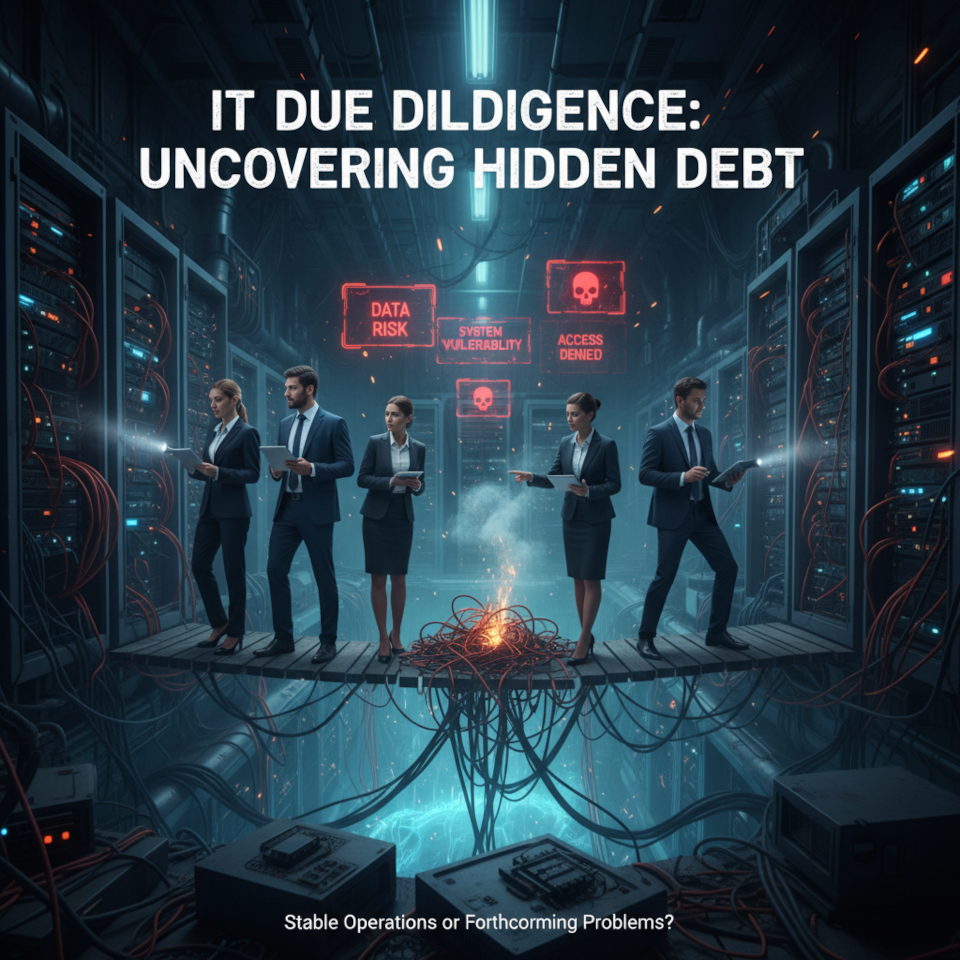
IT due diligence for acquisition: what to check
The purchase price rarely shows the full transaction cost. Especially when acquiring a company with outdated infrastructure, poorly managed system access, or unclear data security processes. This is why IT due diligence for acquisitions is not a technical formality, but a management tool that helps understand what the company is actually buying - a stable operating environment or a bundle of future problems.
While financial, legal, and tax issues are usually already on the agenda when assessing the acquisition, IT is often looked at too late. This is a risk. Modern business operations rely on systems, data, access management, vendors, and continuity. If these foundations are not verified, costs may arise after the transaction that were not included in either the pricing model or the integration plan.

What is IT due diligence for acquisitions
IT due diligence for acquisitions is a targeted examination of the technological environment of the target company before closing the deal. Its purpose is not only to compile a list of systems. The goal is to assess how secure, maintainable, scalable, and critical to business the existing IT environment is, what the main risks are, and what investments will be needed after the acquisition.
A well-executed examination gives management clear answers to three essential questions. First, does the company's IT environment support its current operations without hidden vulnerabilities? Second, how much will need to be invested to stabilize or integrate the environment? Third, are there risks that could impact the transaction's value, timelines, or even the utility of the transaction itself.
This is not only about servers or licenses. The examination also covers processes, distribution of responsibilities, dependencies on suppliers, cybersecurity, backups, disaster recovery, and whether the company can continue operations at all in the event of an incident.
Why this examination affects the transaction value
From a management perspective, the biggest mistake is assuming that IT issues can always be resolved after the acquisition. Some problems can indeed be solved. However, their costs can be so high that an initially attractive deal no longer looks so beneficial.
For example, a company may have a critical business system based on an outdated platform without support from the manufacturer. Formally, the system works, but any failure can lead to prolonged downtime. In another case, all access to infrastructure is concentrated at one external service provider or one employee, without documentation and without a clear handover procedure. Such dependencies become operational and commercial risks after the acquisition.
This is why IT evaluation is not just an audit. It directly influences negotiations over pricing, guarantees, transition periods, investment plans, and the sequencing of integration. Sometimes the conclusion is not that the deal should be halted. The conclusion may be that the terms of the deal need to be changed.
What is examined in the IT due diligence process
The depth of the examination depends on the size of the transaction, the industry, and the timeframe, but several areas are almost always critical.
Infrastructure and system architecture
First, attention is paid to what underlies the company's daily operations. This includes servers, cloud services, network solutions, end devices, business systems, and integrations among them. It is important not only to have an inventory but also to consider the condition - whether the environment is standardized, whether it is maintained, whether there is a lifecycle plan, and whether critical elements are not technically obsolete.
Particular attention should be paid to systems that are uniquely important to the company but whose maintenance relies on non-standard solutions. If the documentation is incomplete or the developer is no longer available, the risk increases significantly.
Cybersecurity and access control
At the moment of acquisition, it is crucial to understand whether the company can protect its data and operations. User access rights, account management, multi-factor authentication, patch management, endpoint protection, log file monitoring, and incident response processes are evaluated here.
In practice, simple yet dangerous issues often come to light - shared administrative accounts, access by former employees, unverified remote access, and systems without security updates. These are not minor flaws; they are direct business risks.
Data management, backups, and recovery
A company may seem well-organized until it comes time to recover operations after an incident. Therefore, it is essential to evaluate where the data is stored, how it is classified, how regularly backups occur, and whether the recovery process has been verified at all.
For many companies, backups theoretically exist, but there is no confidence that full functionality can be restored within an acceptable time. If the acquired company relies on customer data, transaction histories, or production systems, this issue becomes particularly sensitive.
Licenses, contracts, and supplier dependencies
Often, hidden costs arise not from technology but from obligations. Are all licenses used correct and transferable? Are cloud service agreements transparent? Are there long-term commitments to service providers that will not be easy to replace? Do support levels match business needs?
If critical services depend on one partner's knowledge without transfer documentation, the buyer effectively assumes the supplier's risk as well.
Compliance and process maturity
Not all transactions require the same compliance review, but in regulated sectors, it is essential. It is necessary to assess how the company handles data protection, access logging, security policies, audit trails, and internal control.
In a small company, processes may be informal, and this is not always critical. However, there is a limit beyond which informality begins to threaten operational continuity. This boundary must be identifiable.
Where misleading assumptions most often arise
One of the most common assumptions is the idea that the cloud automatically means an orderly IT environment. It does not. A company may utilize modern services while simultaneously suffering from uncontrolled access, license chaos, and unclear data responsibilities.
Another frequent assumption is that if there has not been a major incident, the environment is probably good enough. This is misleading. In many organizations, shortcomings only become visible under load, during staff changes, or upon integration with the buyer's systems.
The third assumption relates to integration. It is often thought that after the acquisition, everything can be quickly connected to the buyer's environment. In reality, integration can be expensive and slow if the data structure is disorganized, the systems are outdated, or the security policy differs significantly.
How management can use IT due diligence findings
The greatest value does not arise from the review itself but from how the findings are used in decision-making. If the review reveals critical risks, it does not mean the acquisition is automatically bad. It means the acquisition must be approached with a more precise financial and operational model.
For example, if significant infrastructure replacement is required in the first 12 months, these costs must be considered in the company's valuation. If security risks are high, it may be justified to request additional guarantees or set clear transition responsibilities for the seller. If dependence on a single IT partner is excessive, it is important to develop a takeover plan promptly.
Management finds value in not only the technical findings but also the priorities. What needs to be addressed immediately after the transaction, what can be solved within 90 days, and what can be included in a longer modernization program. This sequencing allows avoiding overpayment while not taking on unnecessary operational risk.
When an external partner is especially valuable
The internal IT team is not always the best resource for assessing acquisitions. Not because it lacks competence, but because due diligence requires a specific perspective - the ability to assess not only technical quality but also the transaction's impact on continuity, costs, and integration.
An external partner can work more independently, structure priorities more quickly, and help management translate technical risks into business decisions. This approach is particularly helpful for small and medium-sized organizations that do not have a full complement of internal architects, security, and infrastructure specialists. In such cases, a KSK IT-type approach - connecting operational technical evaluation with management-level clarity - yields practical results.
IT due diligence for acquisition does not have to be excessive
Not every transaction needs several months of review. Sometimes a focused assessment in critical areas is enough to uncover the most significant risks. It is important not to overdo it, but also not to overlook issues that could be costly after the transaction.
A good process is proportionate to the transaction's value, industry requirements, and the company's dependency on technologies. A manufacturing company with automation will have different focuses than a professional services firm primarily working in the cloud. However, in both cases, the goal is the same - to gain a clear picture of risks, investments, and takeover realities.
A wise buyer does not view IT as an appendix to the transaction. They consider it one of the fundamental factors that will determine how quickly the acquisition starts generating value and how many resources will be needed to sustain that value at all.
