
AUTHORIZATION
Blog

When should an audit be carried out for a company's IT infrastructure?
Companies rarely ask when to perform an audit when everything seems to be working. Yet it is precisely at such a time that an audit delivers the greatest value: it uncovers risks before they turn into downtime, data loss, or unplanned expenses. An IT audit is not just a technical inventory. For management, it is a tool for understanding whether the technology environment can reliably support the company’s day-to-day operations, growth, and change.
Too often, an audit is postponed until an incident occurs, employees cannot access systems, or it becomes clear that critical data cannot be restored. In such a situation, the company is no longer making calm, well-founded decisions - it is reacting under time pressure. A timely audit makes it possible to set priorities, budget, and responsibilities rather than deal with the consequences.
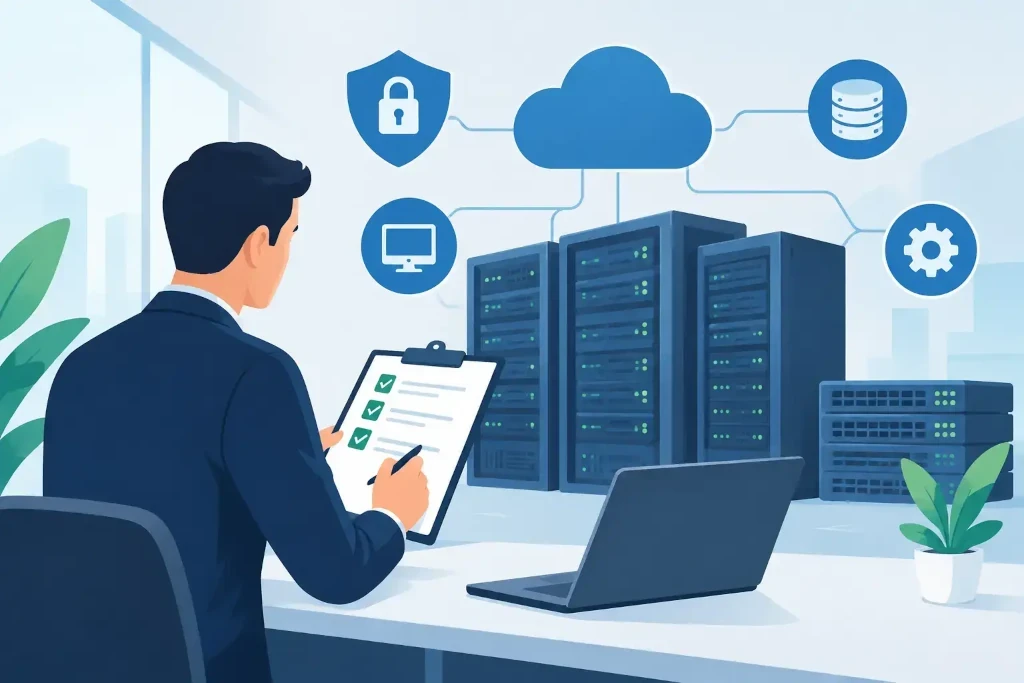
When to perform an audit: key company signals
There is no single universal date that suits everyone. Audit frequency depends on the company’s size, regulation, IT environment complexity, and the pace of change. However, there are several clear events after which an audit should not be postponed.
Before major business changes
If the company opens a new office, implements a new ERP or accounting system, moves to cloud services, or significantly expands the team, the IT infrastructure should be assessed before the changes are introduced. Otherwise, the new solution may be placed on top of an outdated, insufficiently protected, or poorly documented environment.
For example, a rapidly growing company may purchase more software licenses and add new users, but fail to assess access rights, network capacity, or backup volume. At first, this creates inconvenience. Later, it can lead to a security incident or an interruption at exactly the time when the company is most overloaded.
After an incident or repeated problems
One incident report does not always mean there is a structural problem. But recurring system failures, a slow network, inaccessible files, suspicious emails, or unsuccessful data recovery are signals that not a single symptom, but the entire environment should be evaluated.
After a cybersecurity incident, an audit helps determine how the attacker or error occurred, which accesses are unnecessary, and whether the existing protection measures truly work. Backup testing is also essential. A backup that the company has never practically restored is not a proven recovery capability.
Before acquiring, selling, or reorganizing the company
IT due diligence is an essential part of assessing transaction risk. The buyer wants to know whether the company’s systems are licensed, documented, and securely maintained, what agreements and obligations exist, and how much investment will be needed after the transaction.
On the seller’s side, an audit also provides an advantage. A clearly described infrastructure, transparent costs, verifiable security processes, and orderly access rights demonstrate that IT is not a hidden liability. This reduces uncertainty in negotiations and allows management to defend the company’s value with facts.
When changing IT partners or key employees
If IT maintenance has so far depended on one employee, an external specialist, or a small vendor, the transition period is a good time for an independent assessment. It should be known who owns the administrator accounts, where passwords are stored, how licenses are managed, and whether the documentation is sufficient for another team to continue the work.
This is not a matter of trust. It is an operational continuity requirement. The company must be able to manage its critical resources even if people, contracts, or vendors change.
Regular IT audits are not unnecessary formalities
For a company with a stable environment, it is usually useful to perform a comprehensive IT audit once a year. If sensitive data is processed, there are many remote users, multiple locations, or heightened compliance requirements, reviews may be needed more often. In between full audits, shorter targeted checks should be carried out - for example, of access rights, backups, vulnerabilities, or license status.
It is important to distinguish an audit from daily IT support. The support team handles user requests and keeps systems running. An audit asks a broader question: are the systems designed, managed, and funded in line with the company’s risks and goals? Both functions are necessary, but one does not replace the other.
Regular audits also reduce cost fluctuations. Instead of unexpectedly replacing a server, firewall, or critical software in emergency mode, the company can plan replacements and investments over a multi-year horizon.
What management should receive after the audit
A good audit does not end with a technical table that only IT specialists can understand. Management should receive a clear picture of the risks, their impact on the business, and the recommended sequence of actions. The report should help make decisions, not just list shortcomings.
A practically useful result includes an overview of infrastructure and systems, an assessment of cybersecurity and access management, backup and restoration readiness, license and vendor risks, as well as documentation quality. An important part is a prioritized action plan with a clear division: what must be done immediately, what should be scheduled for the coming months, and what can be addressed in the longer term.
Not every finding requires immediate investment. For example, outdated equipment may be an acceptable risk if it still has vendor support, a fallback solution, and a planned replacement. But that same equipment becomes a priority if it is the only point of operation for a critical system. The value of an audit lies precisely in this context - understanding which risks are theoretical and which can stop the company’s work.
How to prepare for an audit without excessive burden
Management does not need to compile every technical detail, but before the audit it is worth appointing a responsible contact person and agreeing on business priorities. The auditor should know which systems are critical for the company, how much downtime it can tolerate, where the most important data is stored, and what plans exist for the next 12 to 24 months.
Available documentation should be prepared: system lists, licenses, contracts, network diagrams, backup information, and existing security rules. If some materials are not available, that is also a significant audit finding. A lack of documentation often increases dependence on individual people and prolongs recovery during an incident.
The audit must be sufficiently independent so that the work of existing service providers can also be assessed objectively. At the same time, the auditor must be able to turn technical findings into real business decisions. KSK IT’s approach in such assessments is based not only on the state of the infrastructure, but also on its ability to ensure continuous operations, data protection, and predictable development.
Audit as a management control tool
The IT environment changes even when the company is not running major projects. Software versions, employees, accesses, threat types, and vendor terms change. That is why an audit is not a one-time project to be done only when problems arise. It is a regular control point that connects technology decisions with the company’s operational needs.
The best time to start is not after the next downtime. It is the moment when the company can still calmly choose priorities, define responsibility, and build an IT environment that supports the business even when conditions become difficult.
