
AUTHORIZATION
Blog

What is included in the IT infrastructure subscription?
At the moment when access to files stops in a company, email stops working, or some incident affects the servers, the question is no longer whether IT maintenance is needed. The question is much more specific - what is included in the IT infrastructure subscription and whether it is enough for the company to operate without unnecessary risk, downtime, and unplanned costs.
For many managers, an IT subscription initially seems like a simple support contract. In practice, it is usually a much broader service model: day-to-day maintenance, monitoring, security, backups, incident resolution, and, in the most important cases, strategic IT management as well. This is exactly where the difference forms between a service that only reacts to problems and one that helps prevent them.
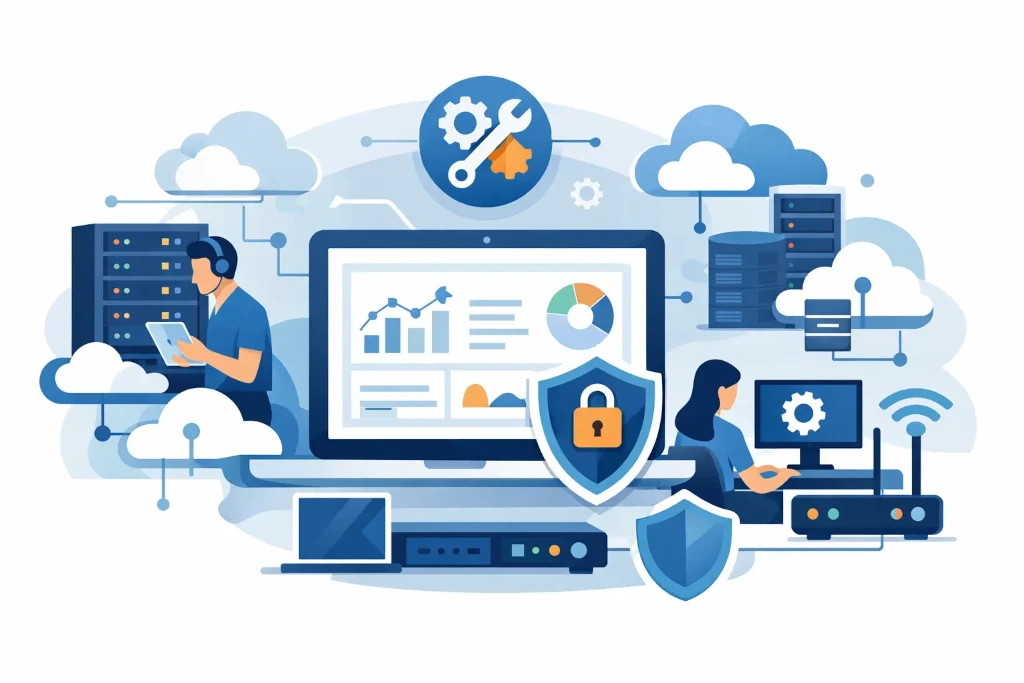
What is usually included in an IT infrastructure subscription
A typical IT infrastructure subscription covers the most essential components of a company's technology environment - workstations, servers, the network, user access, cloud services, and data protection. The goal is not only to keep systems turned on, but to ensure that they are managed, predictable, and aligned with the company's operational requirements.
At the core there is almost always monitoring. This means the IT environment is tracked proactively: server resources, disk health, network devices, service availability, error logs, and other performance indicators. If deviations occur, they can be noticed before users start complaining or a business process has already stopped.
The next layer is user and incident support. Employees need a place to report issues with computers, system access, printers, VPN, email, or business applications. In a quality subscription, such support is organized by priority, with clear response times and responsibilities.
The third element is maintenance. This includes operating system and software updates, security patches, antivirus management, user rights administration, and periodic checks. This brings a significant benefit - the company does not have to look for a separate solution every time for routine but critically important tasks.
Infrastructure management, not just a help desk
At the management level, it is important to understand that a good subscription is not limited to helpdesk functions. If the service covers only ticket handling, the company still lives in a reactive mode. That means failures are fixed after the fact rather than managed systematically.
In a full model, the IT infrastructure itself is managed. This applies to on-premises servers, virtualized environments, Microsoft 365 or other cloud services, firewalls, Wi-Fi solutions, data storage, and remote access solutions. The service provider not only fixes issues but also tracks configurations, risk areas, and capacity.
This is especially important for growing companies. The more users, devices, and systems there are, the more expensive improvisation becomes. In such cases, a subscription serves as a management framework rather than just technical support.
Security as an inseparable part of the subscription
When asking what is included in the IT infrastructure subscription, security is one of the first areas worth clarifying. Some providers understand security as only antivirus. In the context of business risk, that is usually not enough.
The security component often includes endpoint protection, implementation of multi-factor authentication, user access management, security updates, email protection, and basic network security policies. In some cases, incident analysis, log monitoring, and recommendations after an audit or risk assessment are also provided.
One important clarification here. Not every subscription automatically includes advanced cyber security management, compliance implementation, or 24/7 security operations. If a company operates in a regulated industry or processes sensitive data, the security component must be evaluated in much greater detail. A standard service may be enough for an office with moderate risk, but insufficient for an organization with high availability and compliance requirements.
Backup and recovery - where assumptions must not be made
Backups are often mentioned in all offers, but in practice their scope differs. In one subscription, only data copying may be included. In another - also recovery testing, retention policies, backup monitoring, and recovery scenarios after an incident.
It is not enough for a company to know that the backup is turned on. It must know exactly what is being backed up, how often, where the data is stored, how quickly it can be restored, and who takes responsibility if recovery fails. These are business continuity issues, not just a technical detail.
If the subscription also includes disaster recovery planning, then this is already a much more mature service. In such a model, recovery times, critical systems, priorities, and actions during an incident are assessed. For a small or medium-sized company, this is often a way to get an enterprise-level approach without a full internal IT department.
User support and everyday business continuity
From a business perspective, what matters is not only what is maintained, but also how users are supported. If an employee cannot log into the system or a manager does not have access to a presentation during a client meeting, a technically small incident becomes a real business loss.
That is why a subscription usually includes request intake, problem diagnosis, remote assistance, on-site support when needed, and preparation of new users or devices. Sometimes access provisioning, workplace standardization, and equipment inventory are also included.
Here again, the details matter. Some subscriptions cover unlimited remote support, but charge on-site work separately. Others include a certain number of hours per month. The cheapest option does not always mean the best one, because a lower monthly fee can mean higher costs exactly at the moment when help is needed urgently.
Does the subscription also include strategic IT management
This is the point that many companies begin to appreciate only after the first more complex decisions - office expansion, migration to the cloud, implementation of a new ERP system, or an increase in security requirements.
In part of the services, the IT infrastructure subscription includes not only operational maintenance but also consultative management. This can mean regular infrastructure reviews, investment planning, risk assessment, vendor coordination, and recommendations for architectural development. In effect, the company gains external IT management competence without the need to create a full-time management position.
It is precisely here that the subscription creates the greatest added value for companies that are growing or changing their operating model. Solving individual problems is necessary. But even more important is preventing a situation where the infrastructure becomes chaotic, expensive, and difficult to control.
What is often not included in the standard offer
To avoid misunderstandings, it is worth asking the opposite question as well - what is usually not included. A standard subscription often does not include new hardware purchases, large one-time migration projects, office relocations, the construction of complex cloud architectures, development of specialized business systems, or in-depth compliance audits.
Cybersecurity incident investigations, external forensics, full-scale disaster recovery tests, or M&A due diligence are also usually separate services. This is not a drawback if the boundaries are clearly defined. The problem begins when a company assumes that the subscription automatically covers any IT need.
That is why a good service provider precisely defines what is included in the monthly fee, what the response levels are, what is monitored, what is backed up, and which tasks are treated as projects outside the subscription.
How to assess whether the subscription is suitable for your company
In practice, the right question is not only about the list of services. The question is whether the subscription matches your operational risk. If one hour of downtime means missed orders, unserved customers, or reputational damage, then the service quality must be higher than that of an average office model.
When evaluating, four things should be considered: how quickly problems are noticed, how quickly they are resolved, how securely data is protected, and whether someone takes responsibility for the development of the IT environment. If the answer to the last question is unclear, the company is most likely receiving only part of what it actually needs.
Service providers such as KSK IT build this model around business continuity rather than just the execution of technical work. This is important because for management the most important thing is not the server model or firewall configuration, but the fact that systems are available, risks are controlled, and IT does not create unplanned interruptions for the business.
The best subscription is not the one with the most items. The best is the one in which the service content matches your infrastructure, risk level, and growth plans. If this clarity is achieved already at the start of the contract, IT becomes a stable support function rather than a constant source of uncertainty.
