
AUTHORIZATION
Blog

MSP or in-house IT - what suits your company?
If a company regularly faces the question of whether to hire another IT specialist or hand responsibility over to an external partner, the choice between MSP or internal IT is not just a staffing issue. It affects business continuity, cybersecurity, budget predictability, and management’s ability to make informed technology decisions.
In a small or medium-sized business, IT rarely means just installing computers. User access, cloud services, networks, backups, licenses, device security, and vendor management all need to be maintained. As the business grows, responsibility becomes broader, and mistakes become more expensive. That is why the right model is not the one that initially seems cheaper, but the one that provides the necessary expertise and control at the specific level of risk.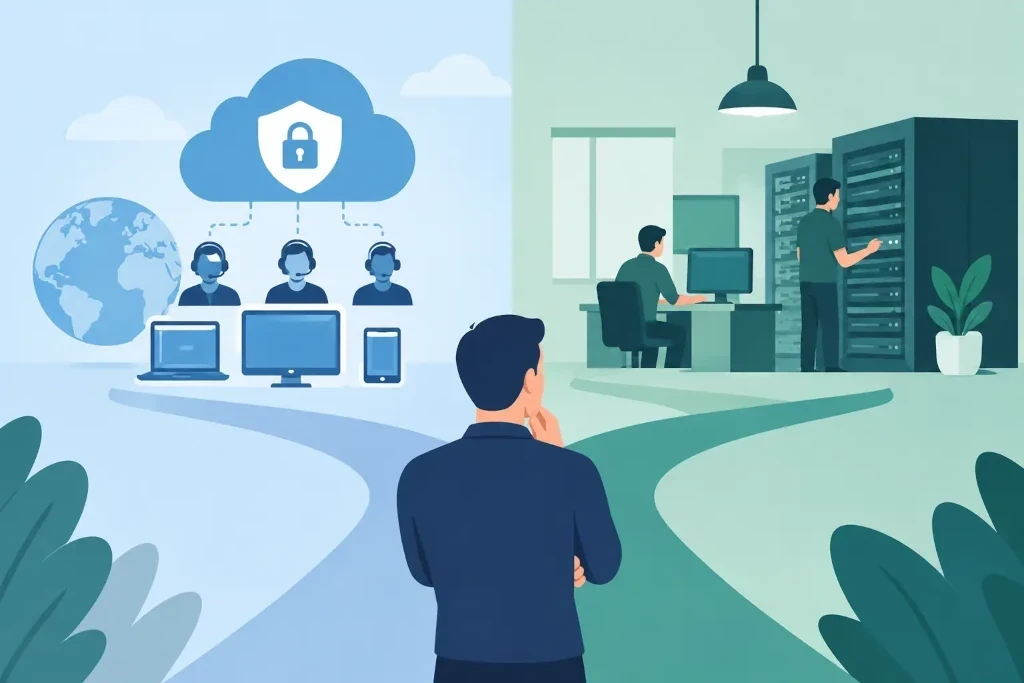
MSP or internal IT is not just a cost comparison
An in-house IT employee provides direct presence and becomes well acquainted with the company’s day-to-day operations. They understand how departments work, where the critical systems are located, and which processes generate the most incidents. For companies with complex manufacturing, many on-premises systems, or highly specialized software, this knowledge can be essential.
However, one person cannot simultaneously be a network architect, Microsoft 365 administrator, security specialist, data recovery expert, project manager, and strategic IT consultant. In addition, vacation, illness, or a job change can leave the company without available support at exactly the critical moment.
MSP, or a managed IT services provider, usually offers a team, processes, and monitoring tools for a fixed monthly fee. This does not mean that an external partner is automatically the better choice. The outcome depends on the scope of the contract, response times, service management, and the partner’s ability to understand business priorities. A help desk is not enough if the company does not have a clear backup policy, an incident escalation procedure, and a plan for the next two or three years.
Compare the full costs, not just the visible ones
The cost of internal IT is not just salary. It also includes employer costs, training, certifications, coverage during absences, management tools, possible external expert support, and the risk that a critical project is postponed due to a lack of competence. If one person maintains the entire environment, the company often still has to purchase separate services - security audits, firewall configuration, server migration, or disaster recovery.
In the MSP model, costs are more predictable because daily support, monitoring, and planned maintenance are combined into one service. But management should find out what is actually included. Is user support included in the price? Are backups reviewed? What happens outside business hours? Are larger projects, hardware, and licenses billed separately?
The lowest monthly fee does not always mean the lowest overall risk. A cheap contract that lacks clear monitoring, documentation, and accountability can become expensive after a ransomware attack or prolonged system downtime.
When internal IT is the right choice
An internal team is often useful when IT is an integral part of the company’s core operations. For example, a company may have its own software product, a large number of users across multiple shifts, a data center, manufacturing technology, or systems that require constant on-site administration.
In such a situation, an internal specialist or team can ensure fast decision-making and a deep understanding of business processes. But even then, it is not mandatory to build all competencies within the company. Security operations, cloud architecture, disaster recovery planning, and independent IT audits are often more effectively obtained as external, specialized resources.
Internal IT is especially justified if the company can sustain not just one universal specialist, but a team with divided responsibilities. This reduces dependence on a single person and makes it possible to document critical knowledge. If such capacity does not exist, the risk should be acknowledged rather than hoping that one employee can cover all needs long term.
When MSP delivers greater business value
MSP is suitable for a company that wants a professionally managed environment but does not want or cannot maintain a large IT department. This is especially relevant during a growth phase, after an acquisition, when opening a new branch, or during migration to cloud services. During these periods, the amount of change increases, while the cost of mistakes is higher than in routine maintenance.
A good managed services model combines daily support with preventive work. That means the partner does not only respond to tickets, but also monitors system health, implements updates, checks backups, maintains documentation, and points out outdated or insecure technologies in time.
For management, a key advantage is access to broader expertise without hiring several full-time specialists. One contract can provide infrastructure support, security recommendations, project execution, and strategic IT oversight. KSK IT structures such an approach as a management model in which technical day-to-day work is linked to business continuity and growth goals.
Assess availability, not just response time
Many contracts promise a response within a certain number of hours. That is important, but insufficient. A response means the incident has been accepted, not that the critical system is already running. The company should define which systems are priorities and how much downtime is acceptable for each.
Email disruptions, an unavailable accounting system, and a production line shutdown cannot be treated equally. Accordingly, an escalation procedure, responsible persons, and a regularly tested recovery process should be agreed upon. A backup that cannot be restored within the required time is not a full business continuity solution.
Questions to ask before making a decision
Before choosing a model, management should answer four questions together:
- How much downtime can the company afford for critical systems?
- What competencies are needed on a daily basis, and which ones only for specific projects or incidents?
- Is the current environment documented, monitored, and regularly checked from a security perspective?
- Who in the company owns responsibility for IT priorities, risks, and the investment plan?
The answers often reveal that the problem is not a choice between external and internal resources. The problem is unclear responsibility. If no one oversees licenses, access, backups, vendors, and aging infrastructure, then the model is not sufficiently managed regardless of who formally supports it.
A hybrid model is often the most practical solution
Companies with an internal IT specialist do not have to choose between complete outsourcing and complete self-sufficiency. In a hybrid model, the internal employee focuses on user needs, understanding business processes, and coordination, while the MSP provides monitoring, second- and third-level support, security expertise, and project resources.
This approach reduces dependence on one person while preserving on-site knowledge. It is also useful when a company wants to gradually modernize its infrastructure without stopping daily operations. The key is to clearly divide responsibilities: who administers access, who approves changes, who leads incidents, and who controls service quality.
The best decision starts not with the question of how many people are needed in the IT department, but with a clear understanding of the company’s risk, critical processes, and next development steps. If these foundations are defined, it is possible to choose a model that allows technology to support the business even when the company grows, changes, or faces an unexpected incident.
