
AUTHORIZATION
Blog
Hybrid infrastructure solutions for businesses
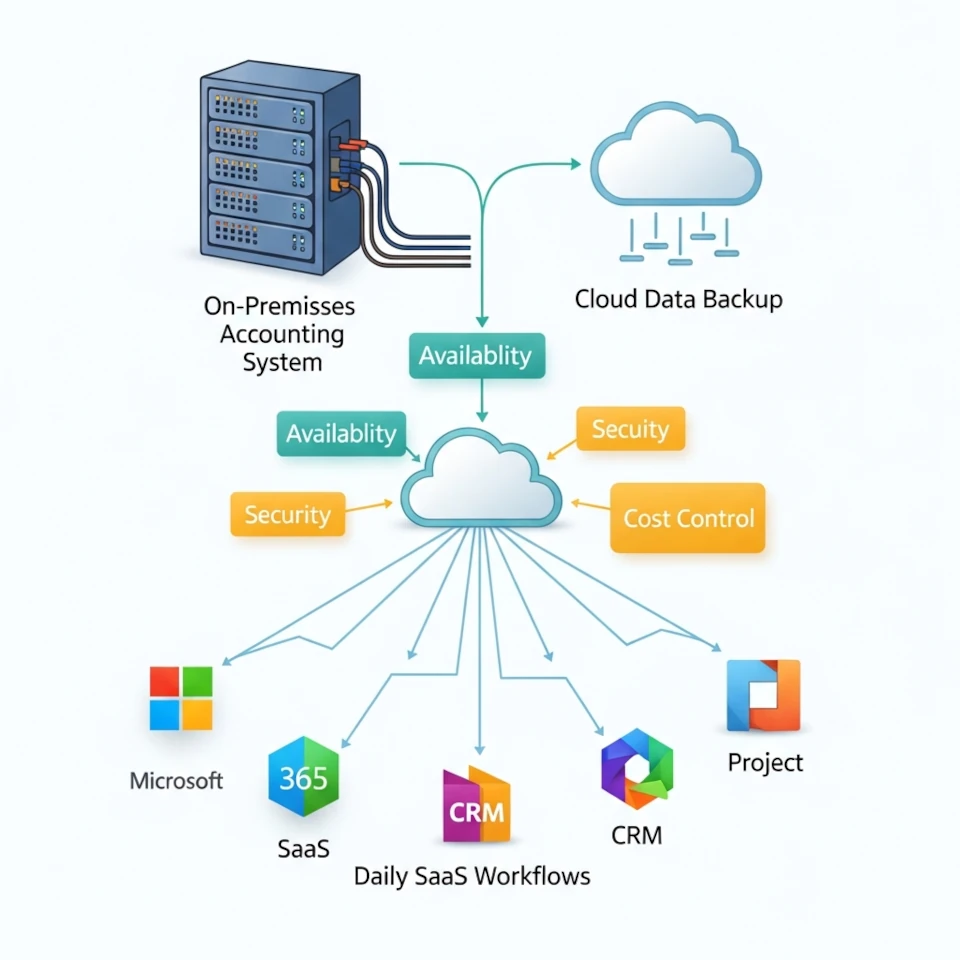
If a company has an accounting system locally, data is duplicated to the cloud, but employees work daily with Microsoft 365 or other SaaS platforms, it already lives in a hybrid model. Hybrid infrastructure solutions are not a theory or a buzzword - they are a very practical answer to the question of how to ensure availability, security, and cost control at the same time.
This question becomes particularly relevant for small and medium-sized enterprises when the IT environment is no longer a single server space or just one cloud service. Branches appear, remote work, stricter data protection requirements, as well as the need to restore operations after an incident without prolonged downtime. It is precisely here that the hybrid approach is often the most pragmatic path.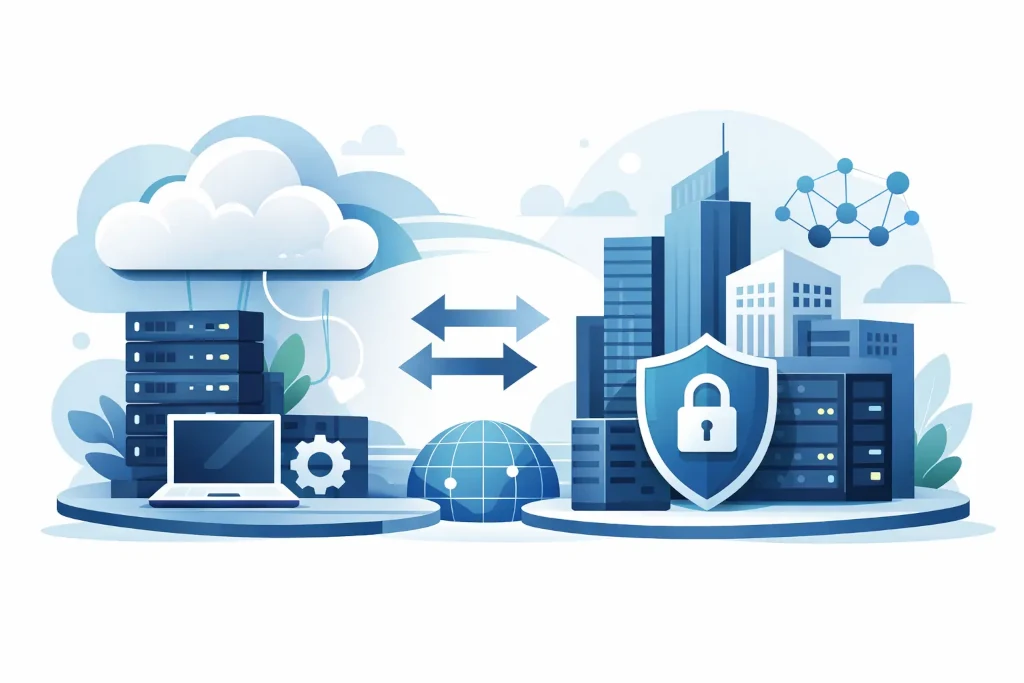
What hybrid infrastructure actually means for a company
Simply put, it is an environment where part of the IT resources reside in the company's local infrastructure, and part in the public or private cloud. However, at the management level, what is more important is not the technical division, but why such a combination is chosen.
Typically, systems that require low latency, specific integrations, licensing peculiarities, or elevated control requirements remain on-premises. Workloads enter the cloud where flexibility, rapid scalability, reserve capacity, remote access, and a predictable service model are important. A well-planned environment does not duplicate costs but distributes tasks according to business needs.
It is precisely here that the most common mistake arises. The company gradually implements various tools without reviewing the overall architecture. As a result, there is a local server, multiple cloud services, separate backups, and unclear responsibility for what happens in the event of an incident. Hybrid itself is not a problem. The problem is an unmanaged hybrid.
Why hybrid infrastructure solutions become a logical choice
Business leaders rarely seek a “hybrid” as a goal. They are looking for ways to reduce risk and maintain operational continuity without increasing the size of the IT team. Therefore, hybrid infrastructure solutions become relevant where a balance must be struck between three things - reliability, costs, and control.
A complete transition to the cloud is not always economically justified. If a company has specialized systems, large volumes of data, or a manufacturing environment with local integrations, full migration can be expensive and operationally risky. On the other hand, a completely local approach often hinders flexibility, disaster recovery scenarios, and secure remote access.
The hybrid model allows critical elements to remain where they work most effectively while simultaneously leveraging the cloud's advantages where it offers a clear business benefit. This is especially valuable for companies in a growth phase, undergoing mergers, opening new offices, or reviewing security requirements.
Where the hybrid approach provides the greatest business benefit
In practice, the most significant gain is not in a single technology but across several operational layers simultaneously. The first is availability. If the local environment experiences disruptions, backup services, data copies, or individual services in the cloud can reduce downtime.
The second is security and recovery. Data backups that are not physically located in the same place are a much safer scenario than a single backup appliance next to the production server. If a ransomware incident occurs, power disruptions, or hardware failure, an external recovery option can determine whether the company resumes operations in hours or days.
The third is cost management. Not all resources need to be maintained at maximum capacity all the time. Some workloads can be shifted to a consumption-based model, while stable systems continue to operate locally. This does not always mean lower costs in every position but often means a more predictable budget and more rational investment distribution.
Hybrid infrastructure solutions are not one-size-fits-all
It is often assumed that there is one right model. This is not the case. A company with 25 employees and one office will have entirely different needs than an organization with multiple departments, an ERP system, a warehouse, and a requirement for 24/7 availability.
In some cases, a local server environment, cloud-based backup, and centralized identity management are sufficient. In others, a full-fledged hybrid architecture with segmented access, replication to a secondary environment, secure remote work, and a clearly defined disaster recovery plan is necessary.
The most important question is not “how much cloud” to use. The right question is – which systems are critical, how much downtime can the company afford, how much data can be lost in the event of an incident, and who is responsible for this environment daily.
What to evaluate before choosing an architecture
Before making technical decisions, there must be business clarity. If this sequence is ignored, the infrastructure becomes a collection of various unfinished compromises.
First, critical systems must be assessed. Accounting, file storage, email, ERP, production management, customer data, and remote access mechanisms are not equally important. Availability requirements and acceptable recovery times must be established for each element.
Next, security and compliance requirements must be evaluated. Some companies can work with standardized cloud services without issues. Others have industry, contractual, or audit requirements that dictate stricter control over data processing, access, and storage.
Equally important is operational management. A hybrid environment is effective only if there is clear monitoring, an update process, backup checks, incident escalation, and a division of responsibilities. It is precisely in this area that many companies realize they need not just a solution, but also constant oversight.
The most common risks management notices too late
The first risk is a false sense of security. The fact that part of the data is in the cloud does not mean everything is protected. A backup policy, access rights, multi-factor authentication, and recovery procedures still need to be defined.
The second risk is cost leakage. In a hybrid environment, costs may seem moderate per component, but together create an inefficient structure – local hardware, cloud resources, licenses, security tools, and outsourcing services. Without regular reviews, the company pays for both an outdated environment and the new model simultaneously.
The third risk is an accountability vacuum. If one part is maintained by an internal administrator, another by an external service provider, and the third by a software supplier, it may turn out during an incident that no one sees the full picture. This is awkward on a regular day and critical in an emergency situation.
How to make a decision without unnecessary technical complications
At the management level, a few disciplined questions are sufficient. What happens if the main server goes down for 8 hours today? How quickly can operations be restored after a cyber incident? Are the data checked for recovery, not just copied? Is remote work secure even outside the office network? Will the existing environment be able to support the company’s growth in the next 24 months?
If there are no clear answers to these questions, the infrastructure model likely needs to be reassessed. In such moments, an external partner not only provides technical execution but also an objective view of where the company is overspending, where it is taking unnecessary risks, and where management-level control is needed. This is the approach that KSK IT applies in practice – not to sell a specific technology but to organize an environment according to business priorities.
When the hybrid model is not the best choice
Not every company needs a more complex architecture. If the entire working environment is based on standardized SaaS solutions, there are no local business-critical systems, and compliance requirements are simple, a fully cloud-based model may be more logical. In contrast, in very specialized production or industrial environments, local control may remain dominant longer than initially planned.
It is essential not to try to create a hybrid just because it sounds modern. The best solution is the one that supports specific business goals, not the one with the most complicated technical description.
For companies currently reviewing their IT environment, the most valuable next step is usually not immediate migration, but a clear audit - what you already have, what is truly critical, and where a hybrid approach reduces risk. Once this picture is clear, the infrastructure finally begins to function as a business tool, not as a collection of ongoing compromises.
