

On Monday morning, the finance department cannot access the shared document folder, the warehouse is not receiving orders, and management does not know whether the data has been saved. In such a situation, a cybersecurity audit example is not a theoretical document - it shows how quickly a technical flaw turns into an operational disruption, customer dissatisfaction, and unplanned costs.
For a medium-sized company, an audit is not just a compliance requirement. It is a management tool that helps determine which IT risks are real, which investments are priorities, and whether the company will be able to continue operating after a phishing attack, equipment failure, or supplier error. Below is a practical scenario for a company with about 80 employees, a hybrid IT environment, and no full-time internal cybersecurity team.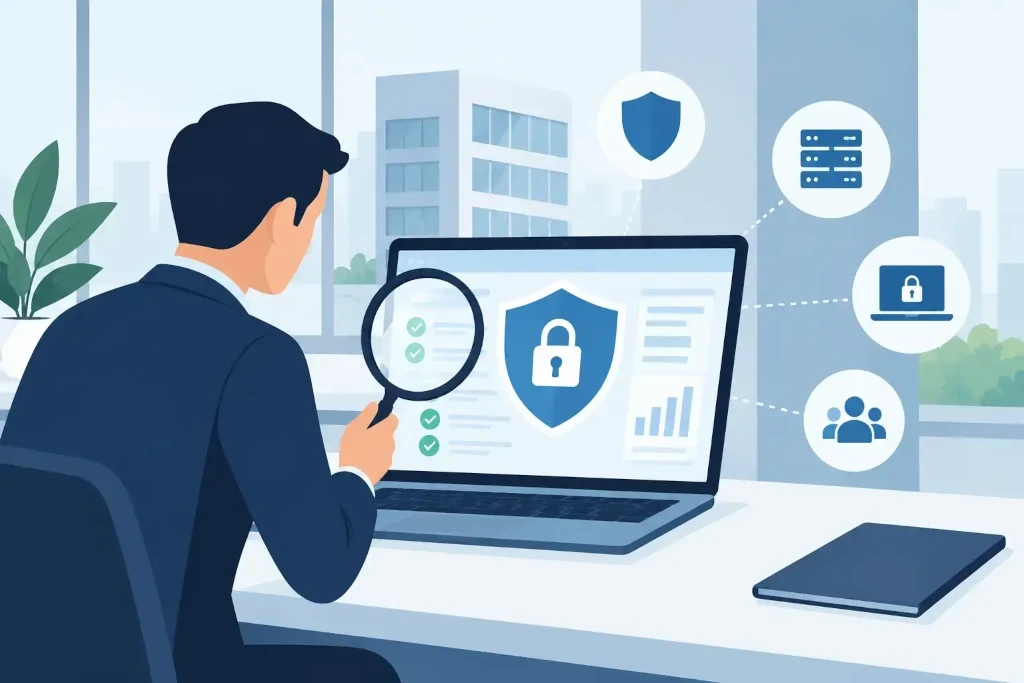
Cybersecurity audit example: initial situation
The company operates in the services and retail sectors. Employees use Microsoft 365, an accounting system, a CRM solution, and an on-site file server. Part of the team works remotely on a regular basis. IT support is provided by an external partner, but historically the systems have evolved gradually - users, suppliers, cloud services, and network equipment were added at different times.
The management's initial question was simple: would the company be able to restore critical services within one working day? To answer that, it is not enough to check whether there is antivirus software and backups. Access rights, data location, device management, incident escalation, and responsibility for decisions also need to be assessed.
The goal of the audit was not to find as many flaws as possible. The goal was to identify risks that could stop the company from operating or cause significant financial and reputational losses, and to prioritize them for remediation.
What was checked in the audit
The audit begins with the company's critical business processes, not with a list of technologies. In this case, it was determined what happens if email, CRM, the accounting system, or the document repository is unavailable. Finance, sales, and operations managers were interviewed to identify the acceptable downtime and the data that must not be lost.
Next, the IT environment was reviewed: user accounts, administrator access, multi-factor authentication, computer and server updates, network configuration, backups, log files, and external supplier access. Processes were also evaluated separately - for example, how a new user is approved, what happens when an employee leaves, and who makes decisions during an incident.
It is important to distinguish a technical finding from a business risk. For example, outdated software alone tells management very little. But if it runs on a server that stores contracts and financial data, and this server is not separated from the rest of the network, the risk becomes clear: one vulnerability exploitation incident could paralyze several departments.
Access and identity management
The audit found 14 inactive user accounts, including three accounts belonging to former employees. Two external suppliers had administrator rights with no defined expiration date and no regular review. Multi-factor authentication was enabled for email, but not for remote access to servers.
This finding is common in companies that grow faster than IT processes are formalized. The risk is not only unauthorized access. Excessive permissions also make incident investigations more difficult, because it is unclear which access was necessary and which remained from the past.
Backups and recovery readiness
The company created daily backups, so initially this area seemed well organized. However, the audit revealed that the backups were stored on a network to which administrator rights were available from the main domain. In the event of ransomware, an attacker could potentially encrypt both working data and part of the backups.
Even more importantly - recovery had not been tested in full within the last 12 months. A backup is not the same as recovery capability. Management needs to know how long it would take to restore a specific system, how much data could be lost, and whether the recovery instructions are available even if the primary environment is not working.
Device security and network segmentation
Of 96 workstations, 18 computers had overdue critical updates. On some computers, the local administrator password was the same, which means that one compromised password could make movement across the company network easier.
The network was designed as one broad environment: office computers, warehouse terminals, printers, the guest wireless network, and servers were located in insufficiently separated segments. Such a configuration is convenient in daily operations, but during an incident it increases the scope of impact. Full segmentation is not always justified for a small company, but critical systems, administrative access, and the guest network should be separated.
How audit results turn into an action plan
A good audit report does not stop at a technical checklist. It should say what to do first, how much it will cost, who is responsible, and what risk each step reduces. In this example, the recommendations were divided by urgency and business impact.
During the first 30 days, the company deactivated old accounts, implemented multi-factor authentication for all remote access, changed shared administrator passwords, and restricted supplier rights. These are relatively quick measures with a significant reduction in risk.
Over the next 90 days, isolated backups were created, a documented recovery test was carried out, and update management was organized. At the same time, the guest network, warehouse equipment, and server environment were separated. These tasks required more technical planning, because incorrect implementation could disrupt existing integrations.
In the longer term, the company approved the access management procedure, incident response procedure, and an annual recovery test. A management-level owner was also designated to receive regular reports on critical risks. This is essential because cybersecurity is not a one-time IT project. The risk picture changes after a new employee, system, or supplier is added.
What management should receive after the audit
The management team does not need an 80-page technical document without clear decisions. A more useful deliverable is a clear risk register where each finding has a business impact, risk level, recommended solution, responsible person, and implementation deadline.
For example, untested backups may be assessed as a high business continuity risk. The solution is not just to purchase additional storage, but to implement backup isolation, define recovery objectives, and regularly simulate recovery. Meanwhile, outdated workstations may be a medium or high risk depending on whether they handle sensitive data and whether they are exposed to external access.
The value of the audit increases when the results are linked to the budget and the company's plans. A company preparing to open a new branch, move to cloud services, or acquire another company will have different risks and priorities than a stable organization with an unchanged environment.
When a basic audit is not enough
A basic audit is often appropriate when a company wants a clear starting point and wants to organize access, backups, and critical systems. However, it may not be enough if the organization processes a large amount of customer data, operates in a regulated industry, uses many external suppliers, or has experienced an incident.
In such cases, a deeper vulnerability assessment, configuration audit, supplier risk assessment, or incident response scenario test may be necessary. The choice depends on the company's risk profile, not on the desire to implement the most complex possible set of controls.
KSK IT's audit approach is based on this principle: the technical assessment should end with an actionable plan for management. If, after the audit, it is clear which three decisions will most reduce the risk of downtime and data loss, the company can act purposefully instead of reacting only after the first serious incident.
