
AUTHORIZATION
Blog

Creating a company cybersecurity policy in practice
Creating a company cybersecurity policy is not a formal document to prepare for an audit and then forget in a folder. It defines how the company protects customer data, financial information, access to systems, and the ability to continue operating after an incident on a day-to-day basis. For a small or medium-sized company, one compromised email, an unmonitored administrator access account, or outdated server software can create not only technical disruptions but also contract, reputation, and cash flow risks.
A good policy does not try to turn every employee into a security specialist. Its task is to clearly define acceptable behavior, responsibilities, and controls so that people can make the right decisions even when the IT team is not nearby. For management, it is a governance system: an opportunity to understand which risks are acceptable, which require investment, and who is responsible for them.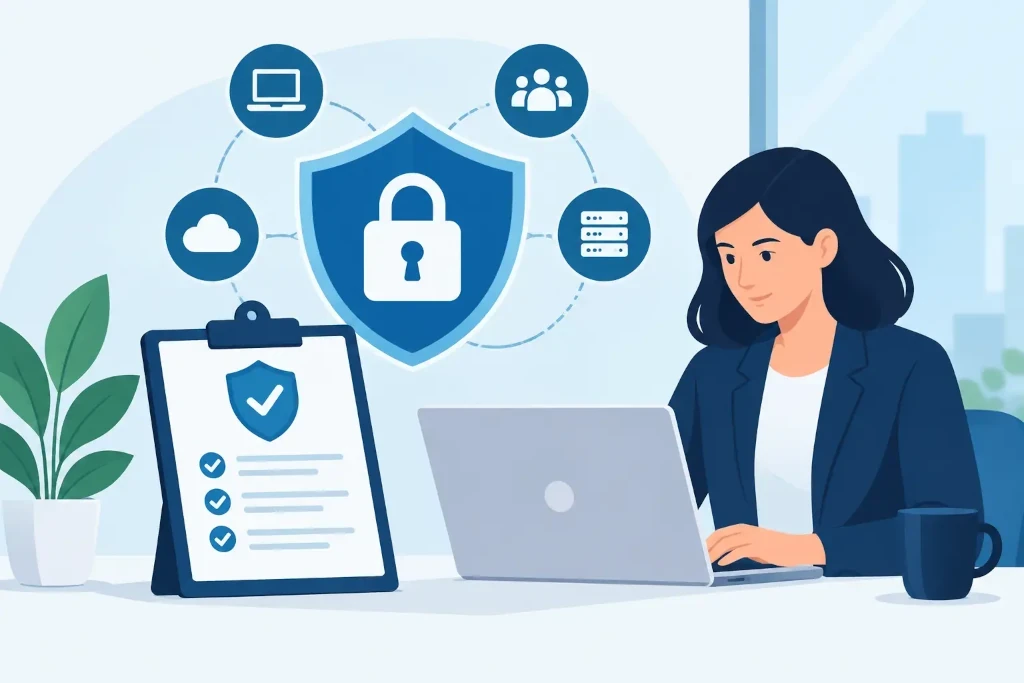
Start with business risk, not a document template
A policy template from the internet can be useful as a structural prompt, but it cannot replace the company’s risk assessment. For a manufacturing company, access to the warehouse and order system may be critical. For a professional services provider, client files, email, and confidential communication will be more important. For a company with remote employees, laptops, mobile devices, and cloud platform accounts become essential.
Before writing the rules, management must agree on the key questions: which data and systems are critical to the business, what would happen if they were unavailable for a day or a week, and what obligations the company has toward customers, partners, and regulators. This stage helps avoid two extremes - excessive bureaucracy and insufficient protection.
Risk assessment must take into account not only external attackers. Incidents are often caused by mistakes: a file is sent to the wrong recipient, an employee uses the same password in multiple systems, a supplier retains access after a project ends, or backups are never tested. The policy must account for realistic company work scenarios, not just theoretical threats.
Core elements of creating a company cybersecurity policy
A practically usable policy usually consists of several interconnected documents or sections. The main document defines principles and management responsibilities, while detailed procedures describe daily operations. This approach makes it possible to change, for example, the password management process without rewriting the entire policy.
Responsibility and decision-making authority
The policy must clearly identify the owner. In a small company, this may be a board member or operations manager working together with an external IT partner. In a larger organization, responsibility may be shared among IT management, the data protection function, the HR department, and process owners.
The most important thing is to separate business decisions from technical execution. Management decides on acceptable risk, budget, and priorities. The IT function implements controls, monitors the environment, and reports deviations. Employees follow the rules and report suspicious cases in a timely manner. If this division is unclear, time is lost during an incident searching for the person who is allowed to make the decision.
Access and identity management
Most company systems today are accessed with a user account, so account protection is one of the most important policy points. It must define how new accounts are created, how access is granted, how it is reviewed, and how quickly it is revoked when an employee or contractor ends their cooperation.
Multi-factor authentication must be mandatory at least for email, remote access, cloud services, and administrative accounts. At the same time, the policy must not ignore work reality. If security requirements are so inconvenient that employees start using personal email or unapproved file-sharing tools, the risk simply moves out of sight. Therefore, secure and usable company tools must be provided.
Administrator rights should be the exception, not the default setting. Separate administrative accounts, logged access use, and regular rights reviews significantly reduce damage if one user is compromised.
Data classification, storage, and transfer
Not all data needs the same level of protection. The policy should help employees distinguish public information from internal, confidential, and highly protected data. For example, price quotes, customer data, payroll information, contracts, and access data must not be stored in personal cloud drives or sent without controls.
It must be defined where work files may be stored, how encryption is used, when secure file exchange is required, and how long data must be retained. The data retention period is also a security issue: the more outdated data a company keeps unnecessarily, the more information may be exposed in an incident.
Balance is required here. Too strict restrictions can hinder customer service and cooperation. But convenience must not mean uncontrolled sharing. The best solution is usually an approved platform with clear access groups, auditability, and training for its use.
Devices, software, and technical maintenance
The policy must state which devices may connect to the company environment, whether private computers and mobile devices are allowed, how software is installed, and how updates are ensured. If work from personal devices is permitted, additional conditions are necessary: a managed user profile, disk encryption, screen locking, a supported operating system, and the ability to remotely remove company data when needed.
Update management must be set according to the risk level. Critical vulnerabilities cannot wait until the next planned maintenance window if attackers are actively exploiting them. On the other hand, deploying an untested update in a production or accounting system can cause downtime. Therefore, the policy must provide for deadlines, an exception approval process, and the ability to test updates before broad deployment.
Incident management and business continuity
A security policy is not credible if it assumes an incident will never happen. It must specify what to do if an employee opens a suspicious attachment, loses a computer, notices unusual logins, or receives a fraudulent payment request. Reporting should be simple and free of blame. An employee who quickly reports their mistake gives the IT team an opportunity to limit the damage.
The incident procedure must define who assesses the event, who is authorized to shut down a system or account, how evidence is preserved, when management is involved, and how communication with customers or partners takes place. Situations in which legal advice or an assessment of personal data protection requirements may be necessary should be defined separately.
Backups are an essential part of this policy, but creating copies alone is not enough. It must be known how quickly critical systems can be restored, whether backups are isolated from the daily network, and whether restoration is tested regularly. A backup that has not been tested is an assumption, not a business continuity guarantee.
Suppliers and cloud services are part of the risk surface
Company security no longer ends at the office network. Accounting systems, customer relationship platforms, email, document workflows, and external IT support often store or process important data. The policy must define how suppliers are assessed, what access they are granted, and how it is reviewed.
Before introducing a new service, the location of the data, access control, backup availability, incident notification procedures, and contract termination scenario should be assessed. It is especially important to understand how the company will get its data back and how quickly it can move to an alternative solution.
An external IT partner also needs controlled, documented access. Trust is essential in a partnership, but managed access protects both parties and makes audits easier. KSK IT can help in such a model combine day-to-day technical management with a management-friendly overview of risk and priorities.
Policies are implemented through a process, not an email
Sending employees a document with a request to read it is not implementation. The requirements set in the policy must appear in the employee onboarding process, access requests, device issuance, supplier evaluation, and regular management reviews. Short, specific training on phishing, password management, and data handling usually delivers more than a rare, long presentation.
The policy should be reviewed at least once a year, as well as after major changes: the introduction of a new system, an acquisition, a transition to remote work, or a serious incident. The review should assess not only the text of the document, but also evidence that controls are working - access reviews, update status, backup restoration tests, and incident lessons learned.
Start with one management decision: name the person responsible for coordinating the policy creation and set a deadline for assessing the most critical risks. A clear first step is more valuable than a perfect document that is never implemented.
