
AUTHORIZATION
Blog
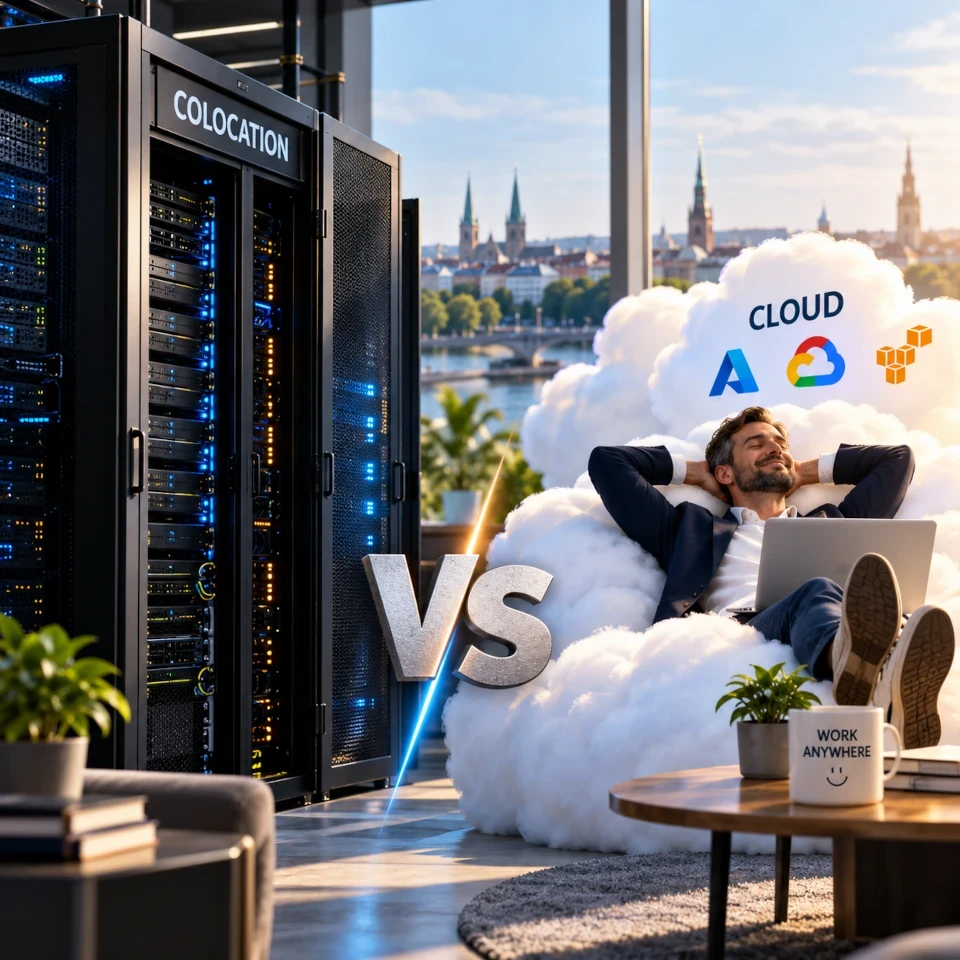
Colocation vs cloud services: what to choose?
For a manufacturing company, a piece of equipment that must not stop even for an hour can be critically important. For a service company, by contrast, the main risk may be the inability to securely enable remote work or quickly open a new branch. That is why the question “colocation vs cloud services” is not just a technical infrastructure comparison. It is a decision about cost structure, data availability, division of responsibility, and the company’s ability to keep operating during an incident.
For many mid-sized companies, there is no need to choose one model forever. Often the most reasonable solution is a hybrid environment, where stable and predictable workloads run in colocation, while flexible or short-term resources are used in the cloud. To make such a decision soundly, it is first necessary to understand what each model actually provides for the company.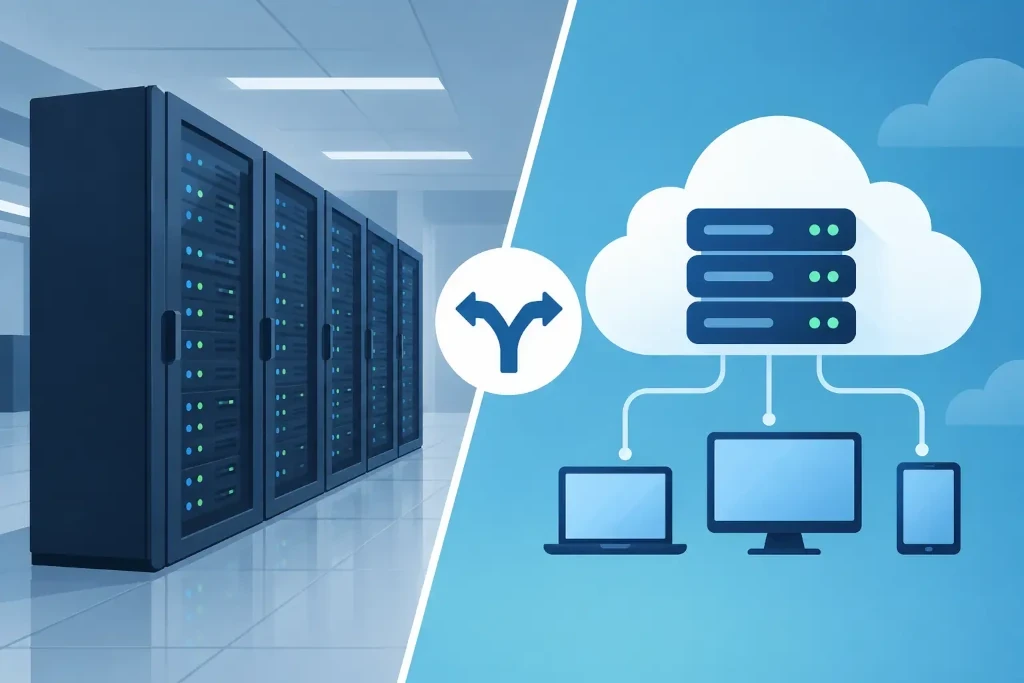
What does a company gain with colocation?
Colocation, or server colocation, means that server equipment owned by the company is placed in a professional data center. The data center operator provides the physical environment - power supply, cooling, fire protection, physical access control, network connections, and often backup infrastructure as well. The company retains ownership of the servers, as well as greater control over configuration, operating systems, and applications.
This model is suitable for situations where the infrastructure load is relatively stable and the resources are predictable in the long term. For example, a company may run an ERP system, a production management solution, a database, or a specialized application that requires specific licenses, special hardware, or low latency.
The main advantage of colocation is control. The company can choose server specifications, security policies, backup architecture, and recovery scenarios according to its requirements. This can be important in regulated industries or in situations where data location, access control, and auditability are matters of contractual or regulatory requirements.
However, control also means responsibility. Hardware must be updated, monitored, repaired, and replaced after several years. The data center takes care of the premises and core infrastructure, but not always of your server’s operating system, vulnerabilities, user access, or backup quality. If these duties are not clearly handed over to a managed IT partner, the company may end up with infrastructure that is well placed but insufficiently supervised.
How do cloud services change the infrastructure model?
Cloud services make it possible to use computing power, storage, backups, platforms, and software as a service. Instead of purchasing and maintaining physical servers, the company pays for the resources used or the selected service level.
The cloud is especially valuable when the company’s needs change rapidly. A new project may require additional resources within a few days or even hours. Seasonal e-commerce demand, the growth of a remote team, testing a new system, or company expansion into another country are situations where cloud flexibility reduces implementation time and initial capital investment.
It is important to distinguish infrastructure availability from the uptime of a specific system. A cloud provider can ensure very high data center and platform availability, but the company is still responsible for its own data classification, user rights, configuration, application security, and recovery procedures. Incorrectly configured access or unverified backups create risk even when a high-end cloud platform is used.
Cloud costs may be attractive at the beginning because there is no need to buy servers and no need to wait for delivery. But in the long term, costs must be evaluated carefully. Data transfer, continuously running virtual servers, additional security services, duplicated environments, and licenses can significantly increase the monthly bill. This is especially true for environments where resource consumption remains constant for several years.
Colocation vs cloud services: a comparison for management
When evaluating colocation vs cloud services, management should not choose technology based on popularity. The model that best supports a specific business risk and operational objective should be chosen.
Colocation often provides better cost predictability when the infrastructure is stable, heavily used, and planned for several years. The initial investment is higher because hardware must be purchased, but after that the costs are usually easier to plan. Cloud services, in turn, reduce the initial investment and speed up implementation, but require disciplined usage and cost control.
In terms of security, no model is automatically superior. A professional data center can provide very high physical protection, while large cloud providers invest significant resources in platform security. In practice, the decisive factor is the company’s configuration: multi-factor authentication, access rights management, log monitoring, regular vulnerability remediation, and verifiable backups.
In scalability, the cloud usually has the advantage. If capacity must be increased quickly or demand is volatile, resources can be expanded without purchasing new hardware. In a colocation environment, scaling requires planning, orders, and physical installation. However, this is not a disadvantage if the company’s workload is well understood and changes are gradual.
Incident recovery must also be considered separately. A second server in the same data center is not a full disaster recovery plan. Likewise, storing data in the cloud is not a guarantee that the system can be restored within the specified time. Two business indicators must be defined: how much downtime the company can tolerate and how much data it may lose. Only then can the appropriate backup, replication, and recovery architecture be selected.
When is the hybrid model the most reasonable?
A hybrid approach combines the control of colocation with the flexibility of the cloud. For example, a company may keep its main business system in colocation while storing backups in a separate cloud environment. This reduces the risk that one physical location becomes the only recovery point.
In another scenario, the database and systems with predictable load run on company-dedicated hardware, while document collaboration, email, remote user access, and analytics capacity are used as a cloud service. This approach makes it possible not to build expensive infrastructure solely for temporary or changing demand.
A hybrid environment is not a compromise just for the sake of compromise. It is a deliberate architectural choice when different systems have different requirements. For it not to become difficult to manage, unified access management, clear levels of responsibility, documented network architecture, and regular recovery tests are needed.
Questions before making a decision
Before choosing an infrastructure model, management together with the IT responsible person should be able to clearly answer several questions. Which systems create the greatest downtime risk? What will resource consumption be over the next three to five years? Are there requirements regarding data location, audits, or customer contracts? How quickly must the system recover after an incident, and has this capability been tested in practice?
It is also valuable to calculate the total cost of ownership, not just the monthly bill or the server purchase price. This should include licenses, maintenance, cybersecurity, backups, internet connections, hardware replacement, specialist time, and the potential cost of downtime. This is often where it becomes clear that the cheapest apparent solution is not the most economical solution for company operations.
In KSK IT practice, infrastructure selection begins not with a specific vendor offer, but with an assessment of system criticality, risks, and recovery requirements. This approach helps connect technical architecture with management priorities and budget discipline.
The right choice will be the one the company can not only purchase, but also securely manage, monitor, and restore in the long term. If there is no confidence today about what would happen after a server failure, ransomware attack, or internet connection outage, the first step is not to rush everything to the cloud or the data center. The first step is to clearly define continuity requirements and check whether the current environment truly meets them.
