AUTHORIZATION
Blog
Artificial intelligence in IT operations at a company
On Monday morning, one inaccessible business system service can stop sales, warehouse operations, or customer service. The IT team then has to understand whether the cause is a network connection, a cloud service failure, a failed update, an access problem, or a security incident. Artificial intelligence in IT operations can significantly speed up this investigation, but only if it is used as a managed work tool rather than as an uncontrolled automation experiment.
For small and medium-sized organizations, the question is not whether to buy another modern tool. The question is where AI truly reduces downtime, improves visibility, and helps IT management make better decisions with the available budget. The most valuable solutions usually start with a specific operational problem, not with a broad promise to automate the entire infrastructure.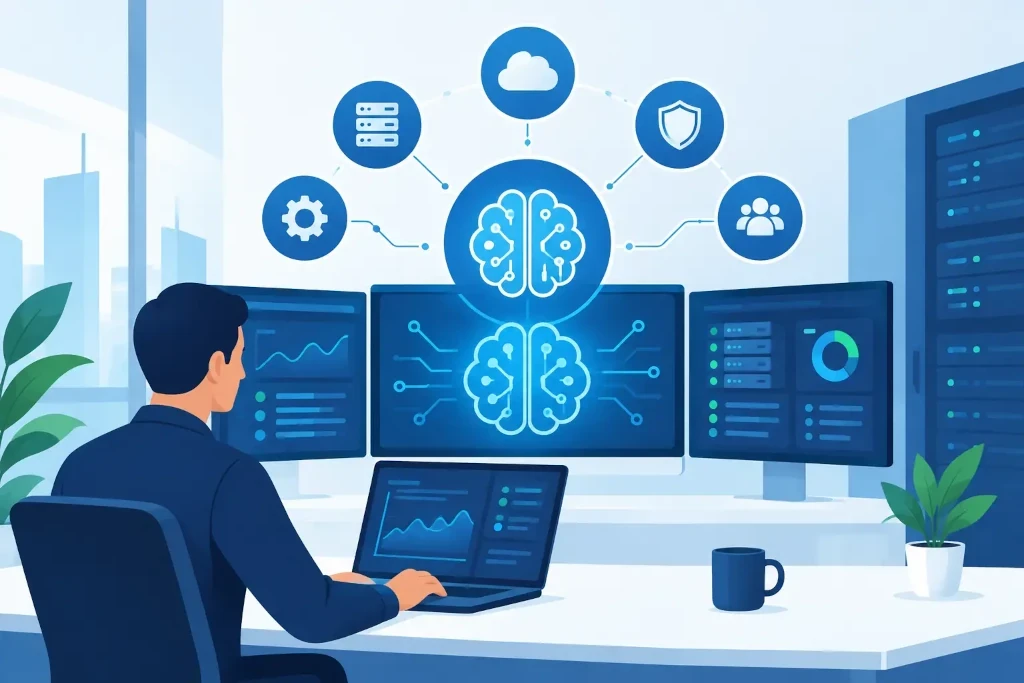
Where artificial intelligence in IT operations creates practical value
IT operations generate a large volume of data: system logs, performance metrics, error notifications, user requests, backup results, and security events. A person can assess the most important information, but finding interconnected signals across multiple systems takes time. This is where AI can analyze patterns and highlight anomalies faster than manual review.
One of the most common uses is anomaly detection. For example, a system can notice that server memory usage is growing faster than usual at a certain time, the number of failed authentication attempts is increasing, or backups are taking an unusually long time. Such a signal is not yet a diagnosis. It is an early basis for investigation before the problem becomes company downtime.
AI can also help prioritize incidents. If dozens of alerts come in at the same time, it is important to distinguish one root cause from its effects. For example, a fault in network equipment can cause errors in several business applications. Well-configured analytics helps combine related events into a single incident so that the IT specialist does not waste time processing identical symptoms.
Another area is service request handling. AI can classify requests, offer answers to frequently asked questions, and prepare initial information for the technical team. This is useful when a clear escalation path is maintained. The employee must be able to quickly reach a competent specialist, especially for access, financial systems, management data, or security issues.
AI is not a substitute for IT governance
The biggest risk is not that AI will make a mistake. Errors are possible in any technology. A greater risk is granting the system too much authority or trusting its conclusion without checking the context.
For example, an automated action may restart a service, block a user account, or change a configuration to prevent a possible incident. In some cases this is justified and necessary. In another situation, such an action can interrupt a critical integration, delay invoice processing, or deny access to someone who is carrying out an urgent work task.
Therefore, the degree of automation should match the level of risk. Low-risk actions, such as request routing, log aggregation, or adding technical information to an alert, can be largely automated. Actions that affect production, data, user rights, or security controls usually require human approval and an auditable justification for the decision.
AI-generated text is not proof either. If a tool summarizes an incident or suggests a possible cause, the IT specialist must verify the source data, change history, and business impact. Management should request not a convincingly worded explanation, but verifiable information: what happened, what the confirmed cause is, what it affected, and how recurrence is being prevented.
Start with processes, not with the platform
Before choosing an AI solution, the company must know how IT operations are currently managed. If it is not clear where the critical systems are, who owns the access rights, how backups are tested, and where infrastructure changes are recorded, AI will only process messy data faster.
A practical start requires four basics:
- an up-to-date list of critical systems, data, and responsible persons;
- centralized monitoring and log collection from the most important platforms;
- incident classification by business impact, not only technical urgency;
- documentation of changes, access, and automated actions.
This foundation helps choose a target that can be measured. It may be a reduction in the average incident resolution time, faster detection of failed backups, fewer repeated requests, or more accurate selection of suspicious access attempts. If the result cannot be measured, it will be difficult to justify both the investment and the ongoing maintenance of the solution.
Data protection and European requirements
IT operations data often contains sensitive information. Logs may include user names, email addresses, device names, IP addresses, file paths, customer data, or technical configuration details. This information must not be entered into publicly available AI tools without evaluation.
Before implementation, it must be determined where the data is processed, whether it is used for model training, how long it is stored, and what the vendor's contractual obligations are. Personal data protection requirements, the data storage region, supply chain risk, and access control must be assessed. For organizations working in regulated sectors or with sensitive customer information, this assessment is not a formality - it is part of security and compliance management.
Access rights discipline is also important. An AI tool should not be given administrative rights across the entire environment just so it can provide broader recommendations. Access should be built according to the principle of least privilege, separate service accounts should be used, and what the automation can actually read or change should be regularly reviewed.
How to evaluate return on investment
AI in IT operations creates value when it improves a specific service outcome. A simple example is night-time alerts. If the monitoring system regularly generates hundreds of insignificant notifications, the technical team loses focus and may miss a serious incident. AI-based correlation can reduce noise, but its quality must be evaluated over a longer period.
When assessing it, it is useful to compare the situation before and after implementation: how many incidents were detected in time, how many false alarms had to be reviewed, how quickly the service was restored, and how much manual work daily support consumed. Costs for licenses, integrations, data storage, expert work, and regular configuration review must also be taken into account.
Not every company needs a full AIOps platform. For an organization with a relatively simple infrastructure, better monitoring, tested backups, and a clear incident process may provide greater value. Conversely, for a company with multiple cloud environments, remote work locations, and critical integrations, AI analytics can become an important tool for maintaining visibility.
Responsibility remains on the company's side
A technology vendor can provide the tool, but responsibility for business risk cannot be handed over to an algorithm. Management must determine which processes are critical, what level of downtime is acceptable, who approves automated changes, and how a security incident is handled. These decisions connect IT operations with business continuity.
A good implementation model starts with a limited pilot project in one clear use case. Then data quality, recommendation accuracy, security impact, and actual time savings are tested. Only then is it justified to expand automation to other systems.
Properly managed AI does not eliminate the need for experienced IT specialists and strategic oversight. It gives them more time for work that directly protects the company: risk prevention, infrastructure planning, recovery readiness, and changes that support business growth. Start with one process whose outcome can be proven, and build trust in the technology gradually - with control, clear responsibility, and measurable benefit.
