
AUTHORIZATION
Blog

5 IT risks for a growing company that are stopping growth
Rapid growth usually starts with good news: the number of customers, the team, order volume, and responsibility all increase. But it is precisely at this stage that 5 IT risks for a growing company can turn successful development into an expensive operational problem. Systems that served ten people well do not always withstand the load of fifty users, remote work, new branches, or more demanding customer security requirements.
An IT risk is not only a cyberattack or a crashed server. It is any technological shortcoming that can stop work, endanger data, create unplanned costs, or prevent management from making informed decisions. For a growing company, the key question is not whether an incident will ever happen, but how well the organization will be prepared to keep working when it does.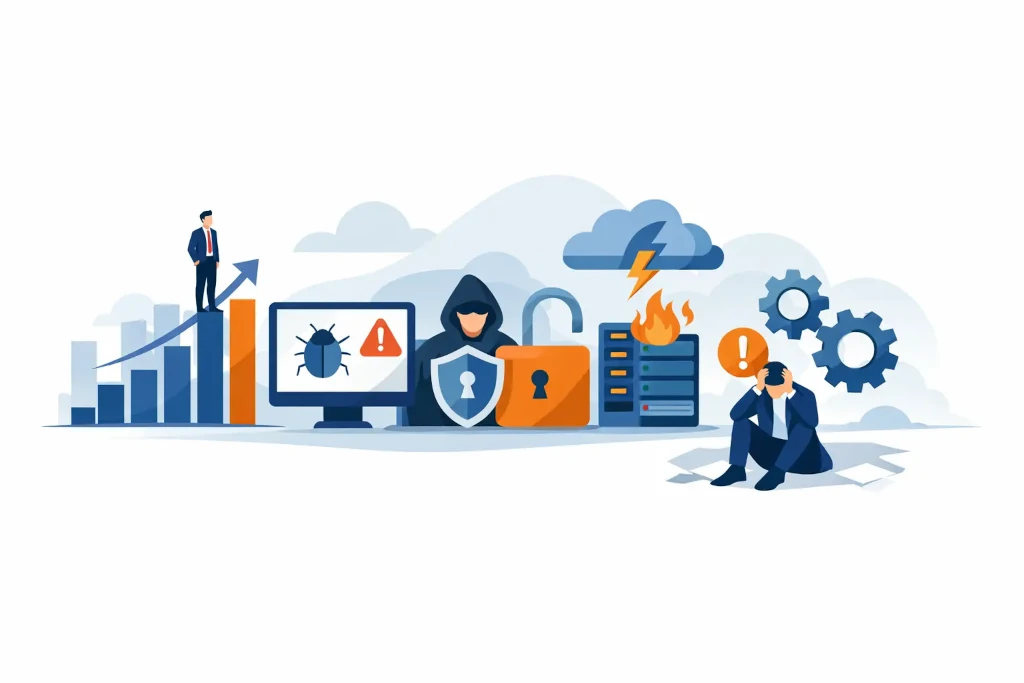
1. The IT infrastructure no longer matches the company’s scale
The first risk is often invisible, because the existing environment still works. File storage becomes slow only at certain times, remote users complain about access, Wi-Fi coverage in the office is uneven, and the supplier’s system regularly requires manual intervention. Each individual problem may seem small. Together, they reduce productivity and create a risk of downtime.
Growth increases not only the number of users. It increases data flow, the number of integrations, access requests, and dependence on the internet connection, cloud services, and equipment. If the infrastructure was built without capacity reserves and a documented development plan, the company starts reacting to problems after the fact.
The solution is not always to buy the most powerful hardware. Sometimes a cloud environment is more suitable; other times - a hybrid model with locally stored critical systems. The choice depends on applications, data volume, regulations, connectivity, and acceptable downtime. What matters is regularly assessing capacity, critical points, and what will happen if one device or connection becomes unavailable.
2. Access rights grow faster than control
A new employee is often granted access for the sake of speed: to shared folders, the customer system, the accounting tool, email, cloud documents. When a person changes roles or leaves the company, these accesses are not always reviewed in time. As a result, sensitive data may be accessible to a wider group of people than is necessary for the work.
This risk is not only a matter of malicious intent. Inaccurate permissions increase the likelihood of mistakes: an employee may accidentally delete documents, forward commercially sensitive information, or change settings in a system they were not supposed to administer. The more tools a company uses, the harder it is to maintain visibility without a clear process.
The basic principle is simple: a user should only have the rights necessary to perform their specific job. In practice, this means centralized user management, multi-factor authentication, regular access-right reviews, and a clear procedure for hiring, role changes, and departures. Special attention should be paid to administrator accounts, because they have the broadest impact on the entire environment.
3. Backups exist, but recovery has not been tested
Many managers receive a reassuring answer: backups are being made. But that statement alone does not guarantee business continuity. A backup may be incomplete, corrupted, too infrequent, or stored in an environment affected by the same incident. It may also fail to restore a particular system within the required time.
For example, a company may save server data once a day, while processing hundreds of orders during the day. If the system becomes unavailable in the afternoon, the company may lose all changes since the previous night. In another situation, the data can be restored, but the process takes three days, while the company can realistically afford only a few hours without the main system.
Therefore, a backup strategy must answer two management questions: how much data can be lost and how long recovery can take. These metrics determine the copying frequency, storage locations, automation level, and required infrastructure. A regular recovery test is also necessary - not just a log entry stating that the backup is complete, but a practical test of whether files, systems, and access can be restored within the planned timeframe.
4. Cybersecurity is seen as one tool, not a process
An antivirus program, firewall, or email filter is necessary, but they are not enough. Modern incidents often start with a stolen password, a fake invoice, a deceptive email, or a vulnerable cloud account. The attacker does not always try to technically break into the system - often they exploit a person, a process, or an unnoticed configuration error.
For a growing company, the risk increases when new employees are hired, outsourcing partners are engaged, and new digital tools are introduced. If each department independently chooses software and stores company information in its own accounts, management loses visibility over where the data is located and what security level it has.
Effective protection is layered. It includes device updates, email protection, multi-factor authentication, strong passwords, user training, log monitoring, and an incident response procedure. However, excessive control can hinder work if security processes are complicated or unclear. Therefore, the rules must be proportionate to the risk and adapted to the company’s daily workflow.
5. There is no clear responsibility for IT decisions
One of the most expensive risks is not technical. It arises when it is unclear who makes decisions about system priorities, budgets, security, vendors, and continuity. In a small company, these issues often fall to the finance manager, operations manager, or owner, who is also responsible for running the core business. As a result, IT development becomes fragmented and is funded mainly by fixing urgent problems.
In such a situation, duplicate tools, uncontrolled subscription costs, unclear contracts, and vendor dependency can arise. Even more seriously, critical knowledge about systems may reside with one employee or one outsourced provider, without documentation or a handover plan.
A company does not necessarily need to build a full internal IT department to gain management-level control. But it does need clear responsibility for the technology direction: an up-to-date system overview, a risk register, a budget plan, vendor management, and regular conversations with management about priorities. An external IT director or CIO consultant can be a practical solution here if the company needs strategic expertise without the cost of a full-time executive.
How to turn IT risks into a manageable plan
Risk management is not a one-time audit that is put in a folder until next year. It is a management discipline in which technical decisions are linked to business consequences. Start by mapping the most critical processes: sales, customer service, warehouse, production, finance, or professional service delivery. Then determine which systems, data, and people these processes depend on.
The next step is to set priorities. Not all weaknesses need to be fixed at once. If the company cannot restore the customer data system, that is usually more urgent than a planned equipment replacement project. If access rights have not been reviewed for several years, that may be quicker to resolve than a full infrastructure rebuild. A good IT audit helps distinguish real business risk from simply outdated technology.
It is also important to agree in advance on incident management. Who makes decisions if the system is unavailable? How are employees, customers, and partners informed? Which services need to be restored first? Such a plan often reveals gaps that are not noticeable in everyday work.
In KSK IT practice, technology management starts with the company’s business goals, not with the choice of a specific product. If the IT environment is documented, monitored, and linked to a continuity plan, growth no longer has to rely on hope that the existing systems will hold out a little longer. It becomes a controllable process in which management can make decisions in time, before risk turns into downtime.
